

Thatte Idli Recipe
Malayalam തട്ടെ ഇഡ്ഡലിTamil தட்டே இட்லிKannada ತಟ್ಟೆ ಇಡ್ಲಿTelugu థట్టే ఇడ్లీ
- Prep20 min
- Soak / ferment12 hr
- Cook40 min
- Serves4
- DifficultyMedium
- DietVegetarian
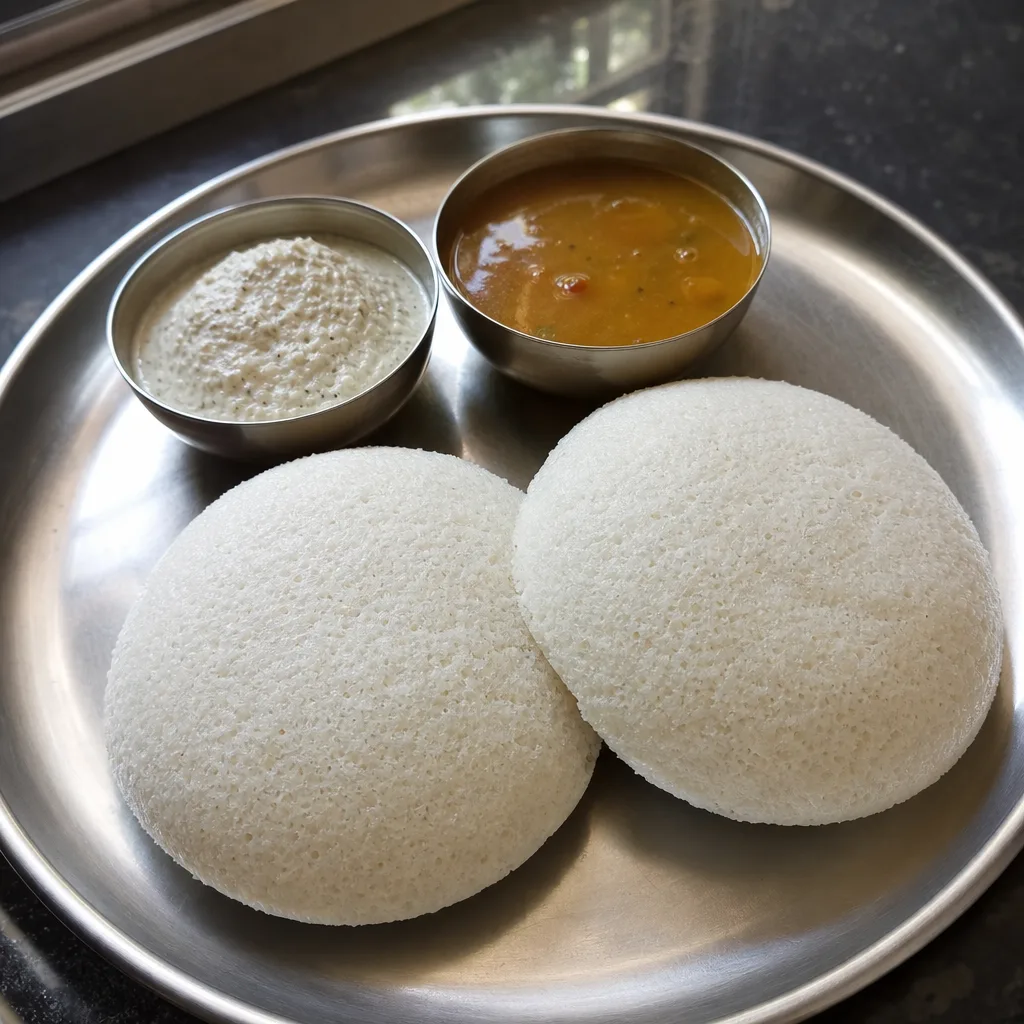
Thatte idli is named for the wide, flat plate (thatte) in which it is steamed. Each idli is roughly 15 centimetres across and about two centimetres thick — much wider and softer than the standard Udupi-style idli. The dish is closely associated with Bidadi, a small town on the Bengaluru–Mysuru highway, where roadside tiffin centres have been serving it for decades. Travellers stop specifically for it, and the reputation has spread the dish across the whole of southern Karnataka.
At home it is a weekend breakfast, made the night before so the batter ferments overnight. The texture should be cloud-soft and uniformly white all the way through, with no browning or crust anywhere on the surface. It tears cleanly, absorbs sambar readily, and holds its shape without crumbling.
Household variation is mostly in the accompaniment rather than the idli itself. Coconut chutney, a thin tomato-based sambar, and a smear of ghee on the hot idli are the standard combination. Some families add a tablespoon of sour curd to the batter if fermentation feels sluggish in cooler weather.
Ingredients (serves 4)
For soaking
For the batter
Method
Soak the rice and dal
Rinse the idli rice in two or three changes of water, then cover with fresh cold water and leave to soak for 4 to 5 hours. In a separate bowl, rinse the urad dal and fenugreek seeds together, cover with cold water and soak for 4 hours. In the last 30 minutes of soaking, add the avalakki directly to the urad dal bowl; it will soften in the water already there.
Grind the urad dal first
Drain the urad dal, fenugreek, and softened avalakki. Transfer to a wet grinder or a powerful mixer-grinder. Grind with the minimum cold water needed to keep the blades moving — add water a tablespoon at a time. Grind for 20 to 25 minutes in a wet grinder (or 10 to 12 minutes in a mixer-grinder, pausing to scrape the sides). The batter is ready when it is very light, white, and fluffy; a small amount dropped into a bowl of water should float. Transfer to a large vessel.
Grind the rice
Drain the soaked rice and grind it with a little cold water to a slightly coarse, smooth batter — the texture should feel like fine semolina between your fingers, not perfectly silky. This slight texture is what gives the idli its body. Add water sparingly; the rice batter should be thick, not pourable.
Combine and ferment
Mix the rice batter into the urad dal batter using your hand or a large spoon, folding thoroughly so no streaks remain. The combined batter should be thick enough to hold a mound in a spoon. Cover the vessel loosely with a lid or damp cloth — do not seal it airtight. Leave to ferment in a warm spot for 8 to 12 hours, or overnight. In Karnataka's warm climate this usually takes 8 to 9 hours in summer and up to 12 hours in winter. The batter is ready when it has risen visibly, smells pleasantly sour, and has a slightly airy, porous surface. If your kitchen is cold, place the vessel inside a switched-off oven with just the oven light on.
Season the batter
Once fermented, add salt and mix gently from the bottom up. Do not beat the batter; you want to keep the air that fermentation has built into it. Taste and adjust salt. The batter will deflate slightly when mixed — this is normal.
Prepare the steamer and thatte plates
Fill the steamer pot with water to about one-third of its height and bring it to a full boil. Thatte idli requires wide, flat stainless-steel plates roughly 14 to 16 cm in diameter, stacked on a special multi-tier stand designed for them. Grease each plate lightly with a few drops of oil wiped across the surface with a cloth or your fingers.
Pour the batter
Ladle batter onto each greased plate to a depth of about 1.5 to 2 cm. Do not fill right to the rim; the idli will rise a little during steaming. One standard ladle (roughly 90 to 100 ml) is usually the right amount per plate, but judge by depth rather than volume.
Steam the idli
Place the loaded stand into the steamer over briskly boiling water. Cover with the lid and steam on medium-high heat for 12 to 15 minutes. Do not lift the lid during steaming. At the 12-minute mark, insert a clean skewer or the back of a spoon into the centre of one idli; it should come out clean with no wet batter clinging to it. The surface will be uniformly white and slightly domed — there is no browning, no golden edge, no crust.
Rest and unmould
Turn off the heat and let the steamer sit, lid on, for 2 minutes. Then remove the stand carefully. Run a wet spoon or a thin spatula around the edge of each idli and lift it cleanly from the plate. A well-made thatte idli comes away in one piece without tearing. If it sticks, the plate was not greased enough or the idli needed another minute of steaming.
Serve immediately
Thatte idli is best eaten the moment it comes off the steamer. Serve whole on a plate — it is large enough to eat directly from the serving plate. It firms slightly as it cools, though it remains soft for 20 to 30 minutes.
How to serve
Coconut chutney, a thin Karnataka-style sambar, and optionally a smear of ghee on the hot idli. Some households serve it with a small bowl of sagu (a mixed-vegetable coconut-based gravy).
Served with: Coconut chutney, a thin Karnataka-style sambar, and optionally a smear of ghee on the hot idli. Some households serve it with a small bowl of sagu (a mixed-vegetable coconut-based gravy).
Cook's tips
The wet grinder makes a real difference
A stone wet grinder produces a much lighter, fluffier urad batter than a mixer-grinder because it aerates the dal as it grinds. If you use a mixer-grinder, grind in short pulses and rest the jar between rounds so the batter does not heat up — heat kills the fermentation cultures.
Batter consistency is the main variable
If the batter is too thin, the idli will be dense and flat rather than soft and thick. Add water to the rice in very small amounts. The combined batter should fall from a spoon in thick ribbons, not run off it.
Fermentation in a cold kitchen
If the batter has not risen after 10 hours and the surface looks flat and smells only faintly sour, it needs more time or warmth. A switched-off oven with the light on, or a warm spot near the stove, helps. Do not add soda — it changes the texture.
Thatte plates
Thatte idli stands with their wide flat plates are sold in kitchen shops across Karnataka and online. Standard idli moulds cannot be substituted — the depth and width of the plate are what make the idli what it is. Some households use flat steel katoris as an approximation, but the idli will be smaller.
Storing leftover batter
Refrigerate fermented batter in a covered container for up to two days. Bring it to room temperature for 30 minutes before steaming. Do not re-ferment refrigerated batter.
Regional variations
Some households add a handful of cooked rice instead of avalakki; tiffin-centre versions are sometimes made with a higher urad proportion for extra whiteness and fluffiness.
Glossary
- Thatte ತಟ್ಟೆ
- Plate or flat disc; refers to the wide stainless-steel plate in which this idli is steamed.
- Idli rice ಇಡ್ಲಿ ಅಕ್ಕಿ
- A short-grain parboiled rice variety sold specifically for idli and dosa; gives a softer texture than raw rice.
- Urad dal ಉದ್ದಿನ ಬೇಳೆ
- Skinned and split or whole black gram; the dal that provides lift and softness to idli batter.
- Avalakki ಅವಲಕ್ಕಿ
- Flattened rice (poha); added in small quantity to the urad dal to improve softness in the finished idli.
- Sagu ಸಾಗು
- A Karnataka mixed-vegetable gravy made with coconut and mild spices, commonly served with idli and dosa.
Two things decide whether thatte idli works: the urad dal must be ground long enough to become genuinely light and fluffy, and the batter must ferment fully before it goes into the steamer. Rush either of those and the idli will be dense. Get both right and it will be soft all the way through, white, and tender enough to tear with a spoon.
More Breakfast & Tiffin recipes
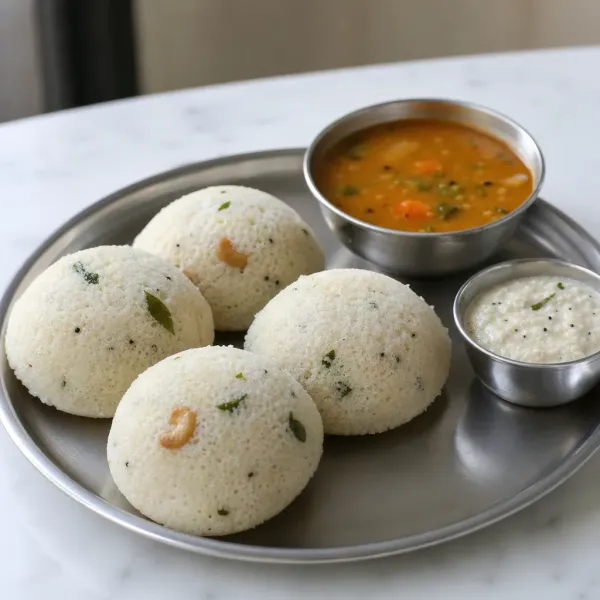
Rava Idli (Karnataka Style)
Traditional Karnataka rava idli made with ghee-roasted semolina, fresh curd and no fermentation. Soft, pale and ready in under an hour.
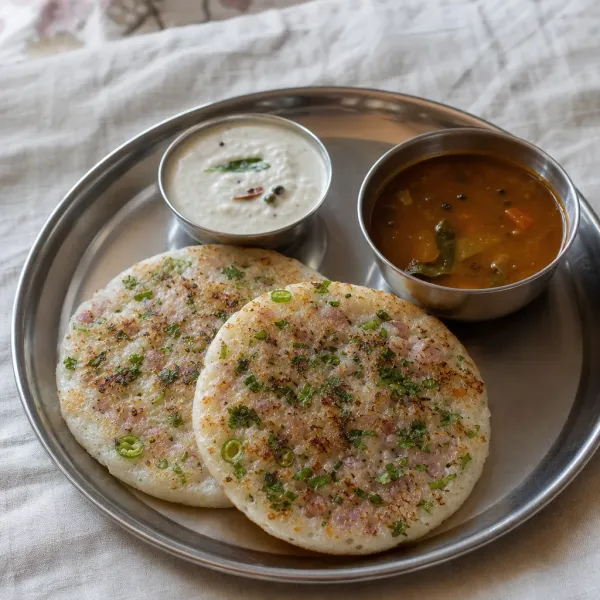
Uttapam: Tamil Brahmin Household Style
Traditional Tamil Brahmin uttapam made from fermented rice and urad dal batter, topped with shallots, green chilli and coriander. Step-by-step method.
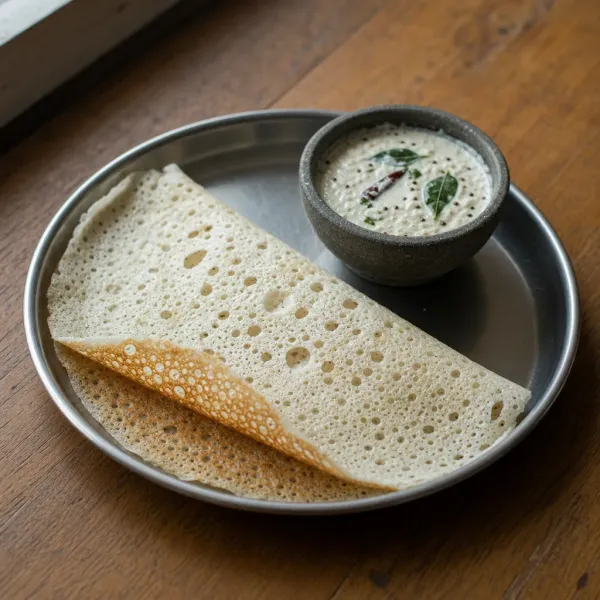
Rava Dosa
Traditional Tamil Iyer rava dosa with semolina, rice flour and gingelly oil. No fermentation, lacy and crisp. Step-by-step home kitchen method.
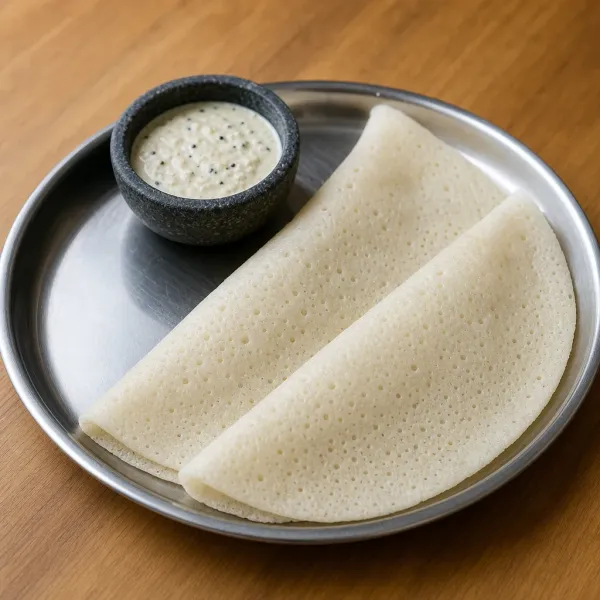
Aval Dosa (Soft Poha Dosa)
Soft, spongy aval dosa made with thick poha and raw rice. A quick-soak batter, no overnight ferment needed. Traditional Udupi home recipe.
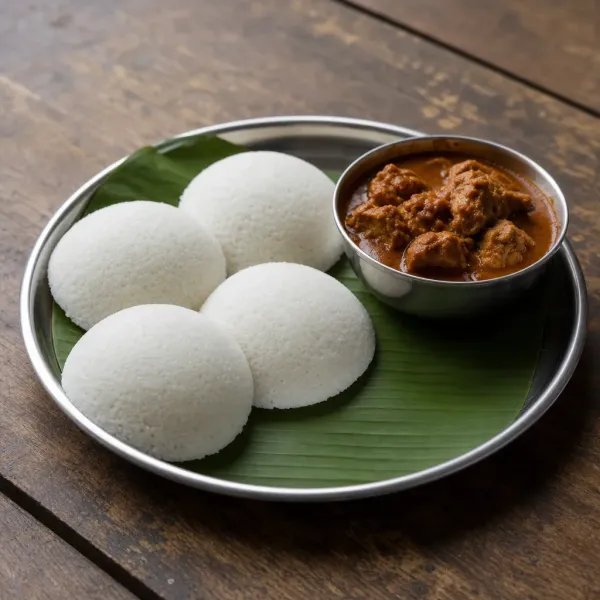
Sannas
Traditional Mangalorean Konkani Catholic sannas: soft, white steamed rice cakes leavened with yeast, made with raw rice and fresh coconut. Step-by-st…
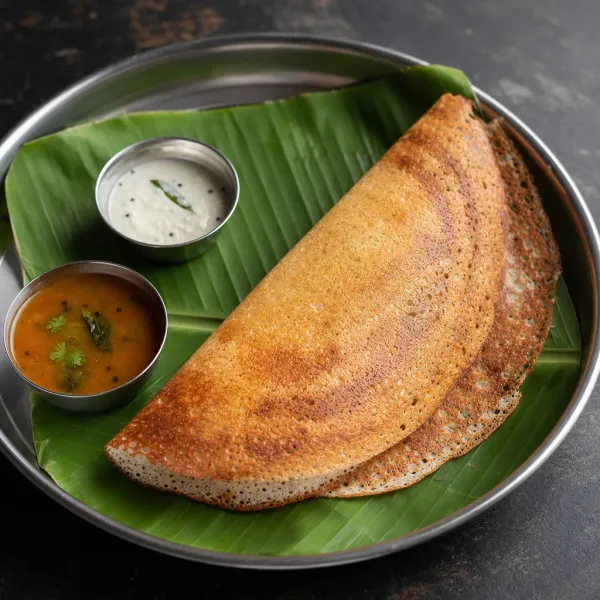
Plain Dosa
Traditional Tamil Iyer plain dosa: fermented rice and urad dal batter, spread thin on a cast-iron tawa with gingelly oil. Crisp, golden, and sour.