

Iyer-Style Rasam with Homemade Rasam Powder Recipe
Malayalam റസംTamil ரசம்Kannada ರಸಂTelugu రసం
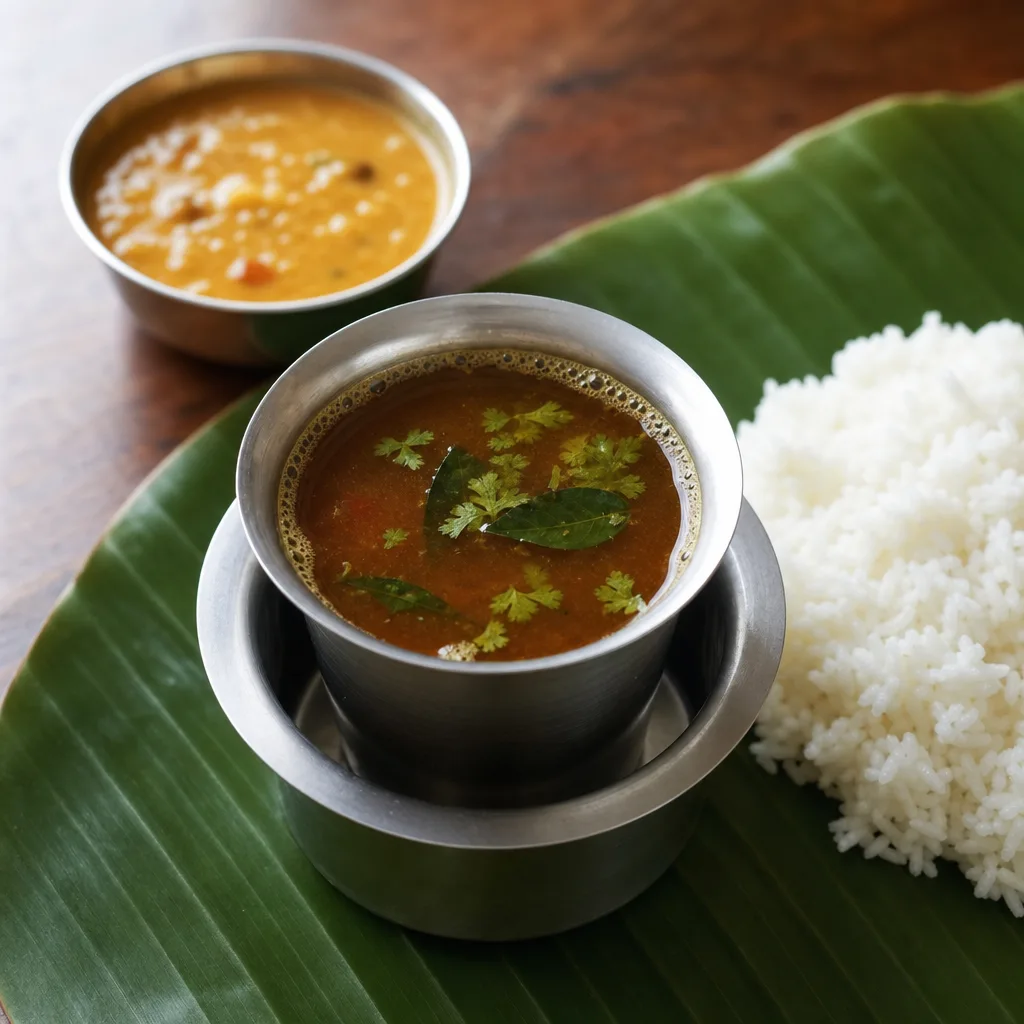
- Prep20 min
- Cook30 min
- Serves4
- DifficultyEasy
- DietVegan
Rasam in a Tamil Brahmin household is not a soup and not a side dish. It is the second course of a meal, poured over rice after sambar, or drunk warm from a tumbler when someone has a cold. It should be thin enough to pool in the hollow of rice, sharp with tamarind, hot with pepper, and fragrant with a very specific spice powder that each family grinds slightly differently.
The powder is the heart of this recipe. Without a proper rasam powder, what you get is spiced tamarind water. The combination of coriander seeds, black pepper, cumin, dried red chillies and curry leaves, dry-roasted and ground together, gives rasam its characteristic smell the moment it hits the hot pan. Most Iyer households keep a small jar of this powder made fresh every two or three weeks.
Households differ mainly in the ratio of pepper to chilli (some families keep it very peppery and almost no chilli-heat, others balance them equally), and in whether they add a small piece of tomato. Tomato is a later addition, common now even in traditional homes, but older recipes use only tamarind. This recipe uses tamarind alone, which is the cleaner, older version. The toor dal water here is not for body; it is for a faint legume sweetness that rounds the sourness.
Ingredients (serves 4)
For the rasam powder
For the tamarind base
For the rasam
For the tadka
Method
Make the rasam powder
Set a small heavy pan over low heat. Add the coriander seeds and roast, stirring constantly, for about 2 minutes until they turn a shade darker and smell nutty. Remove and set aside. In the same pan, roast the peppercorns until they start to pop and jump, about 1 minute. Remove. Roast the cumin for 30 seconds only, then the dried red chillies until they puff and darken, pressing them lightly with the back of a spoon. Finally, add the curry leaves and roast until every leaf is papery and completely dry, about 1 to 2 minutes. If any moisture remains in the leaves the powder will clump. Let everything cool completely on a plate before grinding.
Grind the powder
Grind all the roasted spices together in a small dry mixie jar to a moderately fine powder. It does not need to be as fine as commercial powder; a little texture is fine. You will have roughly 3 to 4 teaspoons. Use 1½ teaspoons for this batch and store the rest in a dry airtight jar away from light. It keeps well for two to three weeks.
Prepare the tamarind extract
Soak the tamarind in 250 ml warm water for 15 minutes. Squeeze it thoroughly with your fingers, working it until the pulp dissolves into the water and only dry fibres and seeds remain. Strain through a fine sieve, pressing the pulp hard. Discard the solids. The extract should be a deep brown and noticeably sour when you taste a drop.
Prepare the toor dal water
Cook 3 tablespoons of toor dal in a pressure cooker with enough water to cover by 3 cm, for 3 to 4 whistles, until it is completely soft and collapsing. Take 3 to 4 tablespoons of this cooked dal, add 200 ml of water, and mash it together until there are no lumps and the liquid is slightly opaque. This is not thick dal; it is thin dal water. Set aside.
Cook the tamarind base
Pour the tamarind extract into a medium saucepan. Add the turmeric, asafoetida, salt and 1 teaspoon of the rasam powder. Bring to a boil over medium heat and let it boil for 6 to 8 minutes, stirring occasionally. This step is important: raw tamarind has a harsh edge that cooking removes. The colour deepens and the smell shifts from sharp to rounded. Do not rush it.
Add the dal water and remaining powder
Pour in the thinned toor dal water and the 300 ml of plain water. Stir well. Add the remaining ½ teaspoon of rasam powder. Bring the whole pot back to a boil, then immediately reduce the heat to low. At this stage the rasam should be very thin and watery, not thick. If it looks thick, add a little more water.
Watch for the froth
Keep the heat on low and watch the surface. After 2 to 3 minutes, a light froth will begin to form around the edges and the rasam will start to look slightly aerated. This is the sign it is ready. Do not let it boil hard at this stage or for too long after this point: a hard boil drives off the volatile pepper and cumin fragrance that makes rasam smell the way it should. Take it off the heat the moment it froths fully.
Add the coriander
Drop in the torn coriander leaves and stems. Stir once. The heat of the rasam is enough to wilt the coriander gently without cooking it to mush. Taste for salt and sourness now. If it needs more tartness, add a few drops of tamarind extract, not lemon juice.
Make the tadka
In a small tadka pan, heat the ghee over medium-high heat until it shimmers. Add the mustard seeds and wait for them to splutter fully, about 30 seconds. Add the broken dried red chilli, then the curry leaves immediately after, standing back as they will spit. Add the pinch of asafoetida, swirl the pan once, and pour the entire contents over the rasam without delay. The ghee should sizzle loudly when it hits the liquid.
Cover and rest briefly
Cover the pot immediately after adding the tadka and leave it for 2 minutes. This traps the fragrance. Serve hot, directly from the pot.
How to serve
Hot rice (the second course, after sambar rice); also drunk plain from a steel tumbler or dabara as a digestive or when ill. Accompaniments at a full meal typically include a vegetable poriyal, papad, and pickle.
Served with: Hot rice (the second course, after sambar rice); also drunk plain from a steel tumbler or dabara as a digestive or when ill. Accompaniments at a full meal typically include a vegetable poriyal, papad, and pickle.
Cook's tips
Why the rasam turns flat
The two most common reasons are boiling it too hard after adding the dal water, which drives off the pepper and cumin fragrance, and using old rasam powder that has lost its volatile oils. Fresh powder, even made an hour before, makes a noticeable difference.
Storing the powder
Keep the ground powder in a small glass jar with a tight lid, away from the stove and steam. Do not store it in a steel container near heat. It is at its best in the first week and still good in the third. After that, the pepper loses its sharpness.
The tamarind must be cooked enough
If you skip the initial 6 to 8 minute boil of the tamarind extract, the rasam will taste raw and harshly sour rather than rounded and tart. This step cannot be shortened.
Ghee in a vegan meal
Traditional Iyer rasam uses ghee for the tadka even when the rest of the meal is dairy-free. If you need to avoid dairy entirely, refined coconut oil works but the fragrance is different. Do not use cold-pressed coconut oil here; its flavour is too strong.
Leftover dal
You will cook more toor dal than you need for this recipe. The rest can go into sambar or be eaten as a simple dal with rice and ghee. Do not discard it.
Adjusting heat
The pepper is the main source of heat in the traditional version, not the dried chillies. If you want more pungency, increase the peppercorns in the powder rather than adding more chilli.
Regional variations
Chettinad rasam (with kalpasi and marathi mokku); Mysore rasam (with fresh coconut ground into the base); Andhra charu (thinner, more tamarind, less pepper); Kerala-style rasam found in some Palakkad Iyer households (closer to the Tamil original but with a touch more coconut oil in the tadka).
Glossary
- Puli புளி
- Tamarind; the sour dried fruit used as the souring agent in this recipe.
- Perungayam பெருங்காயம்
- Asafoetida; a resin used in very small quantities for its digestive properties and its onion-like depth in Brahmin cooking that avoids onion and garlic.
- Thuvaram paruppu துவரம் பருப்பு
- Toor dal; split pigeon peas, cooked soft and used here in small quantity to add body and a mild sweetness.
- Jeeragam ஜீரகம்
- Cumin seeds; one of the three key spices in the rasam powder alongside coriander and pepper.
- Tadka தாளிக்க
- The tempering of whole spices in hot fat, poured over a dish at the end to add fragrance; called thalikka in Tamil.
- Mixie மிக்ஸி
- The countertop wet-and-dry grinder used in South Indian households; here used to grind the dry-roasted spices to powder.
Two things decide whether this works: the rasam powder must be freshly ground from properly dry-roasted spices, and the rasam must be taken off the heat the moment it froths, not simmered on. Get those two right and everything else follows.
More Vegetarian Gravies recipes
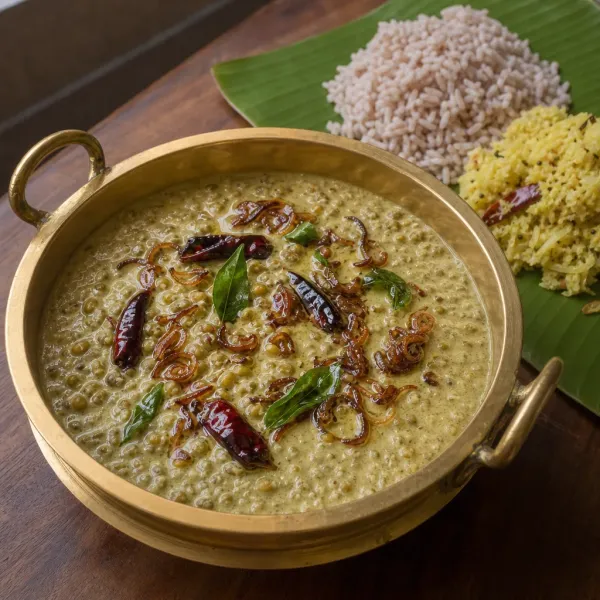
Cherupayar Curry (Kerala Green Gram Curry)
Traditional Kerala cherupayar curry with fresh ground coconut, shallots and coconut oil tempering. A simple everyday dish from Travancore households.
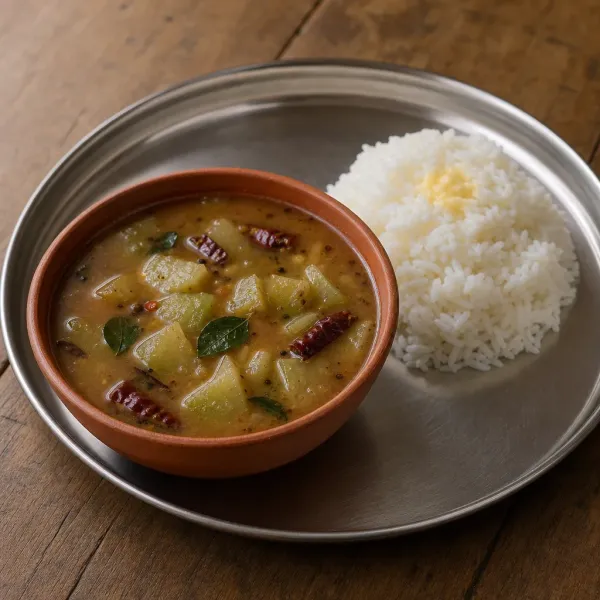
Sorakaya Pulusu
Traditional Coastal Andhra sorakaya pulusu: bottle gourd simmered in tamarind with gingelly oil tempering. Weekday rice dish, step-by-step recipe.
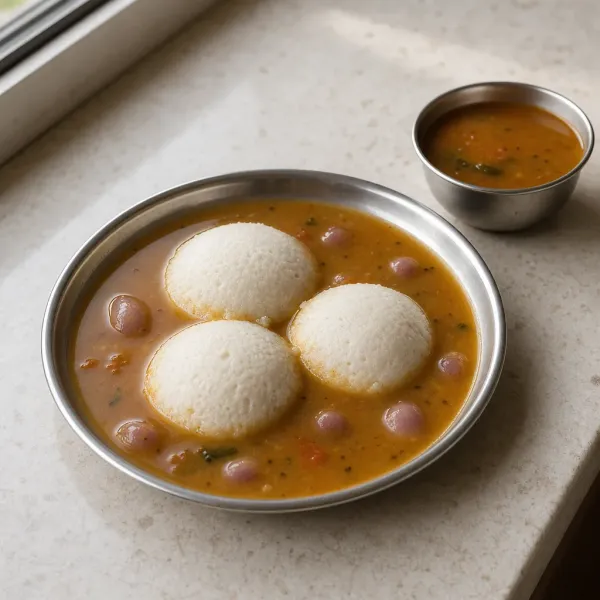
Tiffin Sambar
Thin, shallot-forward tiffin sambar from a Tamil Brahmin kitchen. Made fresh for idli and dosa, cooked with gingelly oil and tamarind. Traditional me…
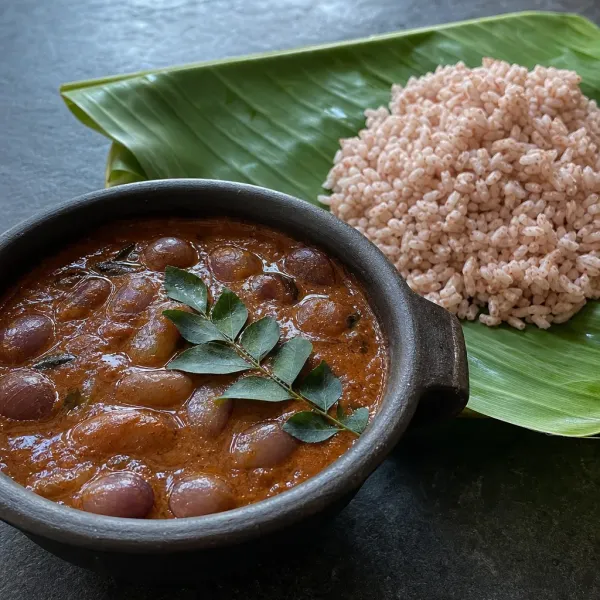
Theeyal
Traditional Kerala shallot theeyal with deep-roasted coconut, kudampuli, and fresh curry leaves. Step-by-step household method from Travancore kitche…
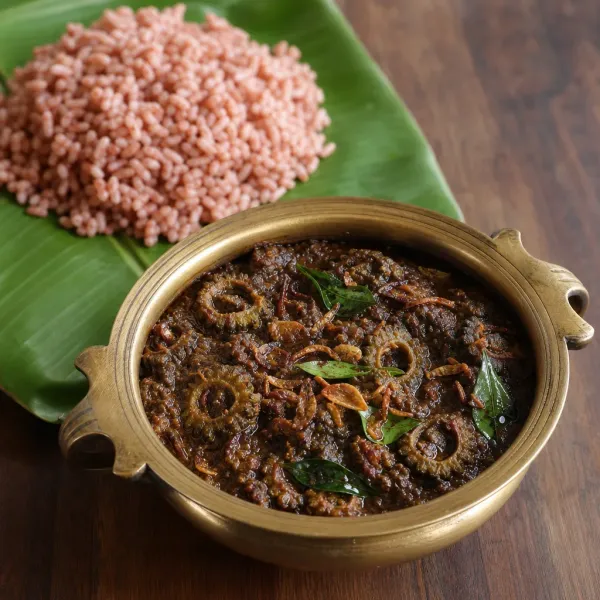
Pavakka Theeyal
Traditional Kerala pavakka theeyal with deeply roasted coconut and kudampuli. Dark, smoky and tangy, served with matta rice. Authentic Travancore met…
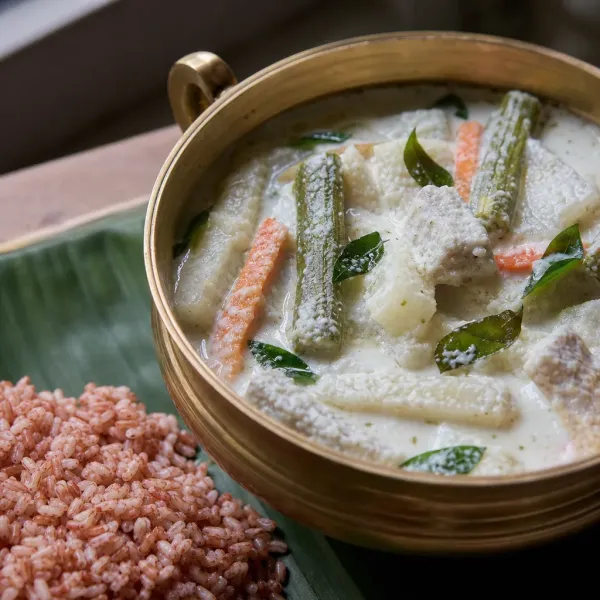
Avial
Classic Kerala avial with fresh coconut paste, sour yoghurt, and raw coconut oil. Traditional Travancore household method with exact quantities.