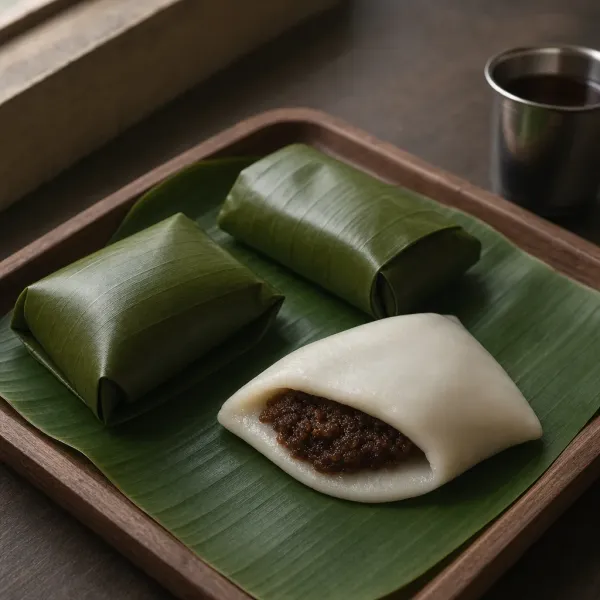
Nirachathu Recipe
Malayalam നിറച്ചത്Tamil நிரச்சதுKannada ನಿರಚತ್ತುTelugu నిరచత్తు

- Prep20 min
- Soak / ferment2 hr
- Cook25 min
- Serves4
- DifficultyMedium
- DietVegetarian
Nirachathu is a Mappila sweet snack from Malabar, made by slitting a ripe but firm nendran banana, packing it with a filling of freshly grated coconut, jaggery and cardamom, then coating it in a rice batter and frying it in coconut oil until the outside is golden and the banana inside is soft and fragrant. The name means roughly "filled" or "stuffed" in Malayalam, and that is exactly what it is: a banana that has been given a second life by what you press inside it.
It belongs to the category of Mappila teatime sweets that appear at iftaar, at weddings and at the kind of afternoon visit where something sweet is expected. It is not an everyday dish in most homes, but it is not difficult either, and families who make it regularly have their own sense of how sweet the filling should be and how thick the batter should sit on the banana.
The nendran banana is not optional. It holds its shape during frying, stays firm enough to slit cleanly, and its flavour works with the jaggery in a way that smaller, sweeter varieties do not. Choose bananas that are ripe enough to be yellow with a few brown flecks but still firm to the touch. An overripe banana will collapse when you slit it.
Ingredients (serves 4)
For the batter
For the filling
For the bananas
Method
Soak the rice
Wash the raw rice twice and cover it with cold water. Leave it to soak for 2 hours at room temperature. The grains should feel slightly soft when you press one between your fingers. Drain completely before grinding.
Grind the batter
Put the drained rice in a wet grinder or a powerful blender. Add water a little at a time, grinding until you have a smooth, thick batter with no grit. It should coat the back of a spoon and fall off in a slow ribbon, thicker than dosa batter. Add salt and stir. Set aside.
Make the filling
Combine the grated coconut, crumbled jaggery and crushed cardamom in a bowl. Mix well with your fingers, pressing the jaggery into the coconut so there are no dry lumps. Taste it: it should be clearly sweet with a warm cardamom note. The mixture should clump when you press it in your palm.
Slit and fill the bananas
Lay each peeled nendran banana on a board. Make a single deep lengthwise slit along one side, stopping about 1 cm from each end so the banana stays in one piece. Open the slit gently with your fingers and pack in as much filling as it will hold without tearing the banana apart, roughly 2 to 3 tablespoons per banana. Press the edges of the slit back together so the filling is enclosed.
Coat in batter
Hold a stuffed banana over the bowl of batter and spoon batter over it, turning it so the whole surface is coated in an even layer. The batter should be thick enough to cling and not drip off immediately. If it slides straight off, the batter is too thin; stir in a small amount of rice flour to thicken it.
Heat the oil
Pour coconut oil into a wide, heavy pan to a depth of about 1 cm. Set it over medium heat. The oil is ready when a drop of batter sizzles and rises within a few seconds. Do not let it smoke.
Fry the first side
Lower a batter-coated banana gently into the oil, slit-side up. Fry two at a time if your pan allows; do not crowd them. Cook on medium heat for 3 to 4 minutes until the underside is a deep golden brown. The batter will look set and dry at the edges before you turn it.
Turn and finish
Turn the banana carefully with a flat spatula and a spoon, keeping it from splitting open. Fry the second side for another 3 minutes until evenly golden all over. Spoon oil over any uncoated spots. The banana inside will be soft and yielding when you press the ends lightly. Lift onto a plate lined with paper.
Fry the remaining bananas
Coat and fry the remaining bananas in the same way, adjusting the heat if the oil gets too hot. The second and third batches tend to colour faster because the oil is hotter, so watch them closely.
Rest briefly and serve
Let them rest for 2 minutes before serving. The filling will be very hot straight from the oil. Serve warm.
How to serve
Served on its own as a teatime snack or as part of an iftaar spread. Sometimes placed alongside other Mappila sweets such as unnakkai or ada. No sauce or chutney is traditional.
Served with: Served on its own as a teatime snack or as part of an iftaar spread. Sometimes placed alongside other Mappila sweets such as unnakkai or ada. No sauce or chutney is traditional.
Cook's tips
Choosing the banana
The banana must be nendran. It should be fully yellow with a few brown spots but still feel firm when you squeeze it. A soft or overripe banana will split when you slit it and fall apart in the oil. If the bananas are very green, leave them at room temperature for another day.
Jaggery moisture
If your jaggery is very hard and dry, dissolve it in a teaspoon of water and cook it for a minute over low heat until it just melts, then cool it before mixing with the coconut. Wet jaggery mixed directly into the coconut can make the filling too loose and it may leak during frying.
Batter thickness
The batter is the thing most people get wrong. Too thin and it slides off the banana and pools in the oil, leaving patches of bare fruit that stick and burn. Too thick and you get a doughy coating that does not cook through. Aim for the consistency of a thick pancake batter.
Keeping the filling inside
Press the slit firmly closed after filling and handle the banana gently when lowering it into the oil. Place it slit-side up first so the weight of the banana keeps the slit closed as the batter sets underneath.
Shortcut batter
Some households skip soaking and grinding and use store-bought rice flour mixed with water to the same consistency. The texture of the coating is slightly less tender but the result is acceptable and much faster. This is a common everyday shortcut, not the traditional method.
Regional variations
Some Malabar households coat the banana in a plain maida batter rather than a rice batter; a few Kannur families add roasted sesame seeds to the filling.
Glossary
- Nirachathu നിറച്ചത്
- From 'nirakkuka', to fill or stuff; the name simply describes what is done to the banana.
- Nendran നേന്ത്രൻ
- A large, starchy cooking-and-eating banana variety native to Kerala, essential for this dish and for banana chips, pazham pori and unnakkai.
- Pachari പച്ചരി
- Raw white rice, as opposed to parboiled rice (puzhungalari); used here for the batter.
- Sharkkara ശർക്കര
- Jaggery made from sugarcane; the Malabar variety is dark and has a deep molasses flavour.
- Iftaar إفطار
- The meal eaten by Muslims at sunset to break the Ramadan fast; Mappila sweets like nirachathu are traditional at this meal.
Two things decide whether this works: the ripeness of the nendran banana and the thickness of the batter. Get those right and the rest follows. A banana that is too soft collapses; a batter that is too thin leaves the fruit exposed to the oil and the filling leaks out. Everything else, the exact sweetness of the filling, the depth of the cardamom, is a matter of your family's taste.
More Snacks recipes
Chakka Varuthathu
Traditional Kerala recipe for raw jackfruit chips fried in coconut oil with a salt brine finish. Crisp, long-keeping, and made the old household way.
Kuzhalappam
Traditional Kerala kuzhalappam recipe: hollow rice crisps pressed through a tube mould and deep-fried in coconut oil with cumin and sesame.