Kuzhalappam Recipe
Malayalam കുഴലപ്പംTamil குழலப்பம்Kannada ಕುಳಲಪ್ಪTelugu కుళలప్పం
- Prep20 min
- Soak / ferment4 hr
- Cook40 min
- Serves4 to 6 (approximately 30 to 35 pieces)
- DifficultyMedium
- DietVegan
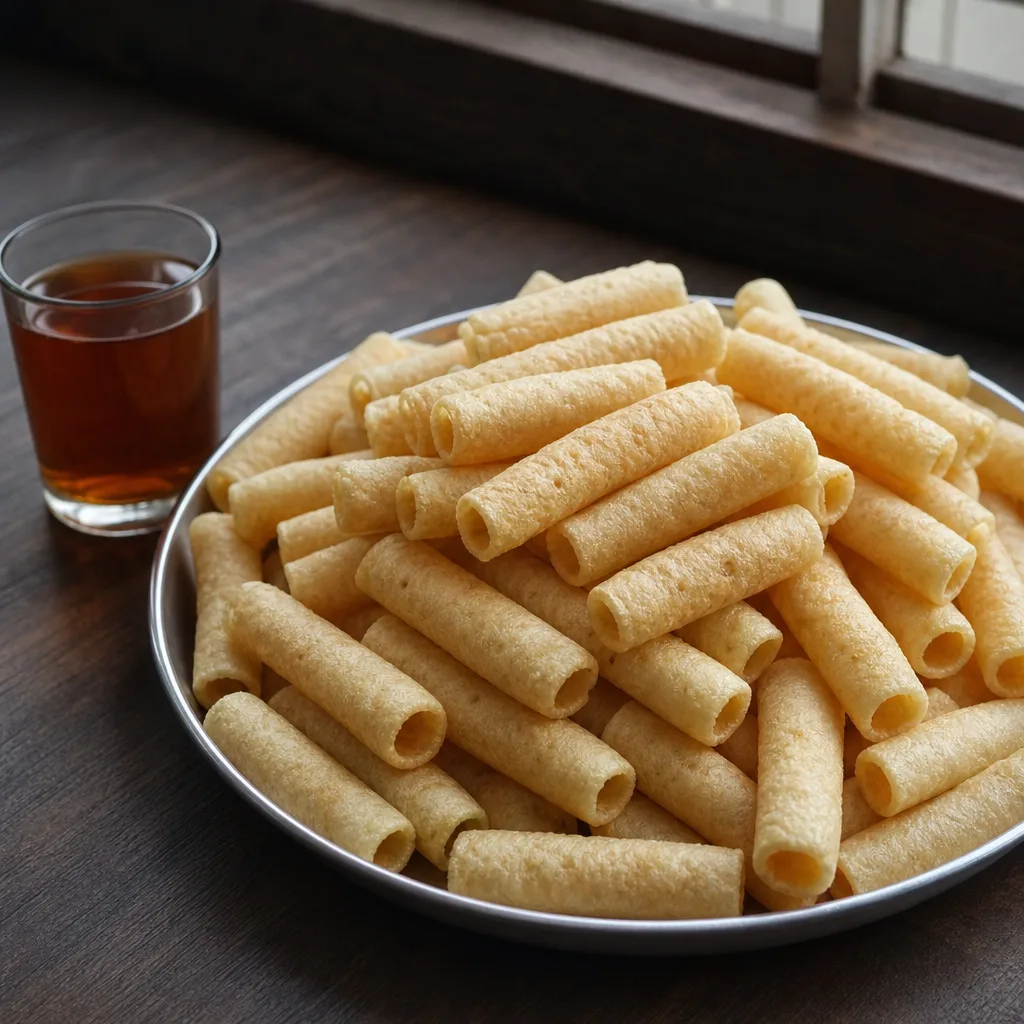
Kuzhalappam is a hollow, tube-shaped crisp made from raw rice dough, pressed through a special cylindrical mould called a kuzhal and deep-fried in coconut oil. The name itself means tube-appam. It is a teatime snack found in homes across Kerala, made in large batches for Vishu, Onam, and family gatherings, then stored in a tin for a week or more.
The texture is the whole point: thin-walled, completely dry, and brittle without being hard. When you bite into one it should snap cleanly and dissolve quickly. Cumin and sesame seed are the standard seasonings, and the faint smokiness of coconut oil is part of the flavour. Some households add a small amount of grated coconut to the dough, which softens the crunch slightly and adds sweetness; others keep it plain. Both are genuinely traditional.
The kuzhal mould is not negotiable. It is a hollow brass or aluminium tube roughly fifteen centimetres long, closed at one end with a disc that has a circular hole in the centre. You press the dough ball into the open end, hold the mould over the hot oil, and push the dough through so the tube of dough drops directly into the oil and seals itself into a cylinder. If you have never done it before, the first few will not be perfect. The oil temperature matters more than anything else: too cool and the appam absorbs oil and goes limp; too hot and it colours before the inside dries out.
Ingredients (serves 4 to 6 (approximately 30 to 35 pieces))
For the dough
For frying
Method
Soak the rice
Wash the raw rice in two or three changes of water until the water runs mostly clear. Cover with fresh cold water and leave to soak for 4 hours at room temperature. The grains should be soft enough to break between your fingers without any hard centre. Drain completely in a colander and let them sit for 5 minutes so there is no pooling water.
Grind to a fine paste
Put the drained rice, grated coconut, cumin seeds, sesame seeds, and salt into a wet grinder or a powerful blender. Grind without adding water first, letting the moisture from the coconut and rice do the work. Add water one tablespoon at a time only if the grinder is struggling. You want a paste that is smooth but stiff, not pourable. It should hold its shape when you press a ball of it in your palm. This takes about 8 to 10 minutes in a wet grinder.
Check the dough consistency
Scrape the paste out onto a plate. It should look like a soft, non-sticky dough, paler than you expect, almost white. Press a small piece into a ball: if it cracks at the edges, add half a tablespoon of water and mix well. If it is wet enough to stick to your fingers, you have added too much water and will need to work the dough for a few minutes on a dry surface. The right consistency is the most important thing at this stage.
Heat the oil
Pour the coconut oil into a deep, wide pan or kadai to a depth of at least 6 cm. Heat over a medium flame. To test readiness, drop a tiny pellet of dough into the oil: it should sink for a second, then rise to the surface and begin to sizzle steadily within 3 to 4 seconds. That is roughly 170 to 175 °C. If it shoots straight up and browns in under a minute, the oil is too hot; lower the flame and wait.
Fill and press the mould
Take the kuzhal mould in one hand. Pull off a piece of dough slightly smaller than a golf ball and press it firmly into the open end of the mould, packing it in with your thumb so there are no air gaps. The dough should be snug against the sides and flush with the top of the mould.
Press into the oil
Hold the mould horizontally over the hot oil, perforated end pointing down. Using the thumb of your other hand, press the dough through the hole steadily so a long tube of dough descends into the oil. Move the mould gently in a circular motion as you press so the tube curls slightly and the two ends meet and seal, forming a closed cylinder. Release the pressure once the tube is in the oil. This takes a little practice; the first two or three will teach you the right speed.
Fry until completely dry and pale golden
Fry in batches of four or five, turning them gently with a slotted spoon after 2 minutes so they colour evenly. The kuzhalappam should turn a very light, even golden, not deep brown. Total frying time is about 5 to 7 minutes per batch. The sizzling will quieten noticeably when the moisture has left the dough. If you lift one out and it still feels soft or pliable, return it to the oil; it will harden as it cools only if it is fully cooked through.
Drain and cool
Lift the finished pieces onto a plate lined with a clean cloth or paper, not stacked on top of each other. Let them cool completely before tasting. They will seem slightly soft when very hot but will crisp up fully within 5 minutes of coming out of the oil. Do not cover them while they are warm or they will go soft.
Continue with remaining dough
Repeat steps 5 through 8 with the rest of the dough, checking the oil temperature between batches. If the oil has cooled, let it return to temperature before pressing the next batch. Rushing this step is how you get greasy kuzhalappam.
Store
Once completely cold, store in a dry airtight tin. They keep well for 7 to 10 days if no moisture enters the tin. Do not refrigerate.
How to serve
Served as a standalone tea-time snack alongside black tea or milky tea. No dipping sauce or chutney is traditional.
Served with: Served as a standalone tea-time snack alongside black tea or milky tea. No dipping sauce or chutney is traditional.
Cook's tips
The mould
Kuzhal moulds are sold in Kerala hardware and kitchen shops and online. Brass moulds are traditional but aluminium ones work equally well. Rinse and dry the mould between batches if dough residue builds up inside the tube, as stuck dough breaks the cylinder when you press.
Dough that is too wet
If the dough is too soft, the tubes will not hold their shape in the oil and will collapse or stick together. Spread the dough on a dry plate, work it briefly with your hands, and let it rest uncovered for 5 minutes before trying again. Do not add rice flour to correct it unless you are comfortable with how that changes the texture.
Coconut in the dough
Some households skip the grated coconut entirely and make a plain rice dough. The result is a harder, more neutral crisp. Both are traditional. The coconut version is slightly more fragile and has a shorter shelf life by a day or two.
Oil temperature drift
Coconut oil heats and cools faster than refined oils. Keep the flame at medium throughout and do not walk away between batches. A thermometer is helpful if you are new to this.
Shortcut note
Some households today use store-bought fine raw rice flour (not roasted rice flour) mixed with coconut milk to make the dough, skipping the soaking and grinding step. It is quicker but the texture is noticeably different, less delicate. It is a genuine household shortcut, not a traditional method.
Regional variations
Some households in Palakkad add a small amount of coconut milk to the dough for a richer flavour; a few Malabar families add a pinch of turmeric giving the crisps a pale yellow colour.
Glossary
- Pachari പച്ചരി
- Raw, unparboiled white rice used in Kerala cooking, distinct from the parboiled matta rice.
- Kuzhal കുഴൽ
- Literally 'tube' or 'pipe'; the cylindrical metal mould used to shape and press the dough into the oil.
- Appam അപ്പം
- A broad Kerala term for various rice-based preparations, both fried and steamed; here used in the sense of a fried rice snack.
- Kadai കടാഹം
- A deep, wide, round-bottomed pan used for deep frying and stir-frying across South Indian kitchens.
Two things decide whether kuzhalappam works: the dough must be stiff enough to hold a tube shape in hot oil without collapsing, and the oil must stay at a steady medium heat long enough for the inside of each cylinder to dry out completely. Get those two right and the rest follows.
More Snacks recipes
Chakka Varuthathu
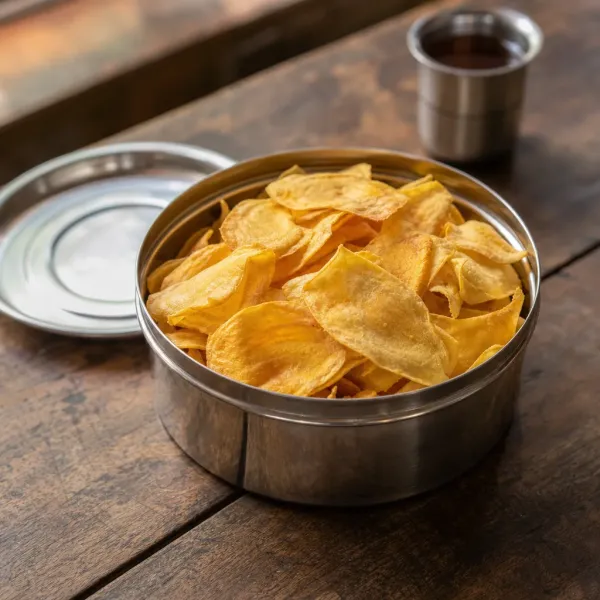
Traditional Kerala recipe for raw jackfruit chips fried in coconut oil with a salt brine finish. Crisp, long-keeping, and made the old household way.
Madras Mixture
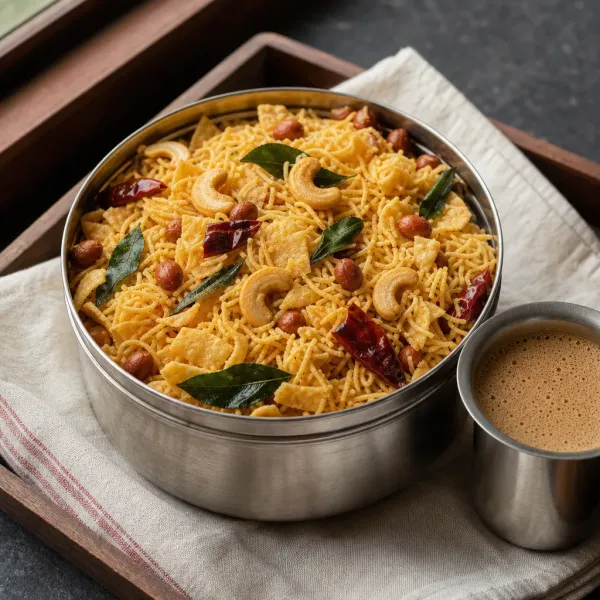
Authentic Tamil Madras mixture with fresh omapodi, ribbon pakoda, peanuts and cashews, fried in gingelly oil and tossed with curry leaves.