Chakka Varuthathu Recipe
Malayalam ചക്ക വറുത്തത്Tamil சக்கை வறுத்ததுKannada ಚಕ್ಕ ವರುತ್ತತ್ತುTelugu చక్క వరుత్తత్తు
- Prep25 min
- Cook40 min
- Serves6 to 8 as a snack
- DifficultyMedium
- DietVegan
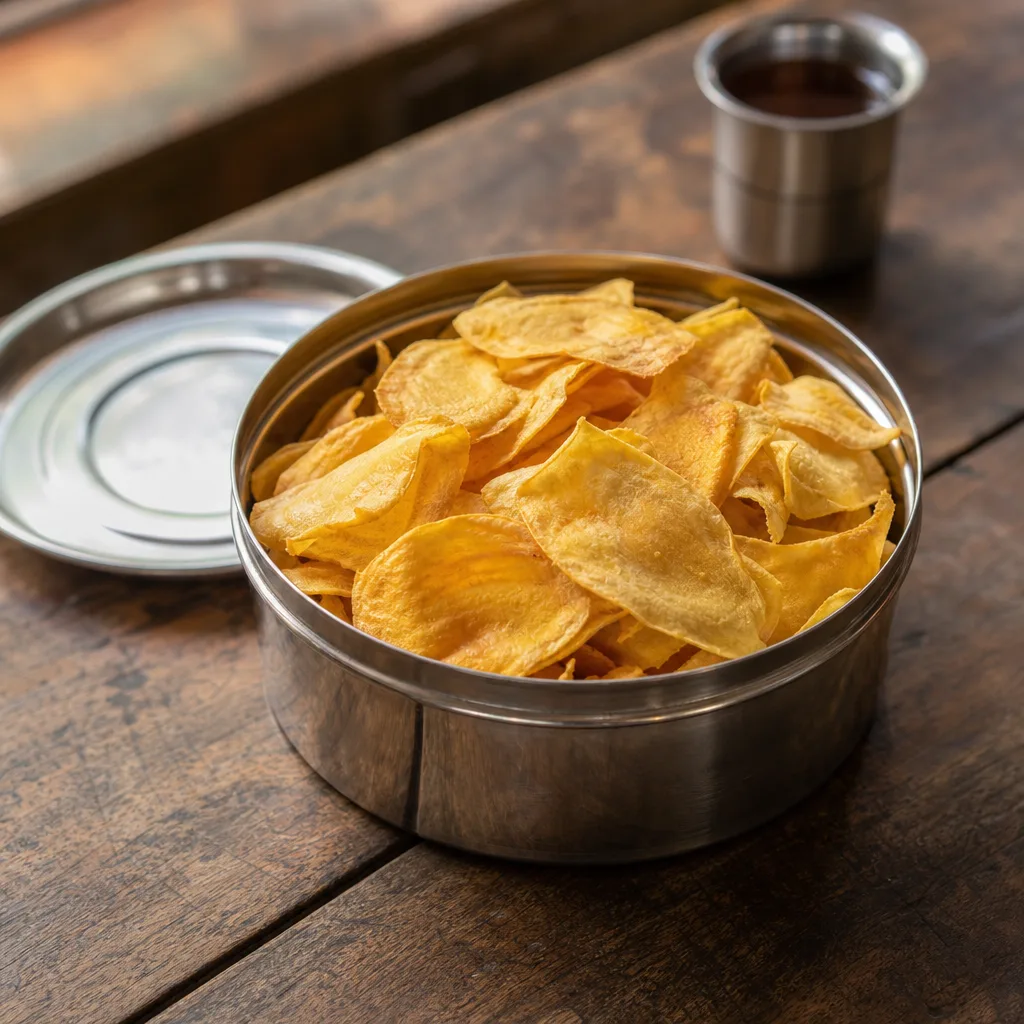
Chakka varuthathu is made in the weeks when raw jackfruit is firm and its flesh is still pale and starchy, before the fruit sweetens and softens into the ripe stage. Every household with a jackfruit tree in the yard knows this window well. The chips are sliced paper-thin, fried in coconut oil until they crunch and hold that crunch for days in a tin.
This is not festival food or restaurant food. It is the snack a grandmother fries on a slow afternoon and stores in a steel dabba for the week. Children eat them with tea; they go into school bags. The flavour is the natural starch of raw jackfruit meeting hot coconut oil, finished with nothing more than salt water sprinkled in at the end of frying to make the chips crisp and lightly salted at once.
The only real household variation is in how thin people manage to slice the jackfruit. A mandoline or the thin blade of a vegetable slicer gives the most even result, but many cooks use a sharp knife and years of practice. Thicker slices are chewier in the centre; very thin ones shatter cleanly. Both are eaten without complaint.
Ingredients (serves 6 to 8 as a snack)
For the chips
Method
Oil your hands and knife
Rub your hands, the knife blade and the chopping board generously with coconut oil before you touch the jackfruit. The raw fruit releases a thick white latex that sets like glue on skin and steel. Working oiled prevents staining and makes cleanup possible.
Peel and core the jackfruit
Cut the jackfruit into large manageable sections. Slice off the thick outer rind with its spiky surface, then cut away the fibrous pale core from each section. You are left with solid, creamy-white to pale yellow flesh. It should feel firm and dense, not soft anywhere.
Slice paper-thin
Using a mandoline set to 1 to 1.5 mm, or a very sharp knife, slice the jackfruit pieces into rounds or long thin slices across the grain. Aim for even thickness throughout; uneven slices will have some burning before others are done. Keep the slices in a bowl of cold water as you work to prevent discolouration.
Drain and dry the slices thoroughly
Lift the slices out of the water and spread them in a single layer on a clean dry cloth. Pat the tops dry with another cloth. Any surface water entering the hot oil will cause violent spattering. Leave them for 5 to 10 minutes; they should feel dry to the touch before they go into the oil.
Prepare the salt brine
Dissolve 1 teaspoon of salt in 3 tablespoons of water in a small bowl and keep it beside the stove. You will need to sprinkle this into the oil at the end of frying each batch. Have a ladle or long-handled spoon ready.
Heat the oil
Pour the coconut oil into a wide, deep kadai or uruli and heat over a medium-high flame. The oil is ready when a small piece of jackfruit dropped in sinks slightly, then rises immediately and begins to sizzle actively. If it sinks and stays, the oil is not hot enough; if it browns in seconds, the oil is too hot. Aim for around 170 to 175°C.
Fry the first batch
Slide in a single layer of slices without crowding the kadai. They will sizzle vigorously at first. Stir gently with a slotted spoon to keep them from sticking together. The sizzling will gradually quieten as moisture leaves the chips; this is the sign you are watching for.
Sprinkle the brine
When the sizzling has calmed considerably and the chips look dry and just beginning to turn a very light gold at the edges, carefully sprinkle about half a teaspoon of the salt brine into the oil from a distance, holding your face back. It will splutter sharply. This step seasons the chips and drives out the last moisture, giving the final crunch. Stir once.
Remove at the right moment
The chips are done when the sizzling has almost completely stopped and they are a pale golden colour, not deep brown. They will crisp further as they cool. Lift them out with a slotted spoon and spread on a plate lined with paper or a clean cloth. Do not stack them while hot.
Fry remaining batches
Return the oil to temperature between batches; adding cold slices to oil that has dropped in temperature makes the chips greasy. Repeat the frying and brine-sprinkling for each batch. The oil will darken slightly over successive batches, which is normal.
Cool completely before storing
Let all the chips cool completely on the cloth, at least 20 minutes. They should snap cleanly when bent. Transfer to a dry airtight steel or glass container. Do not seal them while warm or they will soften from trapped steam.
How to serve
Eaten on their own as a snack, often alongside afternoon tea. Traditionally packed into steel tins and kept for a week or more.
Served with: Eaten on their own as a snack, often alongside afternoon tea. Traditionally packed into steel tins and kept for a week or more.
Cook's tips
Managing jackfruit latex
The latex from raw jackfruit is extremely sticky and will blacken on skin and clothes. Oil everything that will touch the fruit: hands, knife, mandoline blade and board. If latex gets on the knife mid-way, wipe with an oiled cloth, not water.
Choosing the right jackfruit
The fruit must be fully raw and firm, called 'idichakka' or 'kachcha chakka'. If the flesh has begun to yellow and soften, it has too much sugar and will burn before it crisps. Press the flesh; it should feel as firm as a raw potato.
Why the chips go soft
Soft chips have one of three causes: slices were not dried well enough before frying, the oil was not hot enough so the chips absorbed fat, or the chips were stored before they were completely cool. All three are easy to avoid.
The brine sprinkle
Some households skip the brine and toss the finished chips with fine salt while hot. Both work. The brine method seasons more evenly and the sharp splutter it causes drives out residual moisture, which is why traditional cooks prefer it. Stand back when you sprinkle.
Storage
Stored in an airtight tin away from humidity, these keep well for 10 to 14 days. In a Kerala kitchen during monsoon, they may soften sooner. A brief spread on a tray in the sun or a few minutes in a low oven will revive them.
Regional variations
Some households in Malabar add a pinch of turmeric to the oil before frying, giving the chips a deeper yellow; a few families finish with a light dusting of chilli powder and salt after frying.
Glossary
- Chakka ചക്ക
- Jackfruit in Malayalam; here specifically the raw, unripe fruit used for cooking.
- Varuthathu വറുത്തത്
- Fried preparation; from the verb varuthukal, to fry or roast.
- Kadai കടാഹം
- A deep, wide cooking vessel used for deep frying; can be iron, steel or brass.
- Uruli ഉരുളി
- A traditional Kerala vessel, wide and shallow-to-medium depth, often made of bell metal or brass; used for frying and cooking large quantities.
- Idichakka ഇടിച്ചക്ക
- Tender, fully raw jackfruit used in cooking, distinct from the ripe sweet fruit.
Two things decide whether these chips succeed: the jackfruit must be genuinely raw and firm, and the slices must be bone-dry before they enter the oil. Get those two right and the rest follows naturally.
More Snacks recipes
Kuzhalappam
Traditional Kerala kuzhalappam recipe: hollow rice crisps pressed through a tube mould and deep-fried in coconut oil with cumin and sesame.
Madras Mixture
Authentic Tamil Madras mixture with fresh omapodi, ribbon pakoda, peanuts and cashews, fried in gingelly oil and tossed with curry leaves.