Sukhiyan Recipe
Malayalam സുഖിയൻTamil சுகியன்Kannada ಸುಖಿಯನ್Telugu సుఖియన్
- Prep20 min
- Cook40 min
- Serves4
- DifficultyEasy
- DietVegetarian
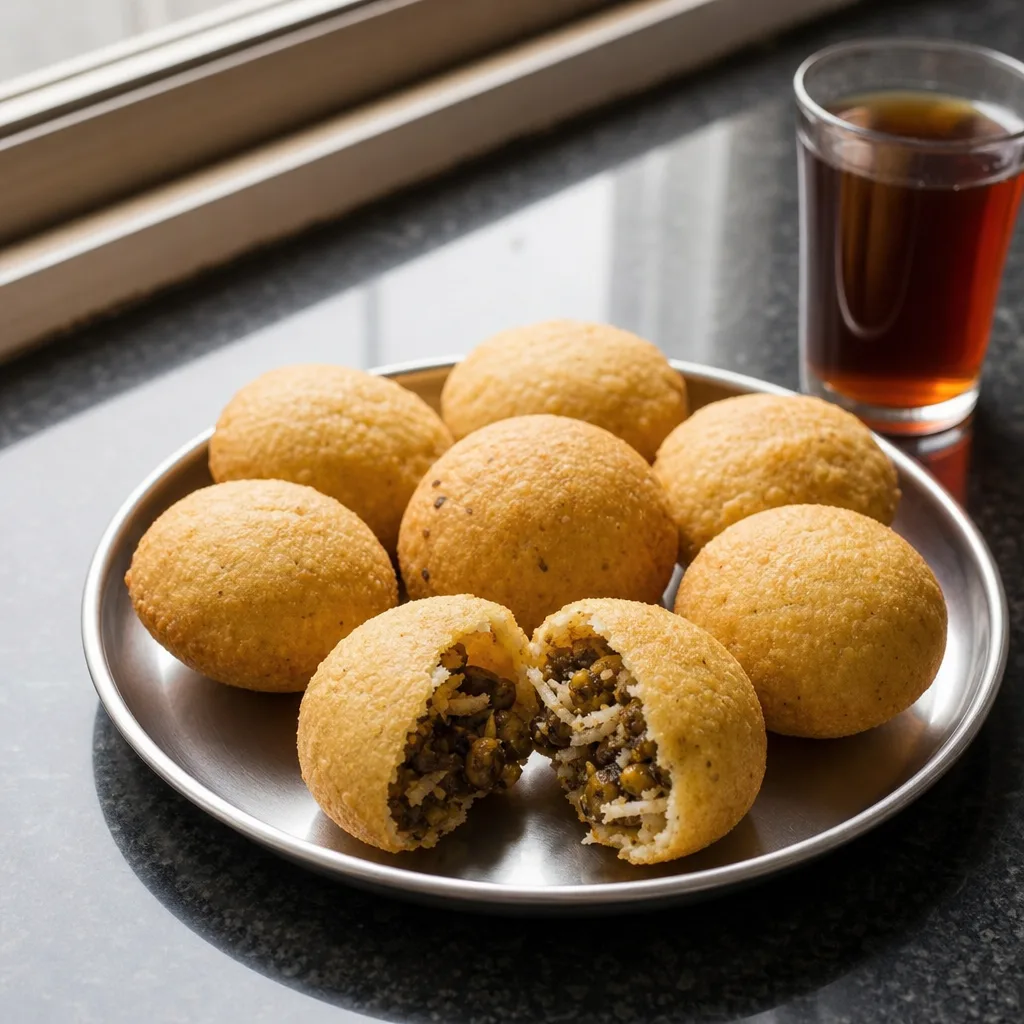
Sukhiyan is a small, round teatime fritter found in almost every Kerala household. Inside is a soft, sweetened filling of cooked whole green gram bound with freshly grated coconut and scented with cardamom. Outside is a thin, crisp shell of rice flour batter fried in coconut oil. The contrast between the yielding filling and the snapping crust is the whole point of the thing.
It belongs firmly to the evening snack table, the kind that appears with black tea on school-day afternoons or on Vishu and Onam alongside other savories. It is not a festival exclusive; mothers make it any time green gram is in the house and there is an hour to spare. The filling is always cooked green gram, always sweetened with jaggery, always has coconut and cardamom. Beyond that, households differ only in how thick they make the batter and how much jaggery they use.
The rice flour batter should be thin enough to coat the ball in a translucent shell, not a doughy jacket. If the batter is too thick the fritter becomes heavy and the filling is lost. If the oil is not hot enough the batter drinks oil and the crust turns soft before it reaches the plate. These are the two things that go wrong most often.
Ingredients (serves 4)
For the filling
For the batter
For frying
Method
Cook the green gram
Put the rinsed green gram in a heavy pot with 500 ml of water. Bring to a boil, then reduce the heat to medium-low and cook, partly covered, for 25 to 30 minutes until every grain is completely soft and just beginning to split. The grains should crush easily between your fingers but the mixture should not be watery. Drain off any excess water and leave the cooked gram in the pot.
Make the jaggery syrup
In a small pan, melt the grated sharkara with 2 tablespoons of water over low heat, stirring until it dissolves completely. Strain through a fine sieve to remove any grit. Pour the strained syrup back into the pan and let it bubble for one minute until it thickens slightly to a single-thread consistency. Do not cook it further or the filling will harden as it cools.
Combine the filling
Add the cooked green gram to the jaggery syrup in the pan. Stir over low heat for 3 to 4 minutes, mashing the gram roughly as you go, until the mixture comes together into a soft, cohesive mass that leaves the sides of the pan. You want some texture, not a smooth paste. Take the pan off the heat, add the grated coconut and cardamom powder, and mix well. The filling should be firm enough to roll into balls without sticking to your palms. If it feels wet, return it to low heat for another minute or two.
Shape the filling balls
While the filling is still warm but cool enough to handle, divide it into equal portions of about 30 g each and roll each portion between your palms into a smooth ball. You should get 14 to 16 balls. Set them on a plate. If the filling cracks as you roll, it has dried out too much; press it together firmly and it will hold.
Mix the batter
In a bowl, combine the rice flour, a small pinch of salt and the turmeric. Add water gradually, whisking as you go, until you have a smooth, thin batter the consistency of a light cream. It should coat a spoon and run off in a thin, even stream. If it is too thick, the shell will be doughy; if too thin, it will not coat the ball. Rest the batter for 5 minutes.
Heat the oil
Pour coconut oil into a narrow, deep kadai to a depth of at least 6 cm. Heat over medium flame until the oil reaches around 170°C. To test without a thermometer, drop a small amount of batter into the oil; it should rise to the surface within 3 seconds and sizzle steadily. If it sinks and sits, the oil is too cool. If it browns in under 5 seconds, the oil is too hot and the batter will colour before the inside warms through.
Coat and fry
Working in batches of 4 or 5, dip each filling ball into the batter, turning to coat it completely, then lower it gently into the hot oil using a spoon. Do not crowd the kadai. Fry for 3 to 4 minutes, turning the fritters once or twice with a slotted spoon, until the batter shell is pale golden and crisp all around. The colour should be a light, even gold, not deep brown. Lift out and drain on a plate lined with paper.
Check the first batch
Break one fritter open before continuing. The shell should be thin and crisp. The filling inside should be soft, warm and fragrant. If the shell is thick and doughy, thin the batter with a tablespoon more of water. If the filling has hardened to a dry paste, the jaggery was cooked too long in step 2; note this for next time but continue with what you have.
Fry the remaining batches
Continue frying in batches, keeping the oil temperature steady by adjusting the flame between batches. Allow the oil to return to temperature for a minute before adding a new batch. Drain each batch on paper and serve while still warm and crisp.
How to serve
Hot black tea (chaya) or black coffee. Sometimes set out alongside banana chips and murukku on a snack plate.
Served with: Hot black tea (chaya) or black coffee. Sometimes set out alongside banana chips and murukku on a snack plate.
Cook's tips
Jaggery quality matters
Kerala sharkara (the dark, slightly smoky unrefined jaggery sold in rounds) gives the filling a deeper, more complex sweetness than pale jaggery. If you can only find pale jaggery, the filling will still work but taste milder.
Filling can be made ahead
The filling balls keep well in the refrigerator for up to two days, covered. Bring them to room temperature before dipping in batter, because a cold ball will crack the hot oil temperature and the batter may slip off.
Batter thickness is the critical variable
Err on the side of thinner rather than thicker. A thin batter gives the characteristic light, crisp shell. A thick batter produces a heavy, bread-like coating that overwhelms the filling. If in doubt, test with one ball before frying the rest.
Reheating
Sukhiyan is best eaten within an hour of frying. If you must reheat, put them in a dry pan over low heat for a few minutes rather than microwaving, which turns the shell soft and chewy.
Shortcut used in some households
Some cooks use a pressure cooker for the green gram: one whistle on high pressure with 300 ml water, then natural release. The texture is slightly mushier than stovetop cooking but the filling holds together once the excess moisture is dried off over heat.
Regional variations
Some households in Malabar use a thicker maida batter instead of rice flour; a few add a pinch of cardamom to the batter as well as the filling.
Glossary
- Cherupayar ചെറുപയർ
- Whole green gram (mung bean), the small green legume used widely in Kerala cooking.
- Sharkara ശർക്കര
- Unrefined Kerala jaggery made from sugarcane, darker and more aromatic than commercially refined jaggery.
- Kadai കടാഹം
- A deep, round-bottomed heavy pan used for deep frying and stir-frying.
- Pachari പച്ചരി
- Raw (unparboiled) white rice, used for batters and rice flour in Kerala.
Two things decide whether sukhiyan works: the filling must be dry enough to hold its shape without cracking, and the batter must be thin enough to fry into a crisp shell rather than a doughy coat. Get those two right and everything else follows.
More Snacks recipes

Nirachathu
Traditional Malabar Mappila nirachathu: ripe nendran banana stuffed with coconut, jaggery and cardamom, coated in rice batter and fried in coconut oi…
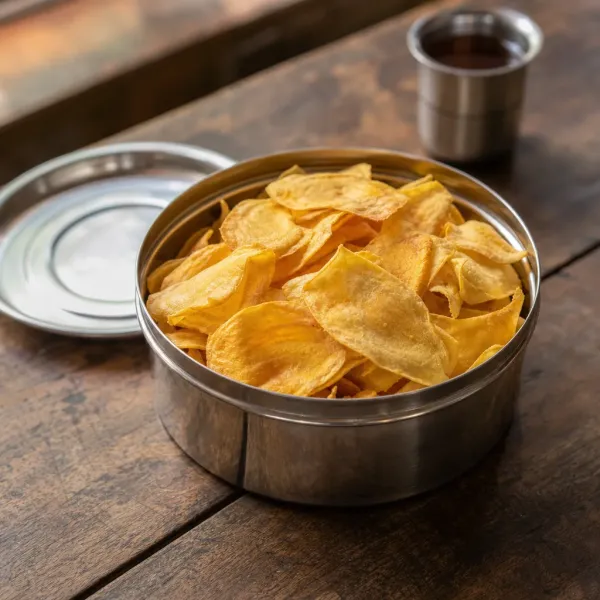
Chakka Varuthathu
Traditional Kerala recipe for raw jackfruit chips fried in coconut oil with a salt brine finish. Crisp, long-keeping, and made the old household way.
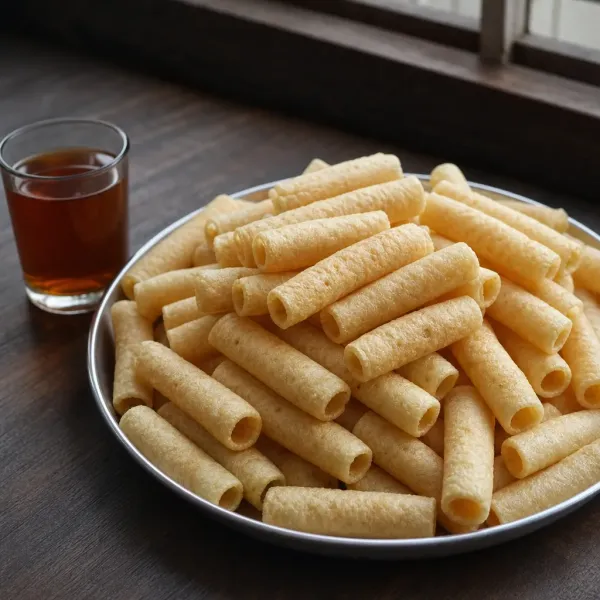
Kuzhalappam
Traditional Kerala kuzhalappam recipe: hollow rice crisps pressed through a tube mould and deep-fried in coconut oil with cumin and sesame.