Achappam Recipe
Malayalam അച്ചപ്പംTamil அச்சப்பம்Kannada ಅಚ್ಚಪ್ಪTelugu అచ్చప్పం
- Prep20 min
- Cook40 min
- ServesMakes approximately 50 to 60 pieces
- DifficultyMedium
- DietEgg
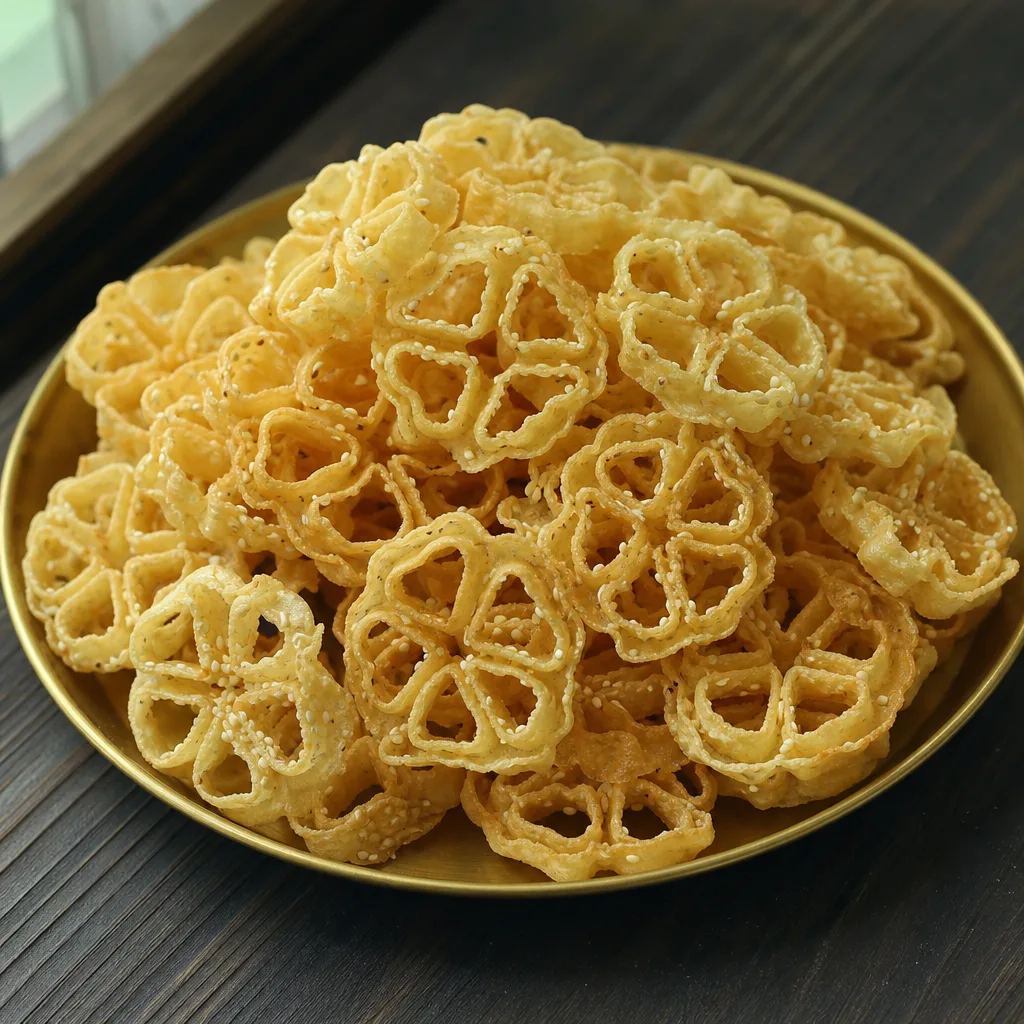
Achappam is a deep-fried crisp wafer made by dipping a hot iron mould into a thin batter and then into hot coconut oil. The batter sets and releases from the mould in seconds, forming a rigid flower or star shape that holds its pattern perfectly once fried. It is a Christmas and Easter sweet in Nasrani homes across Travancore, made in large batches and stored in tins that last the better part of a fortnight.
The batter is rice-based, thinned with coconut milk, lightly sweetened, and bound with egg. The egg is important: it helps the batter cling to the mould and gives the finished piece its snap. The coconut milk should be the first, thick pressing from fresh coconut; thin coconut milk makes the batter watery and the achappam will not hold its shape cleanly. Sesame seeds are scattered through the batter in most households, and they toast against the mould as it fries, adding a faint nuttiness.
Every household has a preferred mould shape. The flower with five petals is the most common in Kottayam and Thiruvalla homes; some families use a star, some a lotus. The mould must be the right weight and the right metal — cast iron or thick aluminium — because a thin mould loses heat too fast and the batter will not set before it slides off. The oil temperature is the one thing that cannot be rushed.
Ingredients (serves Makes approximately 50 to 60 pieces)
For the batter
Method
Make the batter
Beat the eggs and sugar together in a wide bowl until the sugar dissolves and the mixture is pale and slightly foamy. Add the salt and pour in the coconut milk gradually, stirring as you go. Tip in the sifted rice flour a little at a time and whisk until you have a smooth, lump-free batter the consistency of thin cream. Stir in the sesame seeds. The batter should coat the back of a spoon lightly and run off in a thin stream — if it is thicker than that, it will form a casing too heavy to release from the mould.
Rest the batter
Cover the bowl and leave the batter to rest for 15 minutes at room temperature. This allows the rice flour to fully hydrate. Do not skip this; a batter used immediately can give achappam with a slightly gritty texture.
Heat the oil and the mould together
Pour the coconut oil into a deep, narrow kadai or a vessel in which the oil is at least 8 cm deep. Place the achappam mould into the oil before you light the flame. Heat the oil to approximately 180°C on medium-high flame. The mould must heat up inside the oil — this is not optional. A cold mould dipped in batter will not set the batter; it will simply slide off into the oil in a shapeless puddle.
Test the oil temperature
Drop a tiny amount of batter into the oil. It should rise immediately to the surface and sizzle steadily. If it sinks and sits, the oil is too cool. If it browns in under 10 seconds, the oil is too hot and your achappam will colour before the centre crisps. Adjust the flame and test again.
Dip the mould into the batter
Lift the mould from the oil using its long handle. Shake off excess oil gently. Dip the mould into the batter so that it is submerged only to about three-quarters of its depth — if you submerge it fully, the batter will coat the top of the mould and you will not be able to slide the achappam off. Hold it in the batter for 3 to 4 seconds, no longer. You should see the batter sizzle faintly where it touches the hot metal.
Lower into the oil
Carry the mould directly to the oil and lower it in slowly. Hold it still for about 5 seconds. The batter will begin to set and turn opaque. Then give the mould a gentle sideways shake — the achappam should slide off the mould and float free in the oil. If it does not release, hold it a few seconds more and try again. Do not force it or pry it; it will tear.
Fry until crisp and pale gold
Fry the freed achappam for about 1 to 1½ minutes, turning once with a slotted spoon, until it is a very pale golden colour — not deep brown. The colour should be the lightest honey. The moment you see the sesame seeds have turned golden and the surface looks dry and rigid, it is done. Lift it out promptly; it continues to colour from residual heat.
Drain and cool completely
Place the fried achappam on a plate lined with absorbent paper. Do not stack them while they are warm; they are fragile until fully cool and will stick and break. Spread them in a single layer and let them cool to room temperature before stacking.
Return the mould to the oil between each piece
After each achappam, return the mould to the hot oil for at least 30 seconds before dipping it into the batter again. The mould must be hot enough that the batter sizzles on contact. If the mould cools even slightly between pieces, the batter will not adhere properly and you will lose the shape.
Continue through the batter
Work steadily through the batter, frying two or three achappam at a time if your vessel is wide enough. Stir the batter from the bottom before each dip, as the rice flour settles. Keep the oil temperature steady by adjusting the flame as needed; it will drop slightly each time you add a new piece.
Store once fully cool
Once every piece is completely cold, store in an airtight tin or glass jar. They will stay crisp for 10 to 14 days. Even a few minutes in a humid, open environment will soften them.
How to serve
Eaten on its own as a festival sweet or tea-time snack. In Nasrani homes it is set out on a plate alongside other Christmas sweets such as unniyappam and neyyappam, but it is not accompanied by a dip or a drink in any formal sense.
Served with: Eaten on its own as a festival sweet or tea-time snack. In Nasrani homes it is set out on a plate alongside other Christmas sweets such as unniyappam and neyyappam, but it is not accompanied by a dip or a drink in any formal sense.
Cook's tips
The mould must go in cold oil
If you drop the mould into already-hot oil rather than heating it from the start, the mould heats unevenly and the batter sticks to some parts and not others. Always start with the mould in the cold oil.
Fresh coconut milk matters
Canned coconut milk works in a pinch but tends to be thinner and sometimes has a faint metallic note. If you use it, use only the thick layer from the top of the can and reduce the quantity slightly — start with 250 ml and add more if the batter is too thick.
Why achappam stays on the mould
Two reasons: the mould was not hot enough when dipped, or the batter is too thick. If pieces keep sticking, thin the batter by a tablespoon or two of coconut milk and make sure you are returning the mould to the oil long enough between pieces.
Rice flour from scratch
Some households soak raw rice for 2 hours, drain it, dry it on a cloth for 20 minutes, and then grind it fine in a mixer. This gives a slightly fresher flavour. Store-bought fine raw rice flour (not the coarser idiyappam flour) works well for everyday batches.
Oil temperature drift
On a long frying session, the oil temperature tends to creep up as the water in the batter evaporates and there is less cooling effect. Watch the colour of later pieces; if they are browning faster, lower the flame.
Regional variations
A very similar rose cookie exists in Goa among Konkani Catholics under the name rose cookies or kulkuls-adjacent festival sweets; Tamil Nadu Anglo-Indian and Sri Lankan Burgher households make a near-identical version. This recipe is the Kerala Nasrani household version.
Glossary
- Achappam അച്ചപ്പം
- From 'acham' (mould) and 'appam' (rice cake); a crisp fried wafer shaped by a patterned iron mould.
- Pachari പച്ചരി
- Raw, uncooked white rice, as opposed to parboiled or matta rice; used here as fine-ground flour.
- Kadai കടாഹം
- A deep, round-bottomed cooking vessel used for deep frying; the depth keeps the oil from splashing.
Two things decide whether achappam works: the temperature of the mould when it meets the batter, and the consistency of the batter itself. Get both right — the mould hot enough to make the batter hiss, the batter thin enough to flow off the mould cleanly — and the rest follows naturally.
More Snacks recipes

Nirachathu
Traditional Malabar Mappila nirachathu: ripe nendran banana stuffed with coconut, jaggery and cardamom, coated in rice batter and fried in coconut oi…
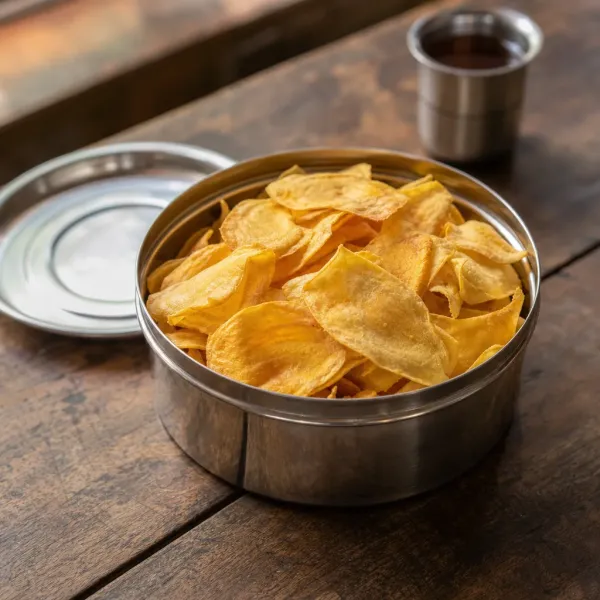
Chakka Varuthathu
Traditional Kerala recipe for raw jackfruit chips fried in coconut oil with a salt brine finish. Crisp, long-keeping, and made the old household way.
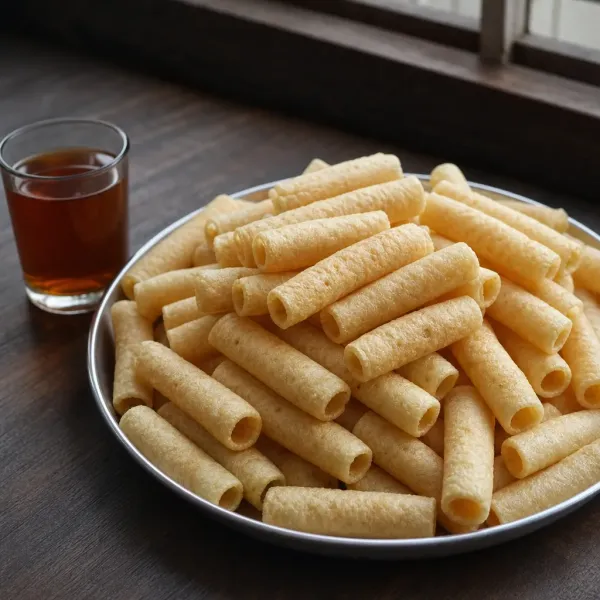
Kuzhalappam
Traditional Kerala kuzhalappam recipe: hollow rice crisps pressed through a tube mould and deep-fried in coconut oil with cumin and sesame.