

Kori Rotti: Mangalorean Crisp Rice Wafers with Chicken Gassi Recipe
Malayalam കോരി റൊട്ടിTamil கோரி ரொட்டிKannada ಕೋರಿ ರೊಟ್ಟಿTelugu కోరి రొట్టి
- Prep30 min
- Soak / ferment4 hr
- Cook1 hr 15 min
- Serves4
- DifficultyHard
- DietNon-vegetarian
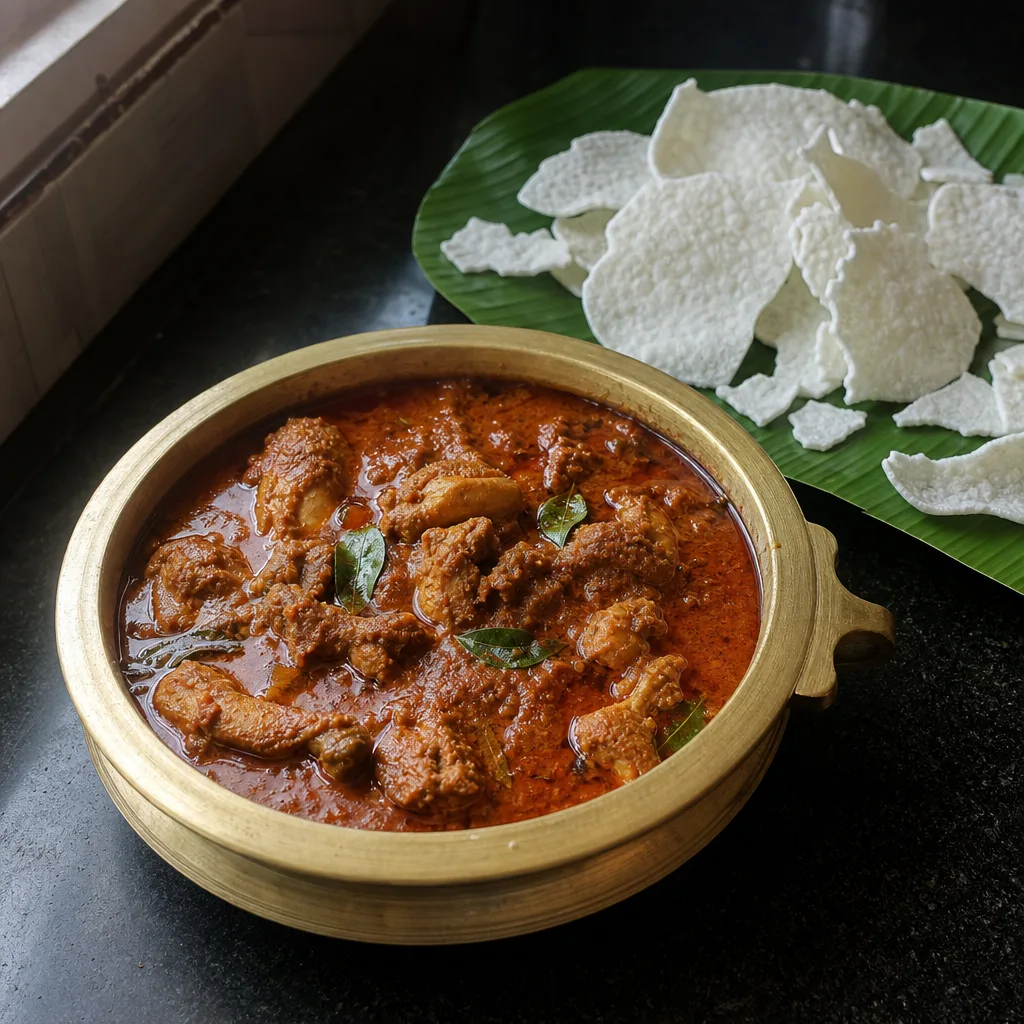
Kori Rotti is the defining festive dish of Tulu Nadu, the coastal strip around Mangalore and Udupi. Kori means chicken in Tulu, and rotti here means not a soft flatbread but a paper-thin, bone-dry rice wafer, brittle as a poppadom. The two are served together: the wafers are broken into the bowl of chicken gassi at the table, soaking up the deep red coconut gravy until they are just yielding at the edges but still have some give at the centre. The eating is immediate. You do not wait.
The gassi is a slow-cooked coconut curry built on a masala of roasted dry red chillies, coriander seeds, and freshly grated coconut. The sourness comes from tamarind. Coconut oil is used throughout, and the final tempering of shallots and curry leaves in coconut oil goes in at the end, not the beginning. The colour is a deep brick red from Byadgi chillies; the heat comes from a smaller proportion of Guntur or similar sharp chillies. This is not a pale or mild curry.
In Mangalorean homes, the rotti is almost always bought from specialist makers who dry the batter on large flat stones in the sun. Making it at home is a considerable undertaking and is done for weddings or when someone insists on the full traditional form. Both methods are described here. The gassi itself is the same either way.
Ingredients (serves 4)
For the kori rotti (rice wafers)
For the gassi masala (roasted and ground)
For the chicken gassi
Method
Soak the rice
Rinse the raw rice twice in cold water, then cover with fresh cold water and leave to soak for 4 hours at room temperature. The grains should feel soft enough to break between your fingers when they are ready. Drain thoroughly before grinding.
Grind the batter for the rotti
Grind the drained rice in a wet grinder or a powerful blender with just enough water to get it moving, adding water gradually. The finished batter must be very thin, thinner than dosa batter, almost like slightly thickened water. Season with salt. It should spread and run freely when you tilt the vessel.
Cook and dry the rotti
Heat a flat iron tawa or a wide non-stick pan over low heat. Pour a ladleful of batter and swirl it to a very thin, nearly translucent round, as wide as the pan allows. Cover and cook on the lowest possible heat for 3 to 4 minutes until the surface is completely dry to the touch and no wet patches remain. Lift it carefully onto a clean dry surface and leave it uncovered in a warm, airy spot. In a Mangalorean kitchen this would go onto a clean mat in the sun. Indoors, place them on a wire rack. They must dry completely, becoming rigid and brittle, which takes several hours or overnight. Make all the rounds and dry them before the meal.
Dry-roast the whole spices
Heat a small heavy pan over medium-low heat without any oil. Add the coriander seeds, cumin, peppercorns, fennel, cloves, and cinnamon. Roast, stirring constantly, for 2 to 3 minutes until fragrant and just beginning to darken. Tip into a plate and let them cool completely.
Roast the chillies and coconut
In the same pan, heat 1 tsp coconut oil over low heat. Add the Byadgi and Guntur chillies and press them gently against the pan for about 1 minute until they puff slightly and smell toasted but not burnt. Remove them. In the same oil, add the freshly grated coconut and stir continuously over low heat for 4 to 5 minutes until it turns a light golden brown and smells nutty. Do not let it go dark brown or the masala will turn bitter.
Grind the masala
Combine the roasted spices, roasted chillies, and toasted coconut in a grinder. Add the tamarind pulp and grind to a smooth, fine paste, adding a little water as needed. The paste should be deep red and completely smooth with no gritty coconut texture remaining. This takes 4 to 5 minutes in a table-top wet grinder; a blender will need longer and may not get it as smooth.
Build the gassi base
Heat 3 tbsp coconut oil in a heavy-bottomed pot or uruli over medium heat. Add the sliced shallots and cook, stirring, for 8 to 10 minutes until they are soft and beginning to colour at the edges. Add the crushed garlic and ginger and cook for 2 more minutes. Do not rush this stage; undercooked shallots leave a raw sharpness in the finished curry.
Add the masala and fry it
Add the ground masala paste to the pot and stir it into the shallot base. Fry over medium heat, stirring frequently, for 8 to 10 minutes. The masala will darken a shade, the oil will begin to separate at the edges, and the raw smell of chilli will give way to a roasted, rounded aroma. This step is what gives the gassi its depth.
Cook the chicken
Add the chicken pieces, turmeric, and salt. Stir to coat every piece in the masala. Add 300 ml water, stir once, and bring to a boil. Reduce the heat to a gentle simmer, cover, and cook for 25 to 30 minutes until the chicken is cooked through and the oil has risen to the surface. The gravy should be thick and richly coloured, not watery. If it looks thin, remove the lid and simmer for a further 5 minutes.
Temper and finish
In a small pan, heat the remaining 1 tbsp coconut oil over medium-high heat. Add the reserved shallots, sliced thin, and fry until they are crisp and deep brown, about 5 to 6 minutes. Add the curry leaves and let them crackle for 10 seconds. Pour this tempering over the gassi immediately and stir it in. Taste for salt. The curry is now ready.
Serve
Ladle the hot chicken gassi into individual bowls. Break the dried rotti into large irregular pieces and arrange them alongside or place them directly in the bowl at the table. The diner breaks more pieces into the gravy as they eat. The rotti should soften in the gravy within a minute or two of contact; it should not dissolve to mush. Serve immediately.
How to serve
The rotti is the accompaniment to the gassi and vice versa; they are served together as a single dish. Some households also set out plain steamed rice for those who want it alongside.
Served with: The rotti is the accompaniment to the gassi and vice versa; they are served together as a single dish. Some households also set out plain steamed rice for those who want it alongside.
Cook's tips
Buying rotti instead of making it
In Mangalore, dried kori rotti is sold in packets at grocery stores and is widely available online across India. The home-made method above is authentic but time-consuming. If you use bought rotti, skip steps 1 to 3. The quality of good commercial rotti is very close to home-made.
Byadgi chillies are not optional
Byadgi chillies give the gassi its characteristic deep red colour without excessive heat. Substituting only Kashmiri chillies will give a similar colour but a slightly different flavour. Do not use ordinary red chilli powder as a substitute for whole roasted chillies in this masala; the flavour will be flat.
Fresh coconut matters
Desiccated coconut will not give the same result. The moisture in fresh coconut is part of what makes the masala grind smoothly and coat the chicken properly. If fresh coconut is unavailable, frozen grated coconut (thawed and drained) is an acceptable substitute.
Do not cover the rotti after drying
Once the wafers are dry and brittle, store them in an open basket or loosely covered with a cloth, never in an airtight container while still warm. Any trapped moisture will make them go soft and they will not crisp up again.
The gassi the next day
The chicken gassi tastes better the next day once the spices have settled. Reheat gently over low heat with a splash of water. The rotti must always be fresh and crisp; do not assemble in advance.
Regional variations
Konkani Catholic (Goud Saraswat Brahmin) version uses the same gassi base with fish (kori becomes fish curry); some households add a small piece of bimbli (Averrhoa bilimbi) for sourness in place of or alongside tamarind.
Glossary
- Kori ಕೋರಿ
- Chicken in Tulu, the Dravidian language of coastal Karnataka.
- Rotti ರೊಟ್ಟಿ
- In this context, a paper-thin, sun-dried rice wafer, not a soft flatbread.
- Gassi ಗಸ್ಸಿ
- A Tulu word for a coconut-based curry, typically made with a roasted spice and coconut masala.
- Byadgi ಬ್ಯಾಡಗಿ
- A variety of dried red chilli from Byadgi town in Haveri district, Karnataka, prized for deep colour and mild heat.
- Uruli ഉരുളി
- A wide, shallow brass or bell-metal cooking vessel used across Kerala and coastal Karnataka.
- Tawa ತವಾ
- A flat iron griddle used for cooking flatbreads and thin pancakes.
Two things decide this dish. The masala must be roasted long enough and ground fine enough; if the coconut is under-toasted or the paste is gritty, the gassi will taste raw and thin. And the rotti must be completely, utterly dry before it meets the curry. Any softness in the wafer before serving means it will dissolve rather than soak, and the whole pleasure of the dish is in that brief moment when the crisp wafer yields just enough in the hot gravy.
More Breads & Staples recipes
Jolada Rotti
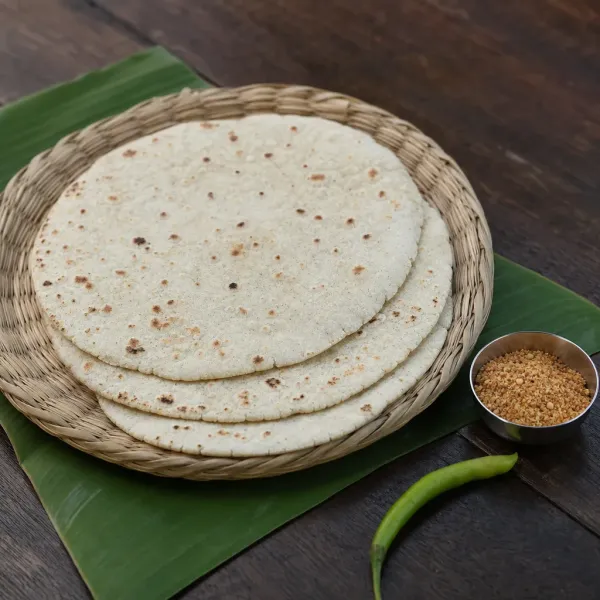
Authentic North Karnataka jolada rotti made with jowar flour and boiling water, shaped by hand on a damp cloth and finished over an open flame. Vegan…
Kothu Parotta with Egg and Masala
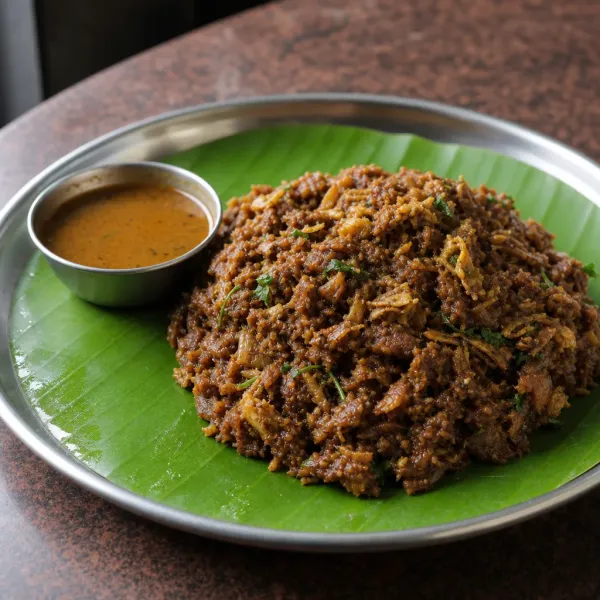
Authentic Tamil Nadu kothu parotta with egg and shallot masala. Traditional tawa method, gingelly oil, step-by-step for home cooks.
Coin Parotta
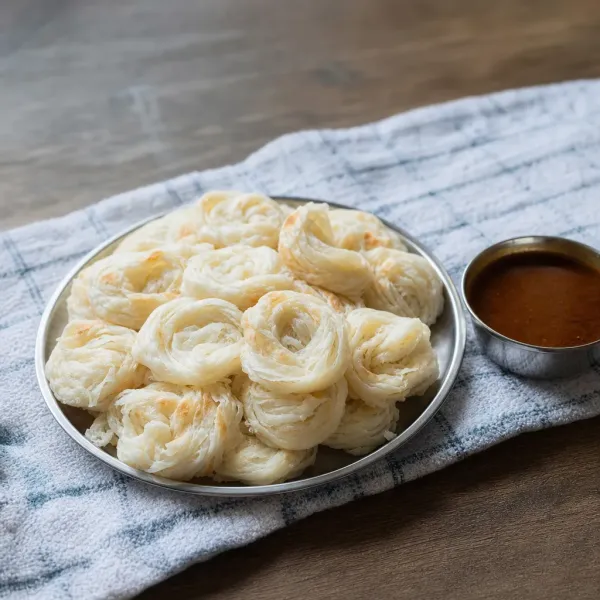
Traditional Tamil Nadu coin parotta: maida dough coiled for flaky layers, cooked on a tawa, sliced into rounds, beaten and tossed. Step-by-step home…
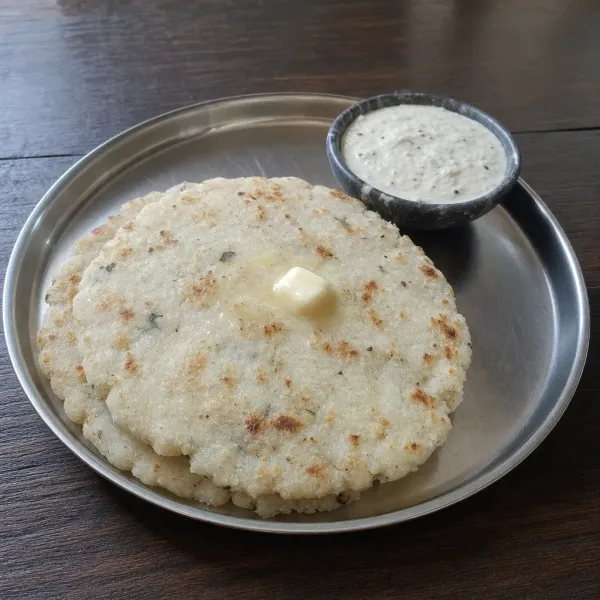
Akki Roti
Authentic Karnataka akki roti with dill, shallots and cumin, patted by hand on a cold tawa. Traditional household method with step-by-step instructio…
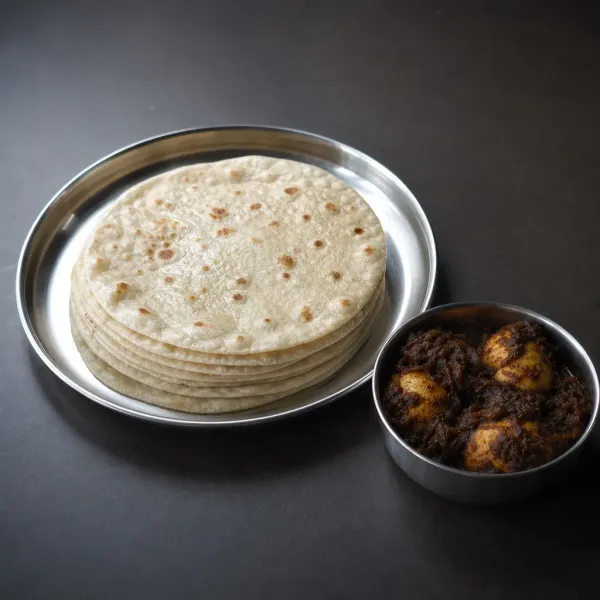
Chapati
Traditional Mappila chapati from Malabar Kerala: soft whole wheat flatbread cooked on a hot tawa with coconut oil, eaten with egg roast or beef curry.
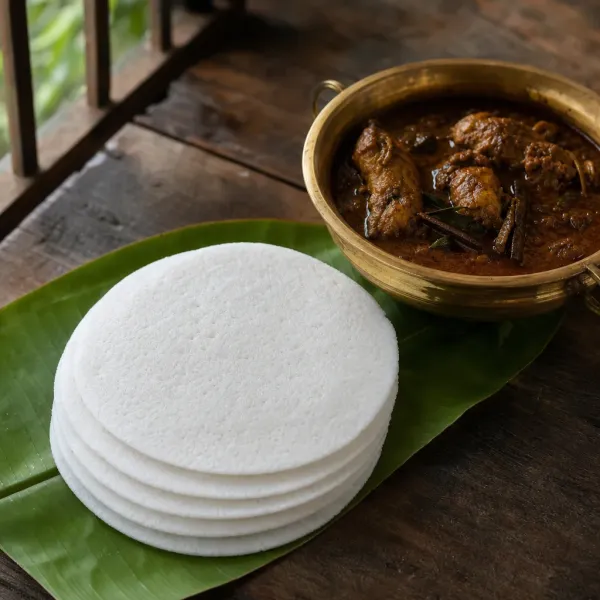
Pathiri
Traditional Mappila pathiri from Malabar: thin, soft, white rice flour flatbread cooked dry on a tawa. Step-by-step Kerala home recipe.