

Jolada Rotti Recipe
Malayalam ജോളദ ರೊಟ್ಟಿTamil ஜோளட ரொட்டிKannada ಜೋಳದ ರೊಟ್ಟಿTelugu జొన్న రొట్టె
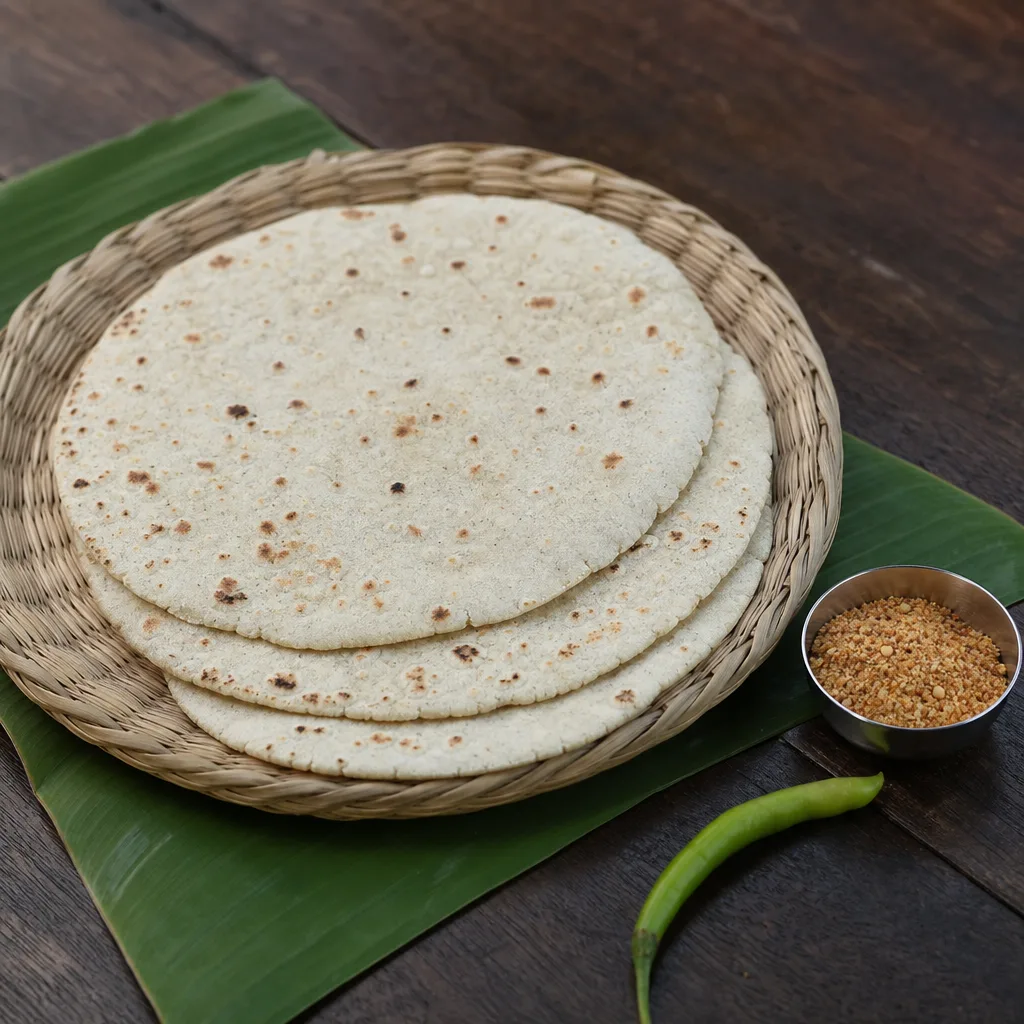
- Prep20 min
- Cook30 min
- Serves4
- DifficultyMedium
- DietVegan
Jolada rotti is the daily bread of northern Karnataka, made from white jowar flour and nothing else but hot water and a little salt. It belongs to the farming households of the Dharwad, Gadag, Bijapur and Belagavi districts, where jowar — called jola in Kannada — has been the staple grain for centuries. Wheat roti and rice are relative newcomers to these tables; jolada rotti is what the household wakes up to make.
The rotti is shaped entirely by hand. There is no rolling pin, no belan, no chakla. A ball of warm dough is pressed and slapped out on a wet cloth or a piece of banana leaf until it is thin enough to see light through at the edges. This takes practice. New cooks often get the dough too stiff or too wet, and the rotti cracks before it can be lifted. The dough must be worked while it is still warm, which is why the flour is scalded with boiling water rather than mixed with cold.
At the table it is eaten with enne (groundnut oil or pure ghee depending on the household), and almost always with yellu-shengdana chutney, a coarse dry chutney of sesame and peanuts, or with a spiced brinjal or green chilli curry. Some households eat it with curds and raw onion. In the fields it is carried wrapped in a cloth, stacked with a smear of ghee between each rotti, and eaten cold at midday without any accompaniment at all.
Ingredients (serves 4)
For the rotti
Method
Bring the water to a full boil
Pour 270 ml of water into a small vessel and bring it to a rolling boil. You need it truly boiling, not merely hot — the heat is what gelatinises the starch and makes the dough pliable. Keep the remaining 30 ml boiling in reserve.
Scald the flour
Put the jowar flour and salt into a wide vessel — a steel parat or a broad-mouthed vessel works well. Pour the boiling water over the flour in one steady stream while stirring quickly with a wooden spoon or the handle of a ladle. Mix until there are no dry patches. The mixture will look shaggy and steam will rise from it. Cover it and leave it for two minutes so the steam finishes the job.
Knead the dough while it is hot
Once it is cool enough to handle — still quite warm, not cool — knead the dough firmly with your knuckles and palm. It should come together into a smooth, non-sticky ball in about two to three minutes. If it cracks at the edges when you press it, add a splash of boiling water, a teaspoon at a time, and knead again. The dough is ready when it feels like soft clay and does not crack when you fold it.
Divide and cover
Divide the dough into six equal portions, each roughly the size of a large lime, about 90 g each. Roll each into a smooth ball and keep them covered with a damp cloth. Jowar dough dries quickly and will crack if left open.
Prepare your shaping surface
Wet a clean cotton cloth — a thin muslin or an old cotton tea towel — and wring it out so it is damp but not dripping. Lay it flat on the counter. Alternatively, use the smooth side of a fresh banana leaf, lightly dampened. This surface prevents the rotti from sticking while you pat it out.
Pat out the rotti by hand
Place one ball of dough at the centre of the damp cloth. With your fingertips and palm, press and pat it outward in a circular motion, rotating the cloth as you go. Work from the centre outward. The rotti should reach about 20 to 22 cm across and be uniformly thin — around 2 mm — with edges that are only slightly thicker than the centre. If the edges crack, wet your fingertips lightly and press the cracks closed. Do not rush this; a rotti patted in under a minute will be uneven.
Prick the centre
Use your fingertip or a fork to make a few small holes in the centre of the rotti. This prevents it from puffing unevenly on the tawa.
Heat the tawa
Place a heavy iron tawa over medium-high heat and let it get thoroughly hot. A drop of water should evaporate immediately on contact. Do not grease the tawa.
Transfer the rotti to the tawa
Lift the cloth and invert the rotti onto the hot tawa in one confident motion, pressing the cloth gently so the rotti adheres to the surface, then peel the cloth away. If any part sticks to the cloth, press it back down quickly with a damp finger. Cook on this first side for about 90 seconds over medium-high heat, until the surface looks dry and matte and the underside has pale golden patches — not brown, not charred.
Flip and finish
Flip the rotti carefully using a flat spatula. Cook the second side for 60 to 90 seconds. Then, using tongs, lift the rotti and hold it directly over the open flame for five to eight seconds per side, turning once, until small brown spots appear and the rotti firms up slightly. This last step on the flame is what gives jolada rotti its characteristic slight char and makes it hold together without becoming brittle.
Rest and stack
Place the finished rotti on a clean cloth or a rotti basket and cover it immediately. This traps steam and keeps it soft. If you are making a stack, a thin smear of groundnut oil or ghee between each rotti will keep them from sticking and drying out.
Shape and cook the remaining rotties
Repeat steps 6 to 11 with the remaining dough balls, re-wetting the cloth each time before you pat a new rotti. Serve as soon as possible; jolada rotti is best eaten within twenty minutes of coming off the tawa.
How to serve
Groundnut-sesame dry chutney (yellu-shengdana chutney), or a spiced green chilli and brinjal curry (badanekayi ennegayi), with raw onion and a smear of groundnut oil or ghee. Many households also serve it with plain curds.
Served with: Groundnut-sesame dry chutney (yellu-shengdana chutney), or a spiced green chilli and brinjal curry (badanekayi ennegayi), with raw onion and a smear of groundnut oil or ghee. Many households also serve it with plain curds.
Cook's tips
The dough must stay warm
Jowar has no gluten. The only thing holding this dough together is gelatinised starch, which loses its plasticity as it cools. If the dough stiffens and starts cracking before you have finished shaping, place the remaining balls in a small vessel set over a pot of hot water to keep them warm.
Flour quality matters more than in wheat roti
Freshly milled, fine jowar flour makes a noticeably more pliable dough. Flour that has sat in a packet for months will absorb water differently and crack more easily at the edges. Buy from a mill that turns over stock quickly, or grind your own if you have access to a chakki.
The cloth trick vs. rolling on the tawa
Some experienced cooks skip the cloth entirely and pat the rotti directly onto the cold tawa, then set it over the heat. This requires confidence and speed. The cloth method described here is more forgiving for home cooks learning the technique.
No open flame on an induction cooktop
The final flame-finishing step cannot be done on induction. Instead, press the rotti firmly against the hot tawa with a folded cloth for the last minute of cooking to get some colour and firmness. It is not identical, but it is acceptable.
Storing leftover rotti
Jolada rotti does not keep well. It dries and becomes brittle within a few hours. If you must store it, wrap tightly in a damp cloth and reheat on a tawa with a few drops of water. It will never be as good as fresh.
Regional variations
In the Bidar and Gulbarga belt the rotti is sometimes thicker and cooked on an open flame after the tawa; in parts of Belagavi a small amount of finely chopped onion and green chilli is worked into the dough for a version called eerulli jolada rotti.
Glossary
- Jola / Jolada ಜೋಳ
- Jowar (sorghum); the word jolada is the genitive form, meaning 'of jowar', used in compound words like jolada rotti.
- Rotti ರೊಟ್ಟಿ
- Flatbread; the Kannada word for a flat, unleavened bread cooked on a tawa, distinct from the Hindi roti in shape and technique.
- Hittu ಹಿಟ್ಟು
- Flour; jolada hittu means jowar flour.
- Parat परात
- A wide, shallow steel or brass tray used for mixing and kneading dough; common across South and North Indian kitchens.
- Ennegayi ಎಣ್ಣೆಗಾಯಿ
- Literally 'oil vegetable'; a North Karnataka style of brinjal or other vegetable cooked in a generous amount of groundnut oil with spices, a classic accompaniment to jolada rotti.
- Yellu-shengdana chutney ಎಳ್ಳು-ಶೇಂಗಾ ಚಟ್ನಿ
- A dry coarse chutney of roasted sesame seeds and peanuts, ground with dried red chilli and garlic; a staple condiment in North Karnataka homes.
Two things decide whether jolada rotti works: the water must be truly boiling when it hits the flour, and the dough must be shaped while it is still warm. Get those two right and the rotti will be pliable enough to pat thin and sturdy enough to lift off the tawa in one piece. Rush either step and the dough will crack, and no amount of extra water will rescue it once it has cooled.
More Breads & Staples recipes
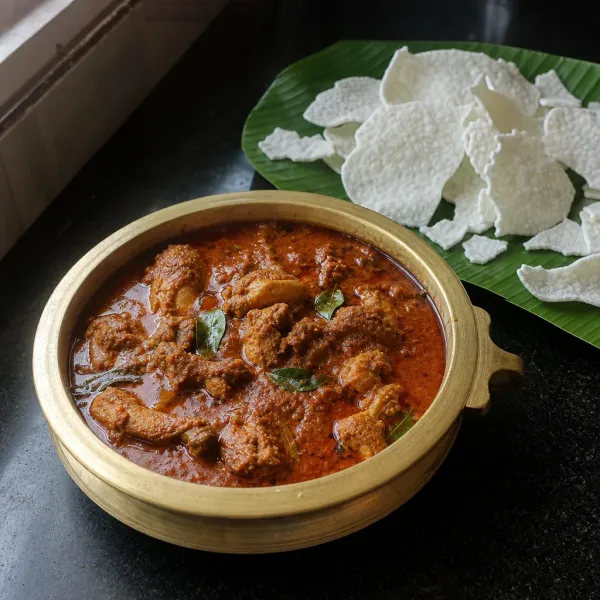
Kori Rotti: Mangalorean Crisp Rice Wafers with Chicken Gassi
Traditional Tulu-style kori rotti from coastal Karnataka: crisp dried rice wafers served with deep red coconut chicken gassi. Home recipe with fresh-…
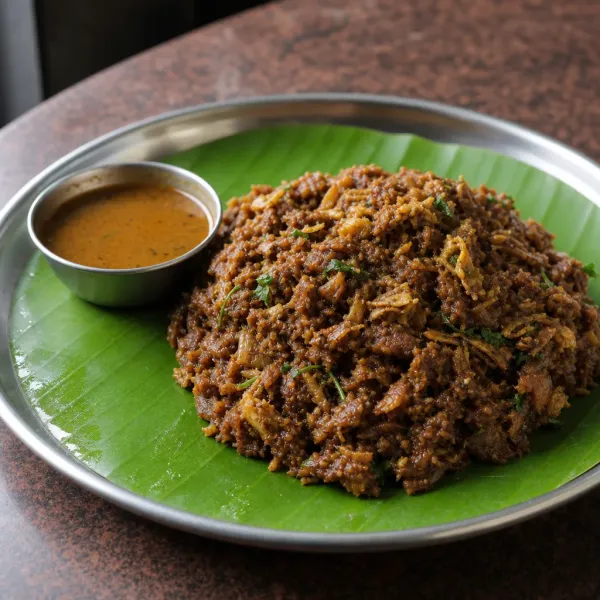
Kothu Parotta with Egg and Masala
Authentic Tamil Nadu kothu parotta with egg and shallot masala. Traditional tawa method, gingelly oil, step-by-step for home cooks.
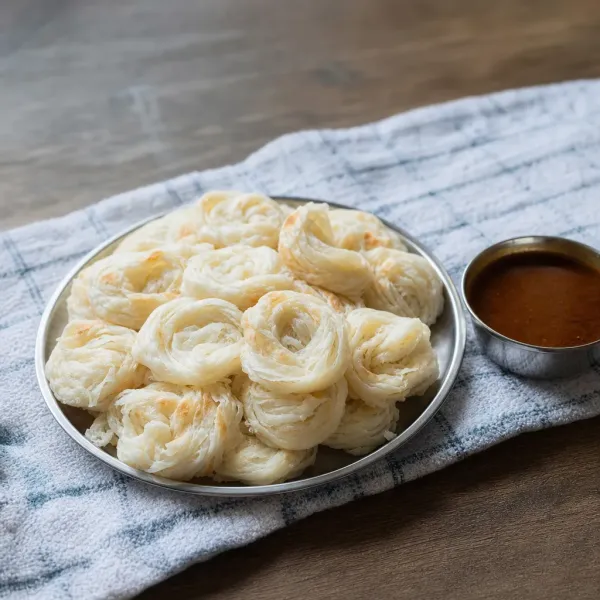
Coin Parotta
Traditional Tamil Nadu coin parotta: maida dough coiled for flaky layers, cooked on a tawa, sliced into rounds, beaten and tossed. Step-by-step home…
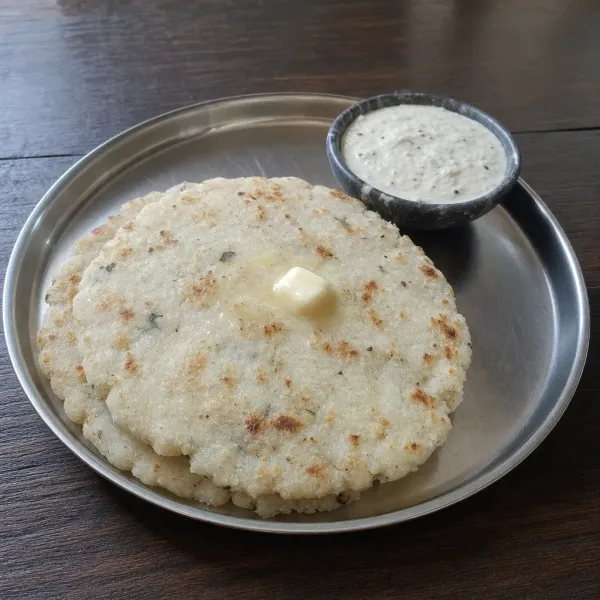
Akki Roti
Authentic Karnataka akki roti with dill, shallots and cumin, patted by hand on a cold tawa. Traditional household method with step-by-step instructio…
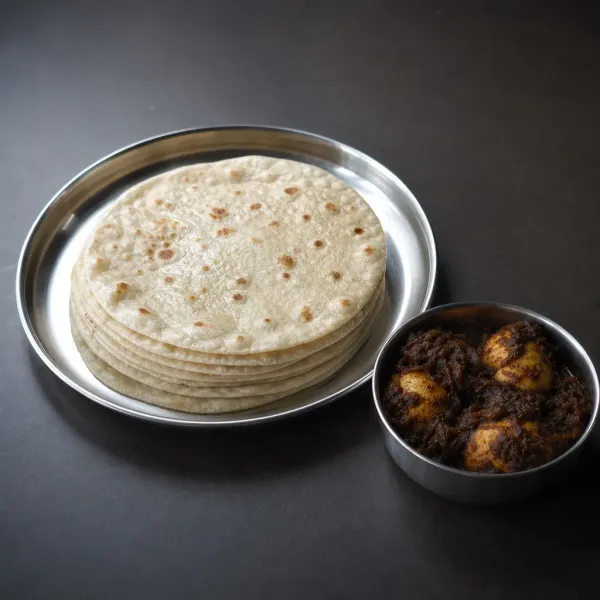
Chapati
Traditional Mappila chapati from Malabar Kerala: soft whole wheat flatbread cooked on a hot tawa with coconut oil, eaten with egg roast or beef curry.
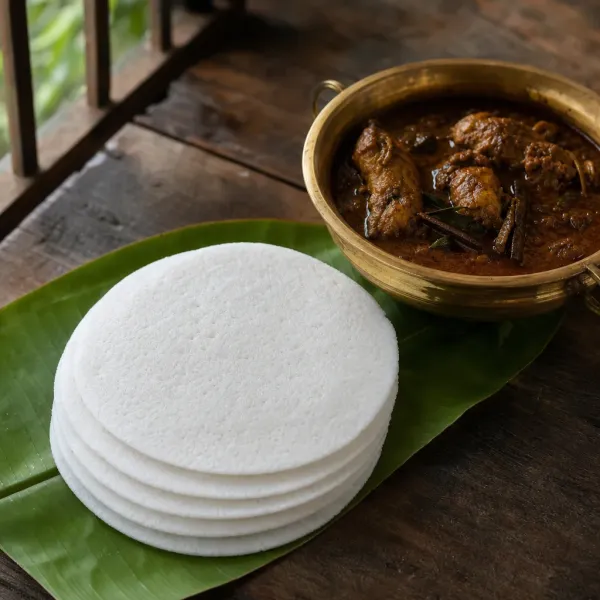
Pathiri
Traditional Mappila pathiri from Malabar: thin, soft, white rice flour flatbread cooked dry on a tawa. Step-by-step Kerala home recipe.