

Gongura Pachadi Recipe
Malayalam ഗോംഗുര പച്ചടിTamil கொங்குர பச்சடிKannada ಗೊಂಗೂರ ಪಚ್ಚಡಿTelugu గోంగూర పచ్చడి
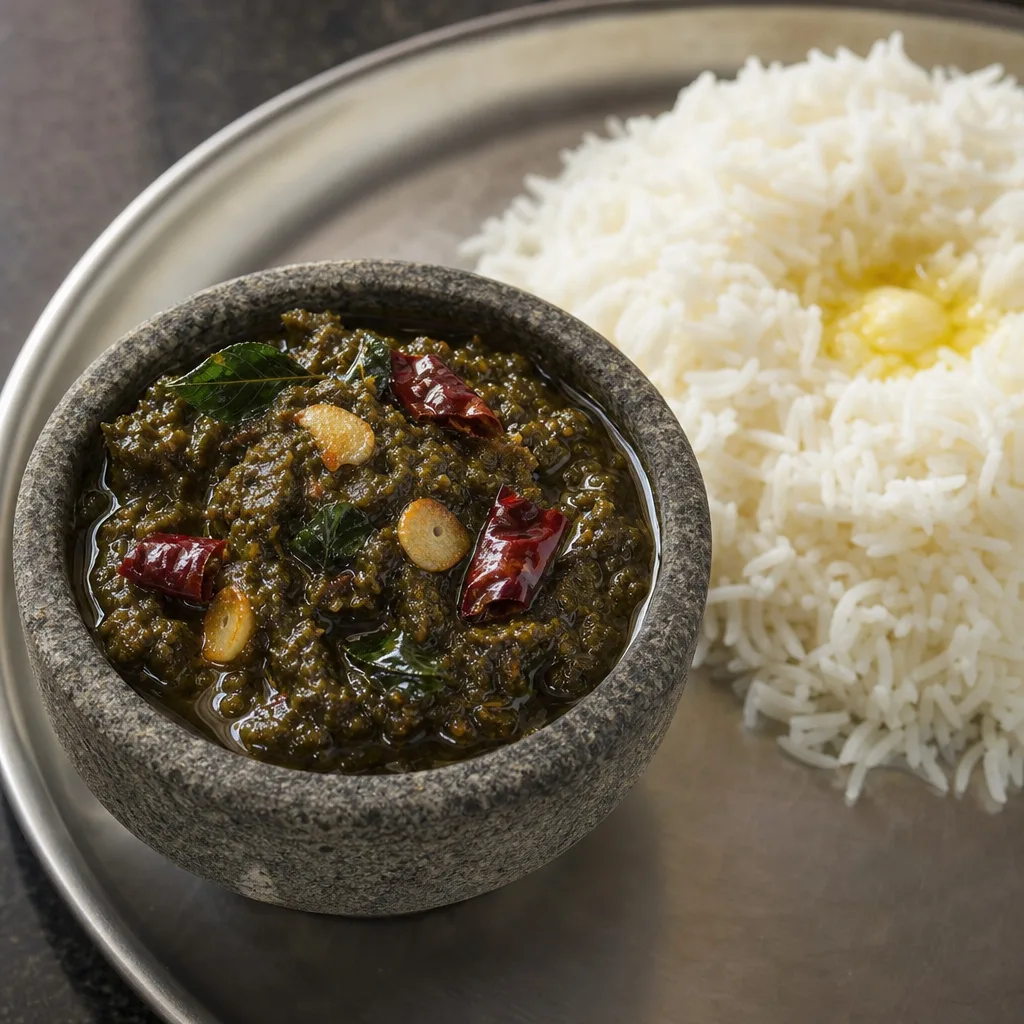
- Prep15 min
- Cook25 min
- Serves6
- DifficultyEasy
- DietVegan
Gongura pachadi is the one chutney that defines Andhra cooking more than any other. The leaf is red sorrel, known in Telugu as gongura, and its sharp, mouth-puckering sourness is the point of the dish, not something to be softened. In Rayalaseema households it is ground coarse, not smooth, and the heat from a generous hand of dried red chillies sits right alongside that sourness without either one retreating.
It is eaten at almost every meal in the season when gongura is fresh and plentiful, spooned alongside rice and ghee, or used as a relish with roti. Households that grow the red-stemmed variety consider it more sour and more desirable than the green-stemmed kind. The two are not interchangeable in flavour, though both are used.
The method is simple but the sequence matters. The leaves must be wilted and their moisture driven off before grinding, otherwise the pachadi turns watery within hours. The tempering goes in last, hot and sizzling, and you fold it through rather than stir it smooth. It keeps for two or three days at room temperature in a cool kitchen, and longer in the refrigerator, though it is always best the day it is made.
Ingredients (serves 6)
For the pachadi
For the tempering
Method
Dry-roast the red chillies
Set a heavy iron or thick-bottomed pan over medium heat. Add the 10 dried red chillies with no oil and roast, turning often, for about 2 minutes until they darken slightly and smell toasty. Do not let them blacken or the pachadi will taste bitter. Tip them out onto a plate to cool.
Roast the garlic
In the same dry pan, add the 6 unpeeled garlic cloves and roast over medium heat for 4 to 5 minutes, turning occasionally, until the skins are charred in patches and the cloves feel soft when pressed. The skin protects the garlic from burning while the inside steams through. Set aside to cool, then peel.
Wilt the gongura leaves
Add the washed gongura leaves to the same dry pan over medium heat. No oil, no water. Stir continuously for 4 to 5 minutes until the leaves collapse completely, release their moisture, and the pan looks almost dry again. This step is not optional: leaves with moisture left in them will make a watery pachadi that does not keep. The colour will shift from bright green-red to a dull olive.
Cool everything before grinding
Spread the wilted leaves on a plate and let the leaves, chillies and garlic all come to room temperature. Grinding hot ingredients in a stone grinder or mixer jar creates steam that makes the texture gluey. Give it at least 10 minutes.
Grind to a coarse paste
Place the cooled red chillies in a stone grinder or mixer jar and grind them first to a rough powder. Add the peeled roasted garlic and grind briefly. Add the wilted gongura leaves and salt, then grind in short pulses to a coarse, slightly chunky paste. Add no water. The texture should hold its shape on a spoon, not flow. Taste and adjust salt.
Make the tempering
Heat the gingelly oil in a small pan over medium-high heat until it shimmers. Add the mustard seeds and wait for them to pop fully, about 30 seconds. Add the broken dried red chillies and sliced garlic and fry until the garlic turns pale gold at the edges, about 1 minute. Add the curry leaves — stand back, they will splutter — and the asafoetida. Fry for 20 seconds more.
Fold the tempering through the pachadi
Pour the hot tempering directly over the ground gongura paste. Fold it through with a spoon two or three times so the oil and aromatics are distributed but the texture stays coarse. Do not stir it smooth. Taste once more for salt. The pachadi is ready to serve immediately or within the hour.
How to serve
Hot plain rice with a spoonful of ghee; also eaten with roti or as a relish alongside dal and rice.
Served with: Hot plain rice with a spoonful of ghee; also eaten with roti or as a relish alongside dal and rice.
Cook's tips
Red-stemmed versus green-stemmed gongura
Red-stemmed gongura is noticeably more sour than the green-stemmed variety. If you can only find green-stemmed, you may need to increase the quantity slightly to get the same punch. Do not mix varieties in one batch.
Moisture is the enemy
If the leaves are not dried out properly in step 3, the pachadi will be watery by the next day. When you think the pan looks dry, give it one more minute. The leaves should look almost paste-like in the pan before you take them off.
Chilli heat
Ten Guntur chillies makes a very hot pachadi, which is traditional. If your household finds that level difficult, reduce to six, but do not go below that or the balance with the sourness is lost.
Storage
Store in a clean dry jar. It keeps 2 to 3 days at cool room temperature and up to a week in the refrigerator. Always use a dry spoon. The sourness intensifies slightly on the second day, which many people prefer.
Oil choice
Gingelly oil is correct here. Coconut oil changes the character of the dish completely. If gingelly oil is unavailable, a neutral oil is a lesser substitute, but the nuttiness that balances the sourness will be missing.
Regional variations
Telangana version uses more garlic and adds fried urad dal to the tempering; Coastal Andhra version is sometimes made with green chillies alone and has a slightly looser texture.
Glossary
- Gongura గోంగూర
- Red sorrel leaf (Hibiscus sabdariffa or Rumex vesicarius depending on the variety); the defining souring ingredient of Andhra cooking.
- Pachadi పచ్చడి
- A Telugu term for a fresh relish or chutney, distinct from a pickle; usually ground and eaten the same day.
- Inguva ఇంగువ
- Asafoetida in Telugu; used in small quantities in the tempering to round the flavour.
- Gingelly oil నువ్వుల నూనె
- Cold-pressed sesame oil; the traditional cooking fat for chutneys and kuzhambu across Tamil Nadu and Andhra Pradesh.
Two things decide whether this pachadi works: the leaves must be completely dry before grinding, and the chilli quantity must be high enough to meet the sourness of the gongura on equal terms. Get those two right and the rest follows.
More Chutneys, Podis & Pickles recipes
Ellu Podi (Sesame Seed Powder)
Traditional Tamil Iyer ellu podi made with white sesame, dried red chillies, urad dal and asafoetida. Dry-roasted and coarsely ground. Ready in 20 mi…
Chemmeen Achar
Traditional Kerala Mappila prawn pickle with coconut oil, shallots, vinegar and whole spices. Keeps for weeks. Step-by-step household recipe.
Paruppu Thogayal
Traditional Tamil Iyer paruppu thogayal: roasted toor dal, dried red chilli, fresh coconut and asafoetida ground coarse. Mixed into hot rice with gin…
Homemade Rasam Podi (Iyer-Style Tamil Brahmin Rasam Powder)
Traditional Tamil Brahmin rasam powder, dry-roasted spice by spice. Peppery, fragrant, made fresh at home. Keeps 4 to 6 weeks.
Tomato Pachadi
Traditional Kerala tomato pachadi with fresh coconut paste and curd. A Travancore sadya side dish ready in 30 minutes. Step-by-step recipe.
Poondu Podi
Traditional Kongunad poondu podi recipe: garlic, urad dal, chana dal and dry red chillies roasted in gingelly oil and ground to a coarse spice powder…