

Kerala Fish Fry (Meen Varuthathu) Recipe
Malayalam മീൻ വറുത്തത്Tamil மீன் வறுவல்Kannada ಮೀನು ಫ್ರೈTelugu చేప వేపుడు
- Prep20 min
- Soak / ferment1 hr
- Cook20 min
- Serves4
- DifficultyEasy
- DietNon-vegetarian
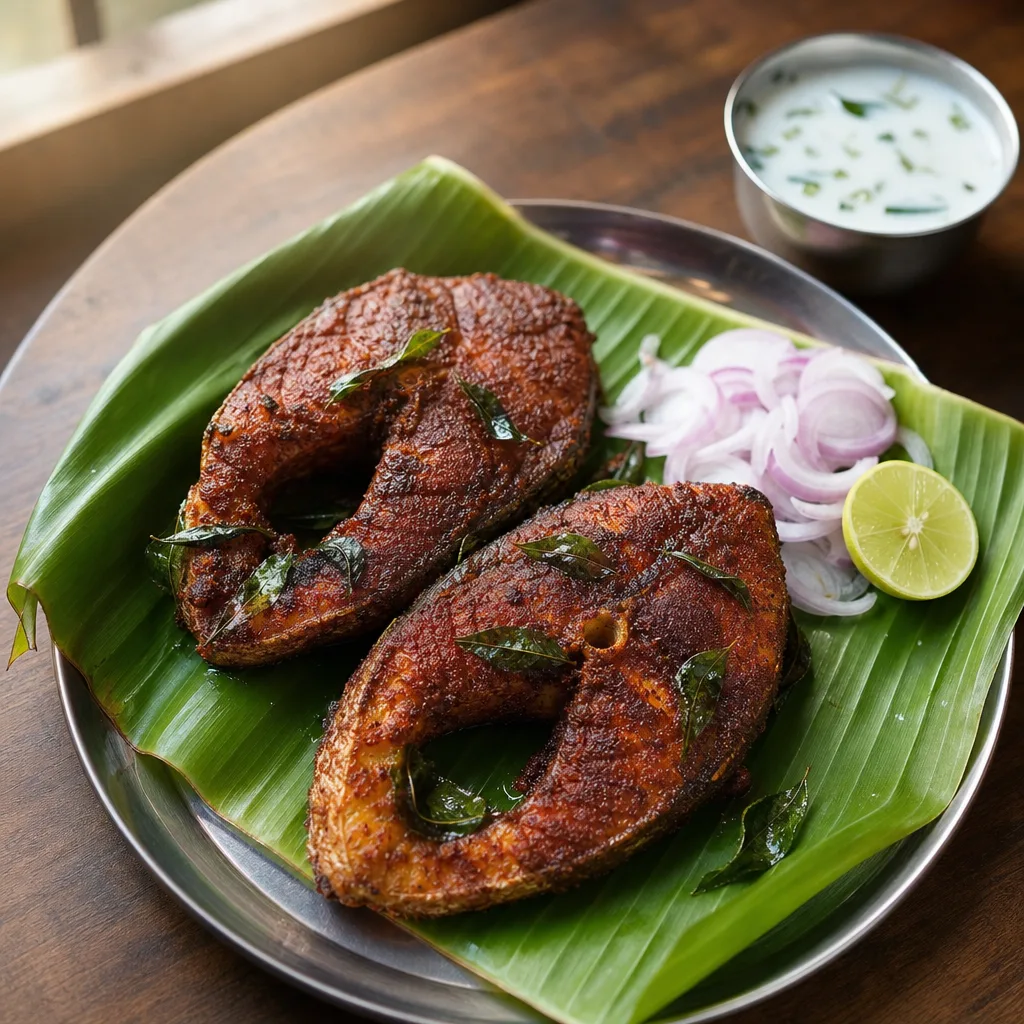
In Malabar Muslim households, meen varuthathu is less a recipe than a reflex. Most evenings there is fish at the table, and this is the preparation that requires the least ceremony while delivering the most satisfaction. The marinade is built on Kashmiri chilli for body and colour, fresh green chilli for bite, and a small amount of kudampuli-soaked water for the faint sourness that rounds everything out. A tawa over moderate heat does the work.
The fish of choice is king fish (neymeen) cut into steaks, though pearl spot (karimeen), red snapper, or any firm-fleshed sea fish works well. Soft fish like tilapia will fall apart at the edges, so avoid them here. The coating must be thin, just enough to grip the flesh, not a thick crust. If it looks like a battered fry, the marinade has been applied too heavily.
Households differ mainly on the souring agent. Purists use kudampuli water. Some coastal homes use a small squeeze of lime at the very end, added off the heat. A few families include a little freshly ground coconut paste to help the marinade cling, though this is not universal. The fat is always coconut oil, refined or raw depending on what the family keeps.
Ingredients (serves 4)
Fish
Marinade
For frying
Method
Soak the kudampuli
Place the kudampuli pieces in 3 tbsp of warm water and leave for 20 minutes. Squeeze the pieces firmly to release all the souring liquid, then discard the pulp. You need 2 tbsp of this dark, tart water for the marinade. Do not use more or the fish will taste sour rather than rounded.
Grind the green chilli paste
Pound the green chillies in a mortar with a pinch of salt until you have a coarse, fibrous paste. A blender will make it too watery. Keep the texture rough so the heat is not uniformly distributed across the fish.
Mix the marinade
In a wide, flat bowl, combine the Kashmiri chilli powder, red chilli powder, turmeric, black pepper, grated ginger, garlic paste, green chilli paste, kudampuli water, and salt. Mix well. The paste should be thick enough to coat the back of a spoon. If it looks thin, the marinade will slide off the fish; let it sit for two minutes and it will thicken slightly.
Coat and rest the fish
Dry the fish steaks thoroughly with a clean cloth. Any moisture on the surface will cause the marinade to slip off and the oil to spit violently during frying. Rub the marinade onto each steak, pressing it into any crevices and onto the cut edges. Lay the pieces in the same flat bowl, cover with a plate, and leave at room temperature for at least one hour. In a hot kitchen, do this in a cool corner away from the stove.
Heat the tawa
Set a flat iron tawa over medium heat and let it get genuinely hot before adding the oil. A cold tawa is the main reason fish sticks. Hold your palm 5 cm above the surface; it should feel uncomfortable within two seconds. Add the coconut oil and swirl to coat the surface.
Add curry leaves and lay in the fish
Drop the curry leaves into the hot oil and let them crackle for ten seconds. Then place the fish steaks on the tawa without crowding them. If the pan is right-sized, two or three steaks at a time. They should sizzle firmly when they touch the oil, not sit in silence. Silence means the tawa is not hot enough; silence means the fish will steam rather than sear.
Fry the first side
Do not touch the fish for four minutes. The marinade needs time to set and form a crust. After four minutes, try to lift one steak at the corner with a flat spatula. If it releases cleanly, it is ready to turn. If it resists, leave it another minute. Forcing it off early tears the crust. The bottom should be a deep terracotta-red, not black.
Turn and fry the second side
Flip each steak carefully and press down gently with the spatula. Fry the second side for three to four minutes. The fish is cooked when the flesh is opaque all the way through and lifts easily from the bone. King fish steaks at 2 cm take about eight minutes total. Do not keep flipping; two turns is all this fry needs.
Drain and rest briefly
Lift the fish onto a plate lined with brown paper or newspaper for thirty seconds to absorb excess oil. Do not stack the pieces or the crust softens under the steam. Serve immediately. This is a fry that does not wait well.
How to serve
Matta rice (red parboiled rice) and a soupy dal or fish curry on the side. At the Mappila table, often accompanied by kachiya moru (tempered buttermilk). Sliced shallots and lime halves may be placed alongside as a table condiment.
Served with: Matta rice (red parboiled rice) and a soupy dal or fish curry on the side. At the Mappila table, often accompanied by kachiya moru (tempered buttermilk). Sliced shallots and lime halves may be placed alongside as a table condiment.
Cook's tips
Kudampuli versus lime
Kudampuli gives a slow, dark sourness that lime cannot replicate. If you genuinely cannot find it, use 1 tsp of tamarind paste dissolved in 2 tbsp water, though the flavour profile will shift. Do not simply use lime juice in the marinade; it makes the flesh soft.
Why the fish sticks
Two causes: the tawa was not hot enough before the oil went in, or the fish was not dry. Moisture between the marinade and the pan creates steam that prevents crust formation. Pat the fish twice if necessary.
Fish to use
King fish (neymeen) is the standard choice in Malabar. Pearl spot (karimeen) works well whole, scored on both sides. Red snapper, seer fish, and pomfret are all acceptable. Avoid any fish with very soft flesh; it will break on the tawa.
Marinating overnight
Many households marinate overnight in the refrigerator, covered. Bring the fish to room temperature for 30 minutes before frying. Cold fish on a hot tawa lowers the surface temperature and causes sticking.
Oil quantity
This is a tawa fry, not a deep fry. The oil should pool slightly in the pan, roughly 3 to 4 mm deep. Too little and the marinade burns on the dry metal before the fish cooks through. Too much and you lose the char that distinguishes this from a shallow-poached fish.
Regional variations
Travancore Hindu and Nasrani households use the same marinade base but often add a pinch of turmeric-heavy paste and fry in coconut oil on a curved iron cheenachatti rather than a flat tawa; Chettinad meen varuval uses kalpasi and stone-ground masala with gingelly oil.
Glossary
- Neymeen നെയ്മീൻ
- King fish or seer fish; the preferred fish for tawa fry along the Malabar coast.
- Kudampuli കുടംപുളി
- Malabar tamarind (Garcinia cambogioides); a dried rind used as souring agent in Kerala coastal cooking, particularly in fish preparations.
- Karimeen കരിമീൻ
- Pearl spot fish (Etroplus suratensis); a freshwater fish widely eaten in Kerala, particularly in backwater regions.
- Matta rice മട്ട അരി
- Red parboiled rice from Palakkad; the everyday table rice of Kerala households.
- Meen varuthathu മീൻ വറുത്തത്
- Literally 'fried fish'; the general term for pan-fried or tawa-fried fish in Malayalam.
- Kachiya moru കാച്ചിയ മോര്
- Buttermilk tempered with mustard, dry red chilli and curry leaves; a common accompaniment at the Kerala table.
Two things decide whether this fry works. The tawa must be genuinely hot before the fish touches it, because that is what sets the crust and prevents sticking. And the fish must be completely dry before the marinade goes on, because surface moisture is the enemy of the sear. Get those two right and the rest follows.
More Non-Vegetarian recipes
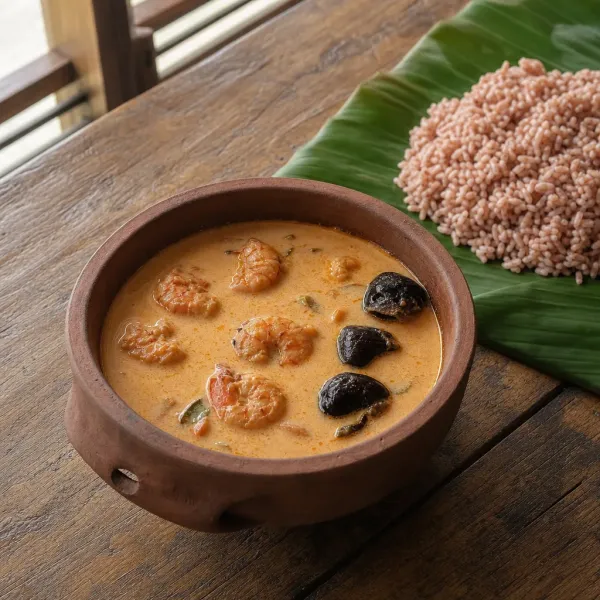
Kerala Prawn Curry with Coconut Milk
Traditional Travancore Nasrani prawn curry made with fresh coconut milk, kudampuli and shallots in an earthenware chatty. Step-by-step household reci…
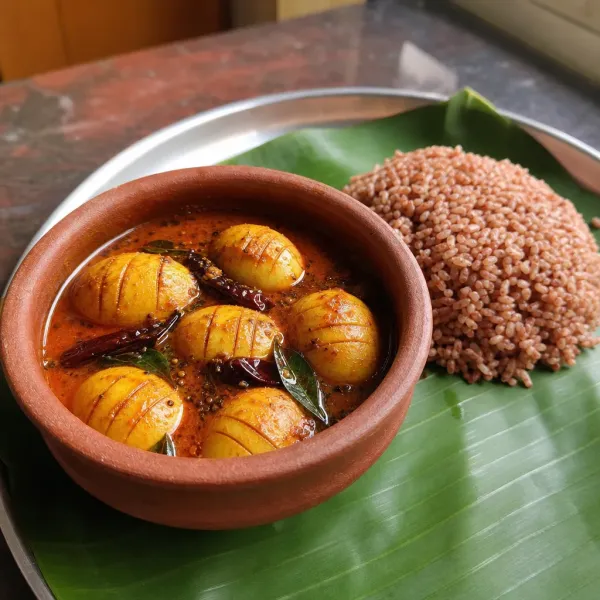
Mutta Curry
Traditional Kerala Nasrani mutta curry with kudampuli, shallots, and coconut milk. Step-by-step home recipe with exact quantities and cook's notes.
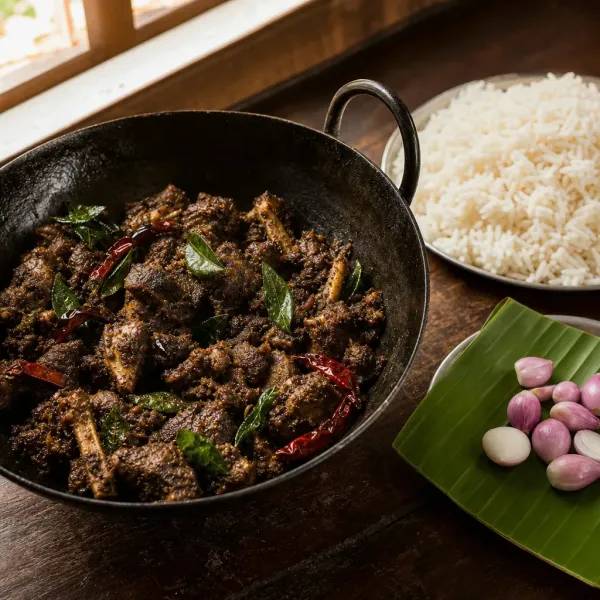
Mutton Chukka Varuval
Authentic Chettinad mutton chukka varuval with freshly ground kalpasi-marathi mokku masala, roasted dry in gingelly oil. Traditional household method.
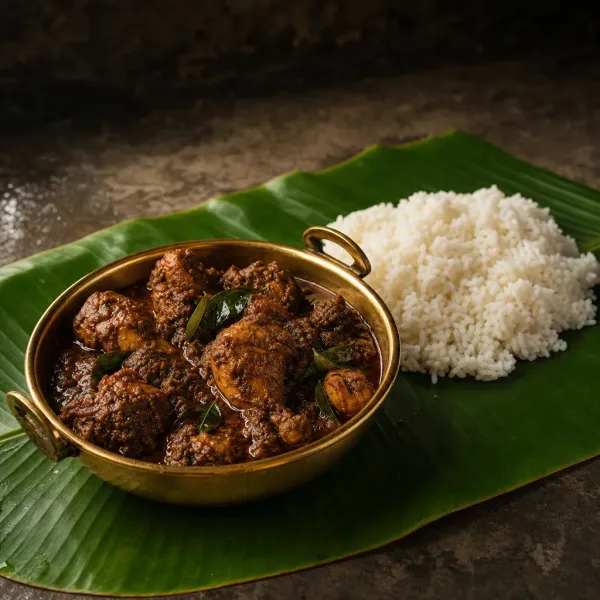
Chettinad Chicken Curry
Authentic Chettinad chicken curry from the Nagarathar kitchen, with fresh-ground masala of kalpasi, marathi mokku and whole spices. Cooked in gingell…
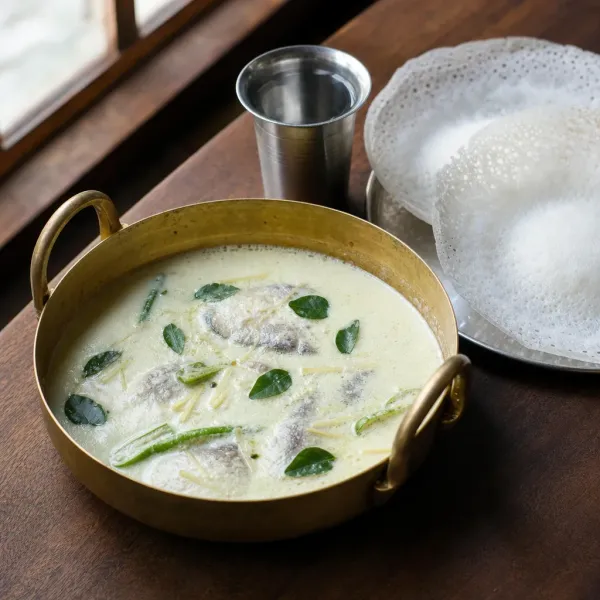
Meen Moilee
Traditional Nasrani Meen Moilee from Travancore: pale coconut-milk fish stew with green chilli, ginger and shallots. Served with appam or matta rice.
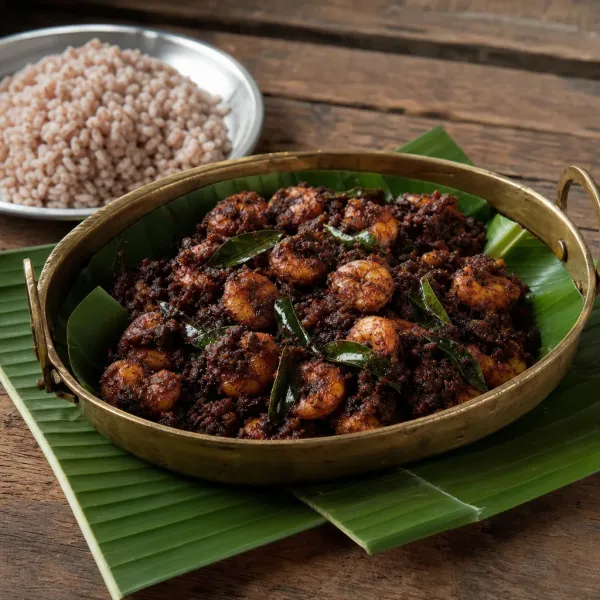
Chemmeen Roast
Traditional Kerala Nasrani chemmeen roast with shallots, kudampuli and coconut oil. Step-by-step method with the slow roasting technique that makes i…