

Dosakaya Pappu Recipe
Malayalam ദോസകായ പപ്പുTamil தோசக்காய் பருப்புKannada ದೋಸಕಾಯಿ ಪಪ್ಪುTelugu దోసకాయ పప్పు
- Prep15 min
- Cook35 min
- Serves4
- DifficultyEasy
- DietVegan
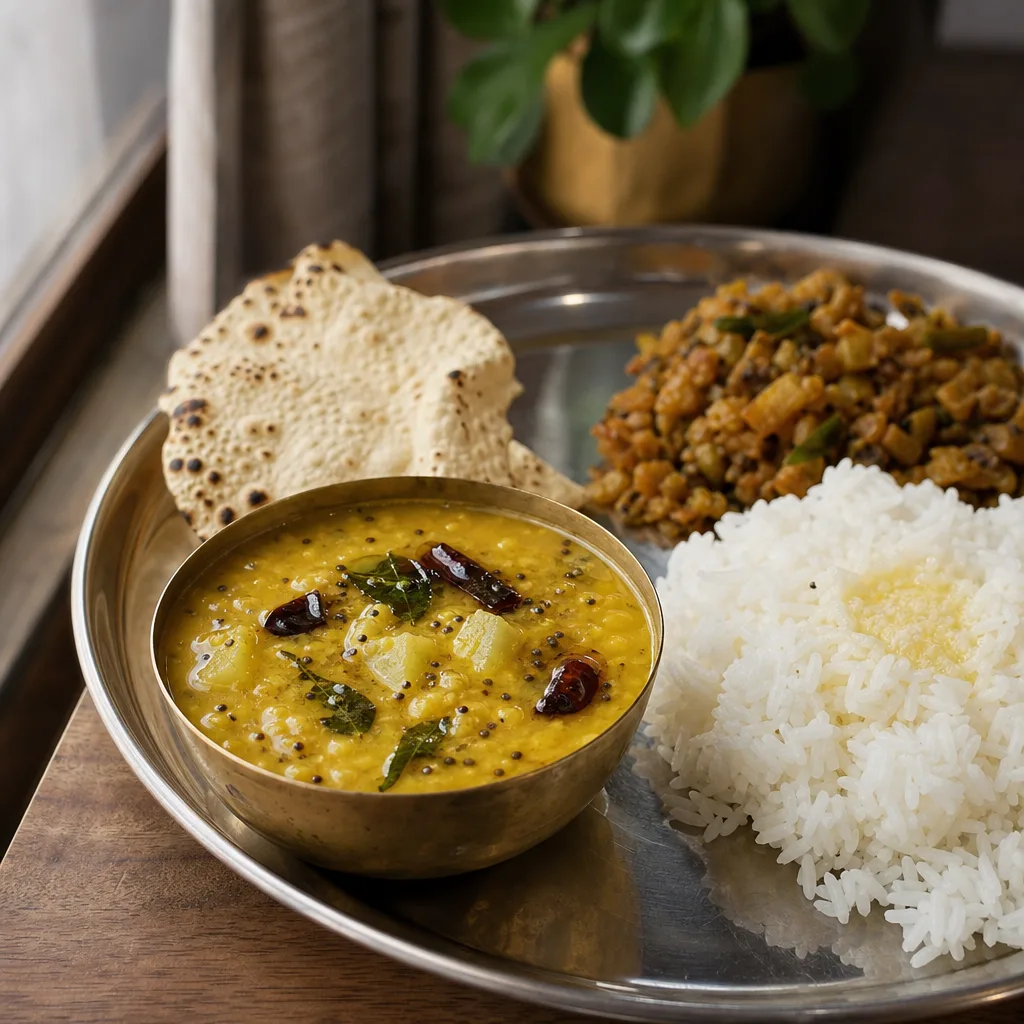
Dosakaya pappu is as close to a daily dal as an Andhra or Telangana household gets. Dosakaya is the pale yellow-green oval cucumber native to the region — mildly sour, slightly seedy, and firm enough to hold its shape when cooked. It goes into the pressure cooker with the toor dal and comes out soft but not dissolved, and that gentle sourness seasons the dal from inside so you need very little tamarind or none at all.
The dish is eaten at the main midday meal with hot rice and a spoonful of ghee poured over the top, alongside a dry vegetable and papad. It is not a side dish in the way a sambar is; it sits at the centre of the plate. The dal should be thick enough that a spoonful holds its shape on rice for a moment before it settles — not thin, not pasty.
Household variation is modest. Some cooks add one or two small shallots to the tempering; others keep it strictly without. A few families drop in a pinch of jaggery at the end to balance the sourness, though this is not universal. The spicing is always restrained: this is not a fiery dal. The cucumber does the work.
Ingredients (serves 4)
For the dal
For the tempering (popu)
Method
Prepare the cucumber
Peel the dosakaya and cut it in half. Scoop out the seeds and the soft central pulp with a spoon — the seeds turn the dal watery if left in. Cut the firm flesh into roughly 2 cm cubes. Taste a small piece: it should be mildly sour and slightly bitter at the skin edge, which is why you peel it fully.
Rinse the dal
Rinse the toor dal in three changes of cold water until the water runs mostly clear. Drain it. There is no soaking needed; it will cook through in the pressure cooker.
Pressure-cook dal and cucumber together
Put the rinsed dal, cucumber cubes, slit green chillies, turmeric, and 600 ml water into a pressure cooker. Close the lid and cook on medium-high heat until you hear 3 full whistles, then lower the heat and cook for another 5 minutes. Turn off the heat and let the pressure drop completely on its own — do not rush this by running cold water over the cooker.
Check the texture
Open the cooker. The dal should be fully soft and the cucumber pieces tender but still holding their shape — they should not have dissolved into mush. If the dal looks too thick for your liking, add a splash of hot water. If it looks thin, leave the lid off and simmer on low heat for 3 to 4 minutes, stirring gently.
Mash lightly and season
Use the back of a ladle to mash the dal roughly — not to a smooth paste, just enough to bring it together. The cucumber pieces stay whole. Add salt now and stir through. Taste: the dal should be gently sour from the cucumber. If your cucumber was unusually mild, add ½ tsp of tamarind paste dissolved in a tablespoon of water at this point.
Make the tempering
Heat ghee in a small heavy pan — a seasoned iron ladle is traditional — over medium-high heat until it shimmers. Add the mustard seeds and wait for them to pop completely, which takes about 30 seconds. Do not move on before they have all popped or the tempering will taste raw.
Add the aromatics
Add the cumin seeds and let them sizzle for 10 seconds. Add the crushed garlic and fry, stirring, until it turns pale gold at the edges — about 45 seconds. Add the broken dried red chillies and curry leaves immediately. The curry leaves will splutter loudly; stand back. Fry for 15 seconds more.
Add asafoetida and temper the dal
Drop in the pinch of asafoetida, stir once, then pour the entire tempering over the cooked dal. It will sizzle and sputter as it hits the dal. Stir gently to distribute the popu through the dal without breaking up the cucumber pieces.
Rest briefly and serve
Let the dal sit covered for 2 minutes off the heat so the tempering flavours settle in. Serve hot. The dal thickens as it cools, so serve it while it is still loose and pourable.
How to serve
Hot plain rice with a spoonful of ghee poured over the top. Alongside: a dry vegetable stir-fry (vepudu), roasted papad, and raw onion slices with lime.
Served with: Hot plain rice with a spoonful of ghee poured over the top. Alongside: a dry vegetable stir-fry (vepudu), roasted papad, and raw onion slices with lime.
Cook's tips
Choosing the right cucumber
Dosakaya must be the pale yellow-green oval variety, not the long dark green salad cucumber. The salad cucumber has almost no sourness and too much water; the dal will turn bland and watery. In Indian grocery shops outside Andhra and Telangana, look for it labelled 'yellow cucumber' or 'dosakai'. If you cannot find it, this recipe does not have a clean substitute — a small piece of ash gourd with a little tamarind is the closest approximation some cooks use, but the flavour is different.
Ghee versus gingelly oil
Traditional Andhra households use ghee for the tempering in this dal. In Telangana, gingelly (sesame) oil is equally common for everyday cooking. Either works; they give the dish a different character. Ghee makes it richer and rounder; gingelly oil adds a faint nuttiness. Do not use refined vegetable oil — it makes the popu taste flat.
The dal should not be thin
If you add too much water during cooking, you end up with a soup rather than a dal. The correct consistency is thick enough to coat the back of a spoon. Simmer uncovered to correct it rather than adding more dal.
Leftover dal
Dosakaya pappu thickens considerably overnight in the refrigerator. Add a few tablespoons of warm water and reheat gently on the stove, stirring. Do not microwave it from cold — it heats unevenly and the cucumber pieces break apart.
Regional variations
Some Telangana households add a small piece of tamarind instead of relying solely on the cucumber's sourness; a few coastal Andhra cooks add a slit green chilli to the tempering alongside the dried red chilli.
Glossary
- Dosakaya దోసకాయ
- The pale yellow-green oval cucumber native to Andhra Pradesh and Telangana; mildly sour and firm-fleshed.
- Pappu పప్పు
- The Telugu word for cooked lentil or dal; used for the category of thick cooked-lentil dishes that anchor a Telugu meal.
- Popu పోపు
- The Telugu term for tempering — the hot fat with mustard, cumin, chilli and curry leaves poured over a finished dish.
- Toor dal కందిపప్పు
- Split and hulled pigeon peas; the standard lentil for pappu in Telugu cooking.
Two things decide this dal. The first is the cucumber: it must be the genuine dosakaya, sour and firm, not a substitute. The second is patience with the tempering — every element in the popu must be properly fried in order, and the mustard seeds must pop fully before anything else goes in. Get those two things right and the dal takes care of itself.
More Lentils & Legumes recipes
Mamidikaya Pappu
Traditional Andhra recipe for mamidikaya pappu: toor dal cooked with sour raw mango, finished with a ghee tadka of mustard, shallots, and curry leave…
Hesarukalu Usli
Traditional Karnataka sprouted moong usli from a Udupi kitchen: steamed hesarukalu, fresh coconut, mustard tadka in coconut oil. Vegan, easy, everyda…
Vanpayar Thoran
Traditional Kerala vanpayar thoran: red cowpea cooked tender, tossed with fresh grated coconut and tempered in coconut oil with mustard and curry lea…
Muthira Puzhukku (Horse Gram Puzhukku)
Traditional Kerala muthira puzhukku: horse gram slow-cooked with kudampuli, finished with a fresh coconut-shallot paste and coconut oil tempering. Se…
Ulavacharu
Traditional Rayalaseema ulavacharu: horse gram broth slowly reduced to a deep mahogany, finished with a gingelly oil tadka. Served over hot rice.
Thatta Payaru Kuzhambu
Traditional Kongunad thatta payaru kuzhambu with tamarind, fresh coconut paste and gingelly oil. A weekday Tamil household recipe for black-eyed pea…