

Vazhakka Curry (Raw Banana in Coconut Gravy) Recipe
Malayalam വാഴക്ക കറിTamil வாழைக்காய் கறிKannada ಬಾಳೆಕಾಯಿ ಕರಿTelugu అరటికాయ కూర
- Prep20 min
- Cook30 min
- Serves4
- DifficultyEasy
- DietVegan
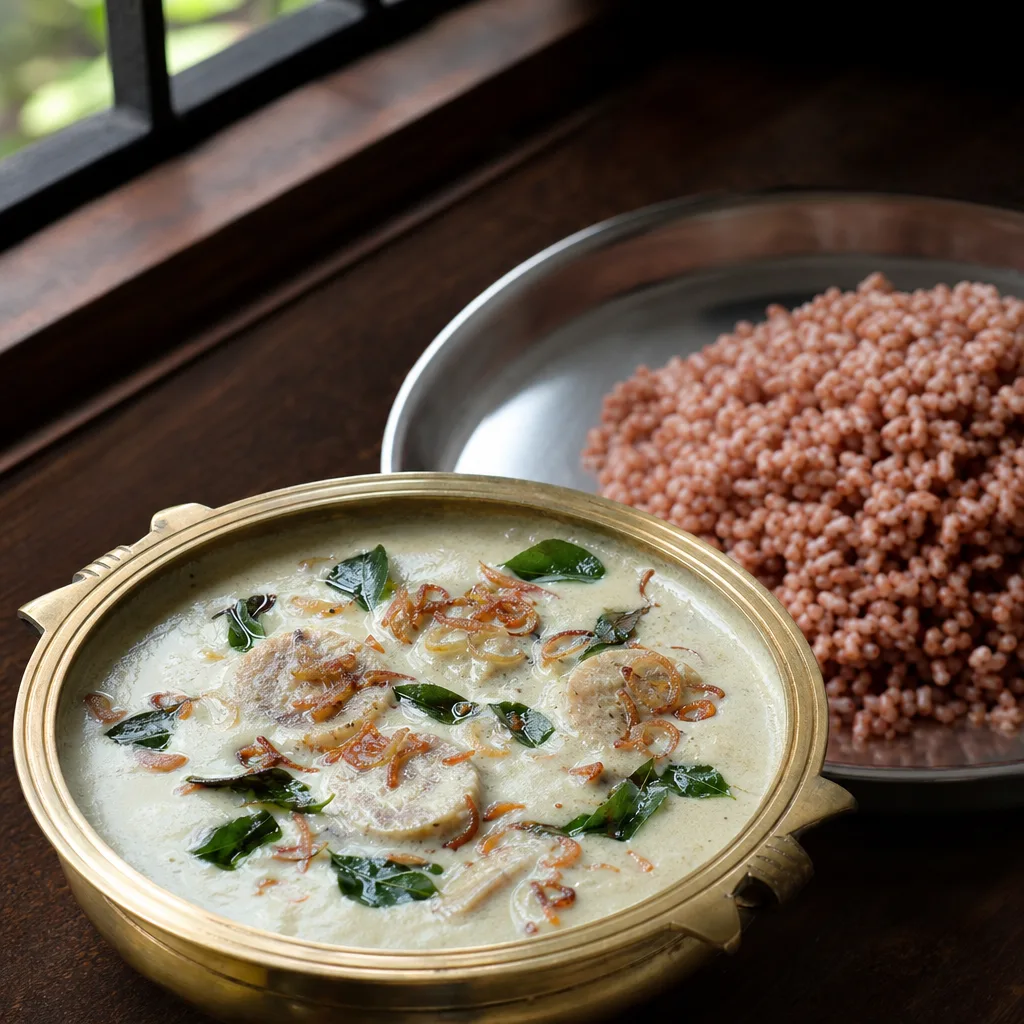
This is everyday Nasrani cooking from central and southern Kerala. Raw banana — vazhakka — is one of the vegetables that appears on the table almost without thought, the kind of dish that does not need a reason. It is cooked in a freshly ground coconut gravy, seasoned simply, and it sits alongside rice and a fish curry or a beef dish without competing with either.
The coconut paste here is ground with cumin and green chilli and a little shallot. It is stirred in after the banana is nearly cooked, not at the beginning, so the coconut stays bright and does not turn heavy. Kudampuli — Malabar tamarind, the dried dark rind — gives the sourness. This is not a dish for tamarind paste or lime juice; the kudampuli has a particular mild fruitiness that tamarind does not replicate.
Households differ on how thick to make the gravy. Some families cook it down until it just coats the banana pieces; others keep it slightly loose so it pools around the rice. Both are correct. What changes the dish most is the ripeness of the banana: choose one that is fully raw and starchy, with no give at all when you press it.
Ingredients (serves 4)
Main
To grind to a paste
For tempering
Method
Peel and hold the banana
Peel the raw bananas and cut them into rounds about 2 cm thick. Drop them immediately into a bowl of water with a pinch of turmeric stirred in. Raw banana oxidises and turns grey quickly; keeping it in turmeric water prevents this and does not affect the flavour.
Soak the kudampuli
Put the two pieces of kudampuli in a small bowl with 3 tbsp of warm water. Leave for 10 minutes. The water will turn a pale amber. You will add both the soaked pieces and their soaking water to the pot.
Grind the coconut paste
Put the grated coconut, cumin seeds, green chillies, shallots and turmeric into a wet grinder or a mixer jar. Add 3 to 4 tbsp of water and grind to a smooth, thick paste. It should have no gritty coconut shreds left. Set aside.
Start cooking the banana
Drain the banana pieces and put them in a wide, heavy-bottomed pan. Add 250 ml water, the soaked kudampuli with its soaking water, the turmeric powder and salt. Bring to a boil over medium heat, then reduce to a steady simmer. Cover and cook for 12 to 15 minutes until the banana is just tender — a knife should go in with only slight resistance. Do not let it go completely soft at this stage.
Stir in the coconut paste
Reduce the heat to low. Add the ground coconut paste to the pan and stir it in gently so the banana pieces do not break. Add 60 to 80 ml water if the curry looks too thick — it should be a coating gravy, not a stiff mass. Let it cook uncovered on low heat for 5 to 6 minutes, stirring occasionally. Do not let it boil hard after the coconut goes in; a hard boil makes the coconut gravy grainy and slightly bitter.
Finish with coconut oil and check seasoning
Stir in 2 tbsp coconut oil directly into the curry. Taste for salt and sourness. If the kudampuli has not given enough tang, add a little more of its soaking water (keep a small reserve). The sourness should be present but gentle. Remove from heat.
Temper and pour over
In a small tempering pan, heat 1 tbsp coconut oil over medium-high heat. Add the mustard seeds and wait for them to pop — about 30 seconds. Add the broken dried red chillies and curry leaves; they will splutter and crisp in 15 to 20 seconds. Add the sliced shallots and fry until they are golden at the edges, about 2 minutes. Pour the entire tempering over the curry and cover the pan immediately for a minute to trap the aroma.
Rest briefly and serve
Let the curry sit covered for 2 to 3 minutes before serving. This short rest lets the tempering settle into the gravy and the flavours come together. Serve warm.
How to serve
Cooked matta rice (Kerala red rice). In a Nasrani household this typically appears alongside a fish curry or beef ularthiyathu, with a simple thoran on the side.
Served with: Cooked matta rice (Kerala red rice). In a Nasrani household this typically appears alongside a fish curry or beef ularthiyathu, with a simple thoran on the side.
Cook's tips
Choosing the banana
Use a banana that is completely raw and firm — no yellow at the tips, no softness anywhere. Nendran is the most common variety used in Kerala homes for this curry. If you press the cut flesh and it springs back, it is right.
Kudampuli sourness varies
Kudampuli pieces vary in potency depending on how long they have been dried and stored. Older, darker pieces are stronger. Start with two pieces and taste before adding more. If you cannot find kudampuli, this dish does not have a good substitute — kokum is the closest in character but gives a different colour and a slightly different sourness.
Do not boil after adding coconut
This is the step people rush and regret. Once the coconut paste is in, keep the heat low. A rolling boil will split the coconut and make the gravy look curdled and taste flat.
Storing leftovers
The curry keeps well for a day at room temperature in a cool kitchen, or two days refrigerated. Reheat gently over low heat with a splash of water. The banana continues to absorb the gravy as it sits, which many people find improves it.
Regional variations
A drier Mappila version uses fennel and less coconut; a Tamil Brahmin version (vazhakkai kuzhambu) uses tamarind and no coconut milk; a Nair household version in central Kerala is nearly identical to this one but skips the small green chillies in the paste.
Glossary
- Vazhakka വാഴക്ക
- Raw, unripe banana used as a vegetable in Kerala cooking.
- Kudampuli കുടംപുളി
- Dried rind of Garcinia cambogia, called Malabar tamarind or gamboge; gives a mild, fruity sourness distinct from tamarind.
- Chuvannulli ചുവന്നുള്ളി
- Kerala shallots; smaller and more pungent than the large onions used in north Indian cooking.
- Jeerakam ജീരകം
- Cumin seeds.
- Matta rice മട്ട അരി
- Kerala red parboiled rice, also called rosematta; the everyday rice of Kerala households.
Two things decide this curry. The first is keeping the heat low once the coconut paste goes in — the texture and taste of the finished gravy depend entirely on that restraint. The second is the kudampuli: use genuine Malabar tamarind, soaked properly, and taste as you go. Everything else in the dish is forgiving.
More Vegetarian Gravies recipes
Manga Curry
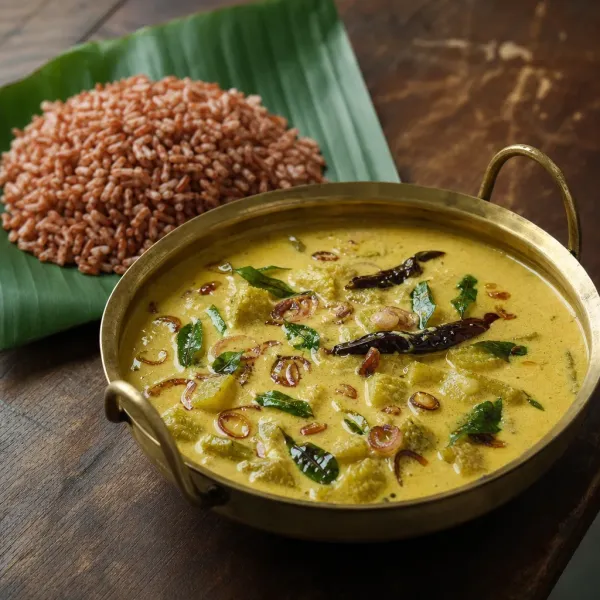
Traditional Kerala manga curry with fresh coconut paste, shallots and curry leaves. A quick, sour, everyday side dish for matta rice. Ready in 40 min…
Gutti Vankaya Kura
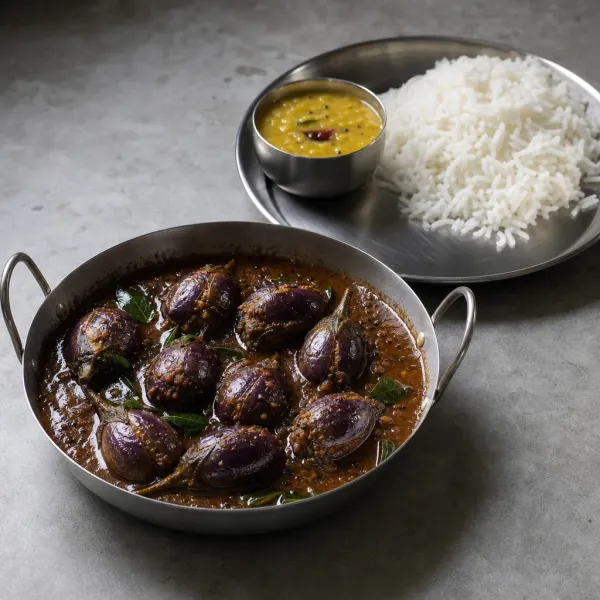
Authentic Rayalaseema gutti vankaya kura: small brinjals stuffed with a peanut-sesame-coconut masala, slow-cooked in a tamarind gravy with gingelly o…
Kerala Muslim Vegetable Kurma
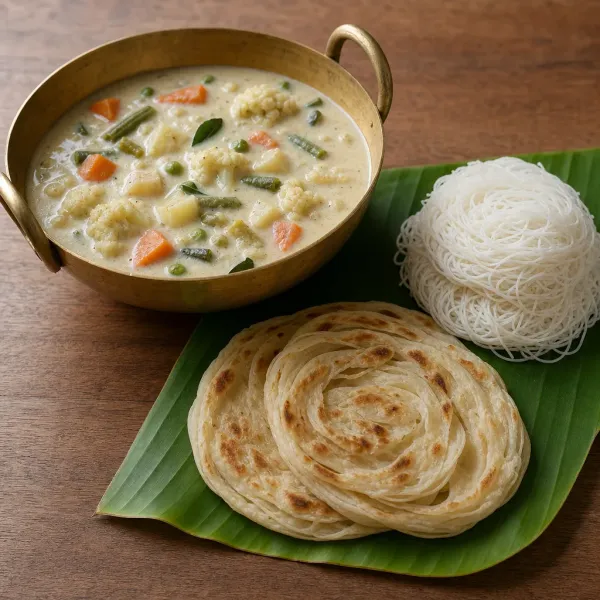
Traditional Malabar Mappila vegetable kurma with fresh coconut, kus kus and cashew paste. Pale, mildly spiced, perfect with parotta and idiyappam.
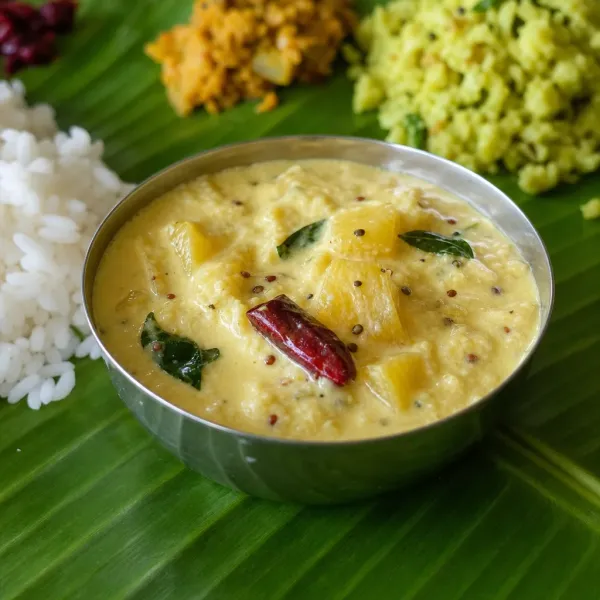
Pineapple Pachadi
Traditional Kerala pineapple pachadi for the sadya leaf: pineapple cooked with coconut paste, finished with sour curd and a coconut oil tempering.
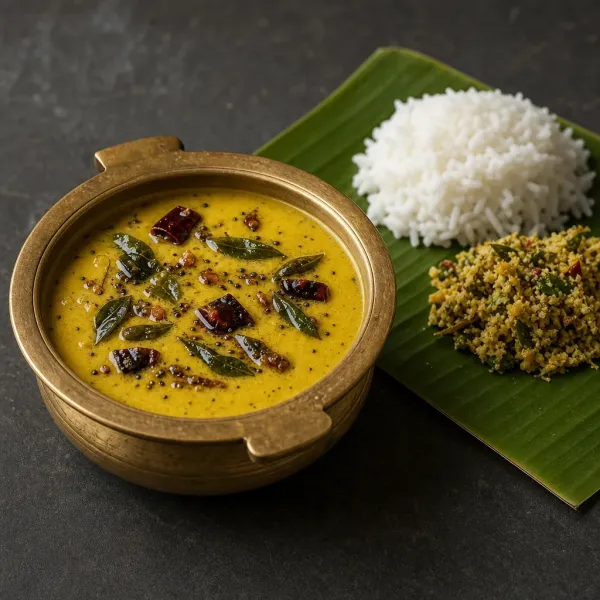
Poricha Kuzhambu
Traditional Tamil Brahmin poricha kuzhambu with roasted coconut paste, toor dal, and raw banana. No tamarind, no onion. Weekday lunch recipe.
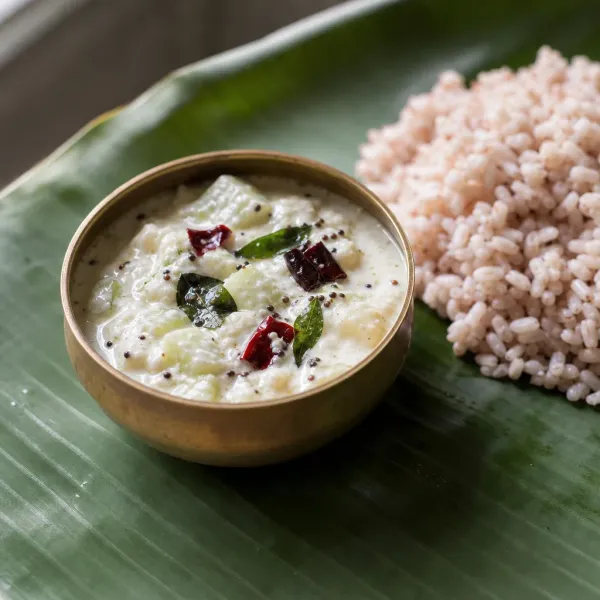
Vellarikka Pachadi
Traditional Kerala vellarikka pachadi with fresh coconut paste, green chilli and thick curd. A cooling sadya side dish ready in 25 minutes.