

Uppu Kozhukattai Recipe
Malayalam ഉപ്പ് കൊഴുക്കട്ടTamil உப்பு கொழுக்கட்டைKannada ಉಪ್ಪು ಕೊಳುಕಟ್ಟೆTelugu ఉప్పు కొళుకట్ట
- Prep20 min
- Cook40 min
- Serves4
- DifficultyMedium
- DietVegan
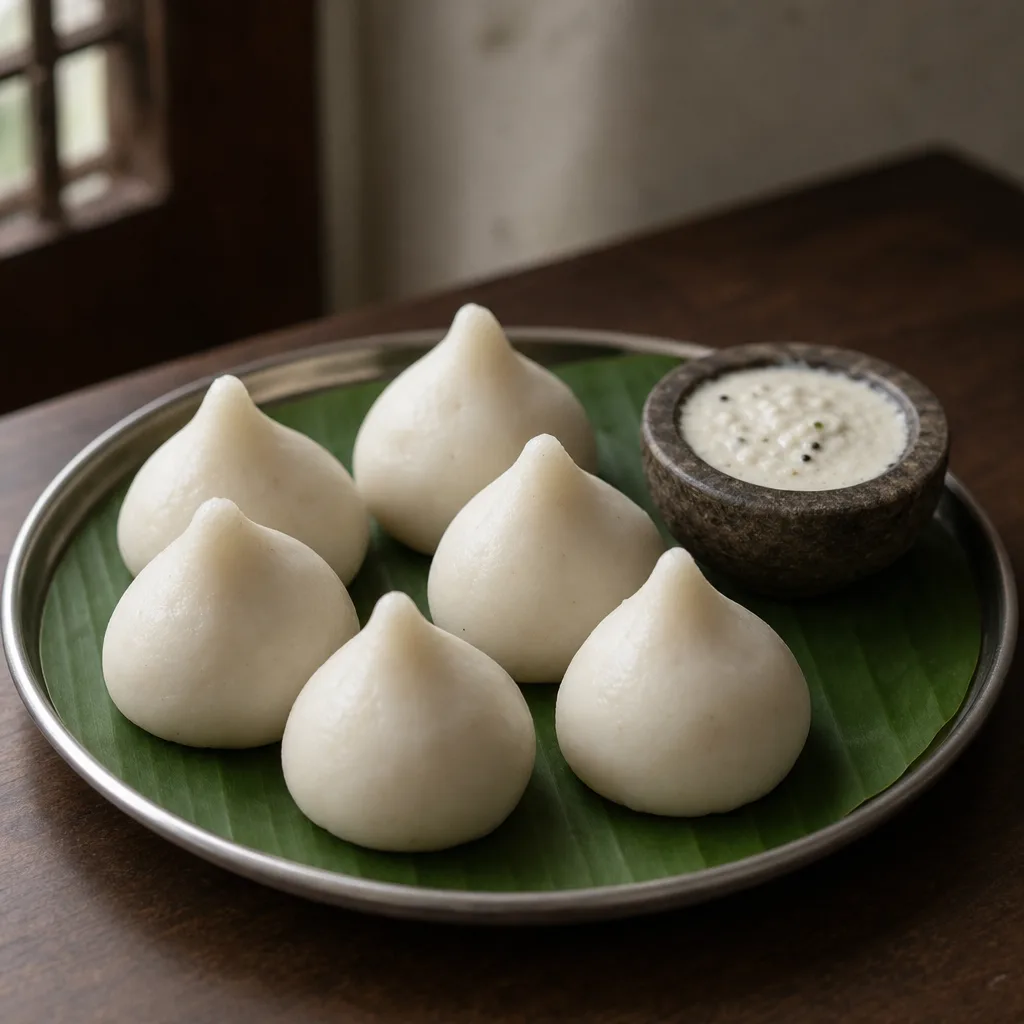
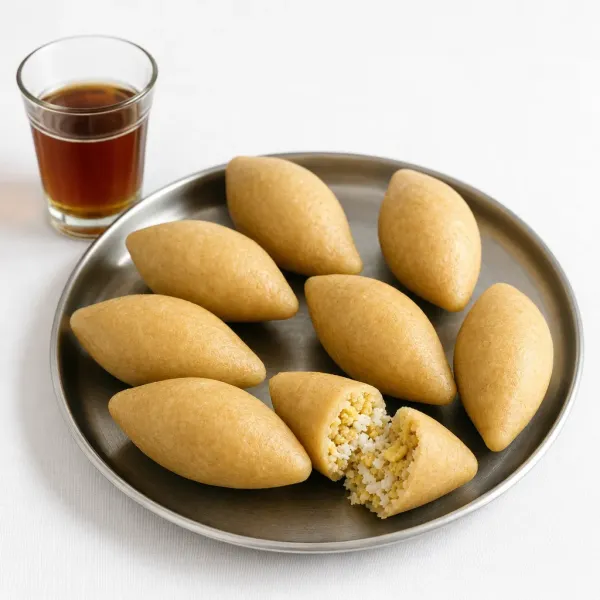
Uppu kozhukattai is a savoury steamed dumpling made from a cooked rice flour dough, shaped by hand and steamed until just firm. In Iyer households it is made on Ganesh Chaturthi alongside the sweet versions, but it is also cooked on any ordinary morning when there is time to stand at the stove and stir. It is not festival food alone; it is practical, filling breakfast food.
The dough is made by cooking rice flour in boiling salted water with a tempering of mustard, urad dal, curry leaves and green chilli, then working it while it is still warm. Getting the water ratio right and cooking the dough fully in the pan are the two things that matter. Under-cooked dough gives dumplings that are dense and gluey inside even after steaming. The dough should feel like soft, pliable playdough and leave the pan cleanly.
Households differ on shape: some make smooth ovals, some make the ridged modak shape, some simply roll small balls. All of these steam in the same time. The accompaniment is coconut chutney, and some families serve it with a small bowl of sambar as well.
Ingredients (serves 4)
For the dough
For the tempering
Method
Prepare your steamer
Fill a wide steamer or idli pot with enough water to steam for 15 minutes without running dry. Bring it to a rolling boil before you start the dough. Grease the steamer plates or a flat vessel you will use for steaming with a little coconut oil.
Make the tempering
Heat 2 tsp coconut oil in a heavy-bottomed pan over medium flame. Add the mustard seeds and wait until they pop fully. Add the urad dal and chana dal and stir until they turn pale gold, about 45 seconds. Add the green chillies, curry leaves and asafoetida. Stand back; the curry leaves will splutter. Let them fry for 20 seconds.
Boil the salted water
Pour 360 ml water into the same pan with the tempering still in it. Add salt and 1 tsp coconut oil. Bring to a full, vigorous boil over high heat. The oil on the surface will form small pools; that is fine.
Cook the flour into a dough
Reduce the heat to low. Add the rice flour all at once and stir immediately and continuously with a wooden spoon or spatula. There must be no dry pockets. Keep stirring and pressing the dough against the pan for 3 to 4 minutes until it comes together into a single mass that pulls away from the sides cleanly and no longer sticks to the spoon. If you rush this step the inside of each dumpling will be raw and paste-like even after steaming. Remove from the heat.
Add coconut and rest the dough
If you are using grated coconut, add it now and knead it into the dough while it is still in the pan. Cover the pan with a lid or a damp cloth and leave for 5 minutes. This resting lets the steam inside finish cooking the flour and makes the dough easier to handle.
Knead to smoothness
Grease your palms with a little coconut oil. Turn the dough out and knead it gently for a minute while it is still warm. It should feel soft, smooth and pliable, like firm mashed potato. If it cracks at the edges it is slightly dry; wet your palms lightly and knead again. Do not add water directly to the dough.
Shape the dumplings
Divide the dough into lime-sized portions, roughly 30 to 35 g each. Roll each between greased palms into a smooth oval or ball. The surface must be crack-free; any crack will let water into the dumpling during steaming and make it wet and heavy. If you want the ridged modak shape, pinch the sides up into small pleats and bring them together at the top.
Steam the dumplings
Arrange the shaped dumplings on the greased steamer plate, leaving a small gap between each one. They will not expand much but need a little air around them. Place in the steamer over briskly boiling water, cover tightly and steam for 12 to 15 minutes. Do not open the lid before 12 minutes.
Check for doneness
The dumplings are ready when the surface looks set and slightly dry, not wet or shiny, and a toothpick or thin skewer inserted into the centre comes out clean without any sticky dough clinging to it. They will be uniformly pale white throughout with no browning anywhere. Remove from the steamer and let them sit for 2 minutes before serving; they firm up a little as they cool.
How to serve
Fresh coconut chutney. Some households also serve a small bowl of sambar alongside.
Served with: Fresh coconut chutney. Some households also serve a small bowl of sambar alongside.
Cook's tips
Water ratio is everything
Different brands of rice flour absorb water differently. If after adding the flour the dough seems too wet and sticky after cooking, let it sit covered for another 2 minutes; it often firms up. If it is genuinely crumbly and dry, wet your palms with a few drops of water while kneading, not the dough itself directly.
Do not let the dough cool completely before shaping
Cold dough cracks when you try to shape it and the surface of the dumpling will split open during steaming. Work while it is warm. If it cools too much, cover it with a damp cloth for a minute to soften it slightly.
Storing leftovers
Kozhukattai harden as they cool and become rubbery when refrigerated. The best way to revive them is to steam again for 3 to 4 minutes, not to microwave. They are best eaten the day they are made.
Coarse versus fine flour
Idiyappam flour (also sold as rice flour for kozhukattai) is finely milled and gives a smooth dough. Regular store rice flour can be slightly coarser and may produce a slightly grainy texture. If that is all you have, sift it once before using.
Regional variations
A Kerala Brahmin version uses rice flour cooked with water and shapes the dumplings more loosely; a Chettiar version adds fennel and dried red chilli to the tempering. Some Tamil households add grated coconut to the dough itself.
Glossary
- Kozhukattai கொழுக்கட்டை
- Steamed rice flour dumpling; the name covers both sweet and savoury versions in Tamil.
- Perungayam பெருங்காயம்
- Asafoetida; the dried resin used in small quantities in Tamil Brahmin cooking as a digestive and flavouring.
- Urad dal உளுத்தம் பருப்பு
- Split and husked black gram; used in tempering for its nutty flavour when fried in oil.
- Chana dal கடலை பருப்பு
- Split Bengal gram; added to the tempering alongside urad dal for texture and a mild sweetness.
- Pachari പച്ചരി
- Raw rice in Malayalam; used here to clarify the type of rice flour required, as opposed to parboiled rice flour.
Two things decide whether these dumplings succeed: cooking the flour fully in the pan before you shape anything, and shaping the dumplings while the dough is still warm. Everything else is detail.
More Snacks recipes
Chicken Pakoda
Traditional Kongunad chicken pakoda with gram flour batter, fennel, curry leaves, and gingelly oil. Bone-in pieces, crisp outside, tender inside.
Kappa Chips (Kerala Tapioca Chips)
Classic Kerala tapioca chips fried in coconut oil and finished with a salt brine. Thin, pale, and crisp — the traditional household method from Trava…
Unniyappam
Traditional Kerala unniyappam made with ground raw rice, dark jaggery, ripe nendran banana and coconut oil in a cast-iron appakaram. Step-by-step hou…
Mysore Bonda
Traditional Mysuru-style maida bonda made with thick sour curd. Crisp shell, soft inside. Step-by-step Karnataka household recipe with tips.