

Thakkali Sadam Recipe
Malayalam തക്കാളി സാദംTamil தக்காளி சாதம்Kannada ಟೊಮೇಟೊ ಸಾದಂTelugu టొమాటో సాదం
- Prep15 min
- Cook30 min
- Serves4
- DifficultyEasy
- DietVegetarian
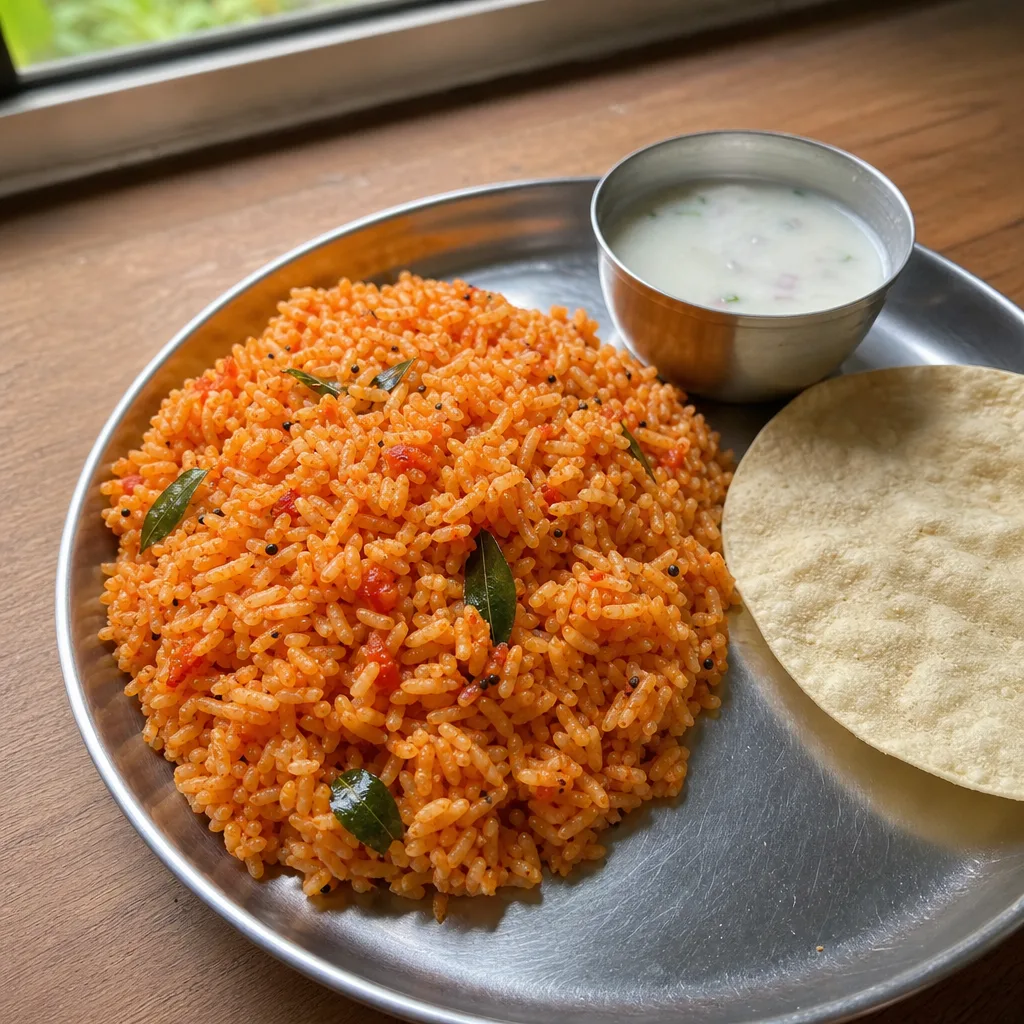
Thakkali sadam is a Tamil Brahmin staple, cooked in almost every Iyer household as a quick weekday lunch or as part of a packed lunch box. It is a rice dish cooked with a spiced tomato base — not a pulao, not a biryani — and it sits firmly in the category of variety rice (kalayana sadam or kalanda sadam) alongside lemon rice, tamarind rice and coconut rice.
The method here is the everyday home version: cooked rice mixed through a freshly made tomato thokku-style base. The tomatoes are cooked down until the raw smell is completely gone and the oil separates at the edges — that is the moment that decides the dish. The fat used is gingelly oil, which gives the rice its characteristic warm, slightly nutty smell. Ghee is sometimes added at the end, and in many households a small spoon of ghee at the finish is considered non-negotiable.
Households differ mainly on heat: some add two green chillies, some add none and rely entirely on the dried red chillies in the tempering. Some cooks add a pinch of asafoetida (perungayam) in the tempering; others skip it. The rice used is ordinary raw rice (pacharisi), cooked so that each grain is separate and not sticky. Leftover rice from the morning works well and is in fact the traditional use for this dish.
Ingredients (serves 4)
For the rice
For the tomato base
For the tempering
Method
Cook and cool the rice
Cook the rice with enough water so that the grains are fully cooked but completely separate — not mushy, not sticky. Spread it on a wide plate or thali and let it cool to room temperature. If the grains clump, run your fingers through them gently to separate. Cold or room-temperature rice mixes through the base without breaking.
Heat the oil and bloom the tempering
Pour the gingelly oil into a heavy kadai and set it over medium heat. When the oil shimmers and is hot enough that a mustard seed dropped in splutters immediately, add the mustard seeds. Let them pop fully — about 30 seconds. Add the urad dal and chana dal and stir; they should turn golden in about a minute. Do not let them go dark brown or they will taste bitter.
Add the dried chillies, curry leaves and asafoetida
Drop in the broken dried red chillies and stir for 15 seconds until they deepen in colour. Add the curry leaves — stand back, they will sputter in the oil. Add the pinch of asafoetida and stir once. The kitchen should smell sharp and toasty at this point.
Fry the shallots
Add the sliced shallots and the slit green chillies. Fry over medium heat, stirring often, until the shallots are soft and translucent at the edges and beginning to colour — about 6 to 8 minutes. Do not rush this; undercooked shallots leave a raw sweetness that sits wrong in the finished rice.
Add the ginger
Add the grated ginger and stir for about a minute until the raw ginger smell softens. The shallots should be fully golden by now.
Add the spice powders
Reduce the heat to low. Add the turmeric, red chilli powder and coriander powder. Stir constantly for 30 to 45 seconds so the powders fry in the oil without burning. If the pan looks too dry, add a small splash of water to prevent scorching.
Add the tomatoes and cook down
Add the chopped tomatoes and salt. Stir everything together and raise the heat to medium. Cook uncovered, stirring every few minutes, until the tomatoes break down completely and lose all their raw smell — about 15 to 18 minutes. The mixture should thicken into a paste-like base, and the gingelly oil should begin to separate and pool at the edges of the pan. This is the essential sign that the base is ready. If the oil has not separated, keep cooking.
Taste and adjust
Taste the tomato base for salt, sourness and heat before the rice goes in. It should taste slightly more intense and saltier than you want the finished dish to be, because the rice will absorb and dilute it. Adjust now.
Mix in the rice
Add the cooled rice to the pan in two or three additions, folding gently with a wide spatula or the back of a large spoon. The goal is to coat every grain evenly without mashing the rice. Work over low heat. If the rice seems too dry, a small splash of water — no more than 2 tablespoons — can help the base distribute.
Finish with ghee and rest
Once the rice is evenly coated and heated through, drizzle the teaspoon of ghee over the top and fold it in gently. Turn off the heat, cover the pan with a lid, and let it rest for 5 minutes. This rest allows the flavours to settle into the rice.
How to serve
Plain papad (appalam), a small bowl of mor (thin buttermilk seasoned with salt and green chilli), and raw sliced shallots or a simple cucumber raita. Often packed into a lunch box with a small portion of potato chips (vadam).
Served with: Plain papad (appalam), a small bowl of mor (thin buttermilk seasoned with salt and green chilli), and raw sliced shallots or a simple cucumber raita. Often packed into a lunch box with a small portion of potato chips (vadam).
Cook's tips
Which tomatoes to use
Sour, thin-skinned country tomatoes (naatu thakkali) give the best result. Large, watery hybrid tomatoes take much longer to cook down and the base ends up thin. If you can only find hybrid tomatoes, use fewer and cook them longer.
The oil-separation test
The single most common reason this dish tastes flat is that the tomato base was not cooked long enough. The oil must visibly separate at the edges before the rice goes in. If you mix the rice in too early, the base remains acidic and the spices taste raw.
Gingelly oil is not negotiable in this version
Substituting refined sunflower oil changes the character of the dish significantly. Gingelly oil is what gives thakkali sadam its warmth. If you are not used to its flavour, start with 2 tablespoons and increase next time.
Leftover rice works best
Freshly cooked rice that is still warm will clump and break when mixed. If you are cooking rice fresh for this dish, spread it on a plate and let it cool fully — at least 30 minutes at room temperature, or 15 minutes under a fan.
Storage
Thakkali sadam keeps well at room temperature for a full day, which is why it is a classic lunch box dish. Refrigerated, it becomes dry; warm it in a covered pan with a few drops of water.
Regional variations
Andhra households make a sharper, more tamarind-forward version with curry leaves and dried red chillies in a larger quantity of gingelly oil; Karnataka households sometimes add jaggery for a mild sweetness.
Glossary
- Pacharisi பச்சரிசி
- Raw white rice, as opposed to parboiled rice (puzhungal arisi); the standard rice for variety rice dishes in Tamil Brahmin cooking.
- Naatu thakkali நாட்டு தக்காளி
- Country tomato; small, thin-skinned, sour variety of tomato preferred over larger hybrid tomatoes for cooking down into a base.
- Chinna vengayam சின்ன வெங்காயம்
- Small shallots, literally 'small onion'; the standard allium in Tamil cooking, sharper and more aromatic than large onions.
- Nallennai நல்லெண்ணெய்
- Gingelly oil, sesame oil; the traditional cooking fat for Tamil variety rice dishes and kuzhambu.
- Perungayam பெருங்காயம்
- Asafoetida; a resin used in very small quantities in Tamil Brahmin cooking as a digestive and flavouring, particularly in tempering.
- Vathal milagai வத்தல் மிளகாய்
- Sun-dried red chillies; used in tempering for heat and a slightly smoky depth distinct from fresh chillies.
- Kadugu கடுகு
- Black mustard seeds; the first ingredient added to hot oil in most Tamil tempering.
- Kalanda sadam கலந்த சாதம்
- Mixed rice; the category of Tamil rice dishes in which cooked rice is mixed through a prepared base — includes lemon rice, tamarind rice, coconut rice and tomato rice.
Two things decide whether this works: the tomato base must be cooked until the oil separates cleanly at the edges, and the rice must be completely cool and grain-separate before it is folded in. Get those two things right and the rest follows.
More Rice Dishes recipes
Jeerakasala Rice (Jeera Rice)
Traditional Kerala jeerakasala rice cooked with ghee and cumin in a Brahmin household style. Simple method, exact water ratio, no shortcuts.
Hyderabadi Kacchi Gosht Ki Biryani
Traditional Hyderabadi kacchi biryani: raw marinated mutton layered with parboiled basmati, sealed with atta dough and cooked on slow dum. Authentic…
Keerai Sadam (Greens Rice)
Traditional Tamil Iyer keerai sadam made with Amaranth greens, toor dal, fresh coconut paste and gingelly oil. Everyday rice done right.
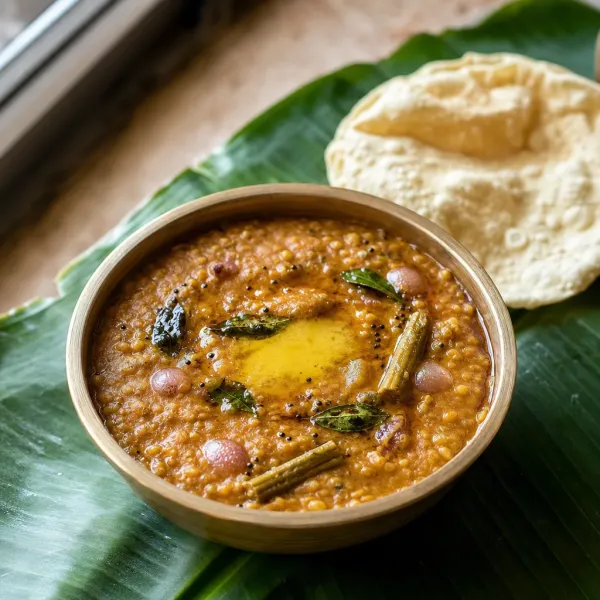
Sambar Sadam (One-Pot Rice and Sambar)
Authentic Tamil Iyer sambar sadam: rice and toor dal cooked with tamarind, drumstick and sambar powder, finished with a ghee tempering. One pot, real…
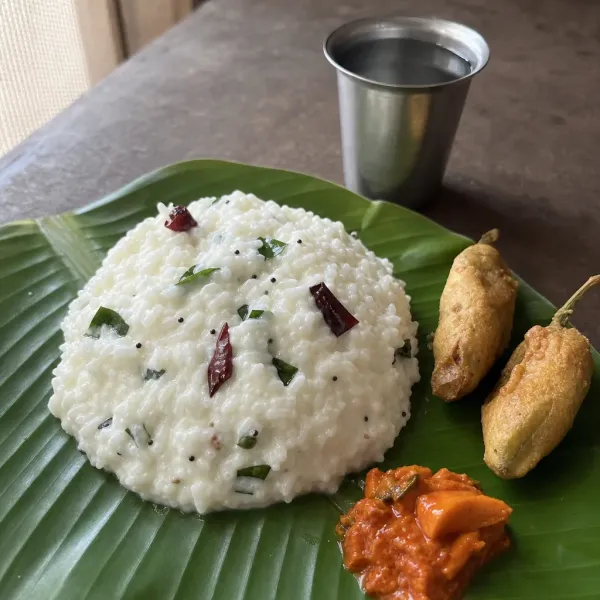
Thayir Sadam
Authentic Iyer-style thayir sadam with gingelly oil tempering, mustard seeds, curry leaves and fresh curd. The traditional Tamil Brahmin curd rice re…
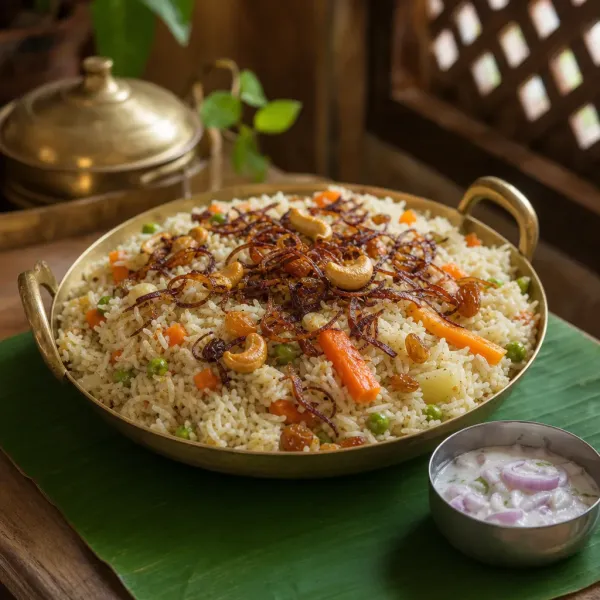
Vegetable Pulao (Mappila Style)
Traditional Malabar Mappila vegetable pulao cooked in coconut milk with whole spices and jeerakasala rice. Authentic Kerala Muslim household recipe.