

Hyderabadi Kacchi Gosht Ki Biryani Recipe
Malayalam ഹൈദരാബാദി കച്ചി ബിരിയാണിTamil ஹைதராபாதி கச்சி பிரியாணிKannada ಹೈದರಾಬಾದಿ ಕಚ್ಚಿ ಬಿರಿಯಾನಿTelugu హైదరాబాదీ కచ్చి బిర్యానీ
- Prep1 hr
- Soak / ferment4 hr
- Cook1 hr 15 min
- Serves6
- DifficultyHard
- DietNon-vegetarian
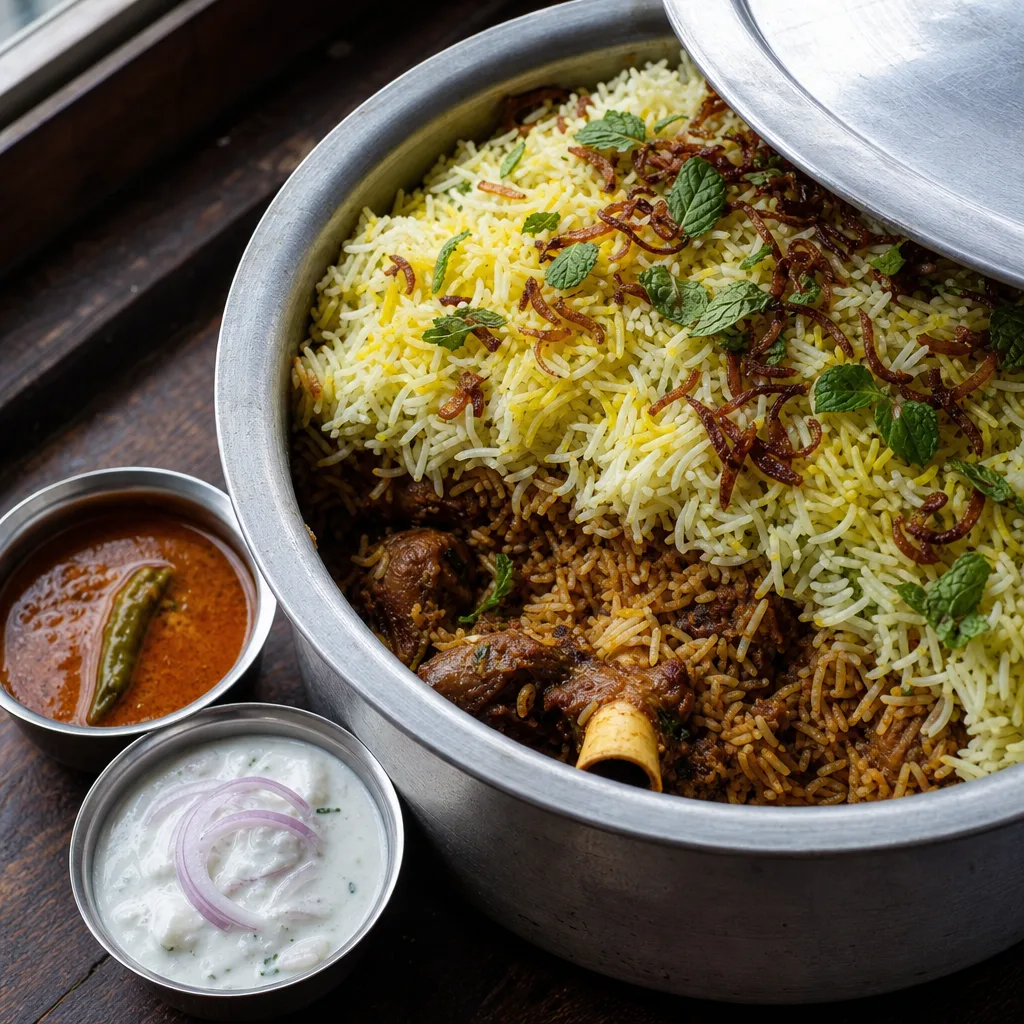
Kacchi biryani is the one where the meat never sees the pot before dum. Raw marinated mutton goes in at the bottom, half-cooked rice goes on top, the pot is sealed, and the two finish together in trapped steam. The meat cooks entirely in its own moisture and the moisture of the marinade. If the marinade is thin or the seal breaks, the rice on the bottom layer turns to paste. That is the risk, and it is also why the dish tastes the way it does.
This is a Hyderabadi dish from the Deccani Muslim kitchen, and it has been cooked in Hyderabad homes for generations. The spicing is assertive but not fiery: whole spices do the aromatic work, fried shallots and browned onions add sweetness and depth, and saffron soaked in warm milk gives the top layer its colour. Yoghurt is the tenderiser and the moisture source for the meat. Nothing here is optional.
Household differences are real. Some families add raw papaya paste to the marinade as a tenderiser, especially for older mutton. Some use ghee throughout; others use a mix of ghee and neutral oil for the rice. The dum vessel matters: a heavy-bottomed pot with a tight lid holds heat evenly, and many households still seal the lid with a rope of atta dough to trap every wisp of steam. The dough seal is not decorative. Use it.
Ingredients (serves 6)
For the meat marinade
For the rice
For the dum layering
For sealing the pot
Method
Fry the onions (birista)
Slice 4 large onions into thin, even rings. Heat 120 ml neutral oil in a wide, heavy pan over medium heat. Add the onions and fry, stirring often, for 25–35 minutes until they are a deep reddish-brown and crisp. They will look darker than you expect and will seem to be burning just before they are done. Spread on a plate lined with paper and let them cool completely; they crisp further as they cool. You need 120 g total: 80 g for the marinade and 40 g for layering. If you rush this step and pull them out golden, the biryani will taste sweet and flat rather than deep.
Marinate the mutton
In a large bowl, combine the whisked yoghurt, ginger paste, garlic paste, red chilli powder, coriander powder, turmeric, lime juice, all the whole spices listed under the marinade, the slit green chillies, 80 g of the fried onions, the torn mint, coriander, ghee, and salt. Add the papaya paste if using. Mix well, then add the mutton pieces and turn to coat thoroughly. Press the marinade into the pieces. Cover and refrigerate for a minimum of 4 hours; overnight is better. Take the meat out of the refrigerator 45 minutes before you begin cooking so it is not fridge-cold when it goes into the pot.
Soak the saffron
Warm 4 tbsp full-fat milk until it is just hot to the touch — not simmering. Add the saffron strands and leave them to steep for at least 20 minutes. The milk will turn a deep amber-orange. Set aside.
Parboil the rice
Bring 4 litres of water to a rolling boil in a large pot. Add salt generously — the water should taste distinctly salty, like a light brine. Add the whole spices listed under the rice. Drain the soaked basmati and slide it into the boiling water. Cook uncovered over high heat, stirring once after 2 minutes. The rice is ready when each grain is about 70 percent cooked: it bends slightly before it breaks, the outside is tender but the centre still has a firm, chalky core when you press it between your fingers. This takes roughly 5–7 minutes depending on the age of the rice. Drain immediately through a colander. Do not rinse. Spread the rice loosely on a large tray so the grains do not clump and steam escapes.
Prepare the dum pot
Choose a heavy-bottomed pot with a tight-fitting lid — a thick-based aluminium or stainless steel degchi or a cast-iron pot works well. The pot must be wide enough that the meat sits in a single, roughly even layer. Spread the marinated mutton with all its marinade evenly across the bottom of the cold pot. Do not heat the pot first. The meat must start cold so it cooks slowly from the bottom up.
Layer the rice
Spoon half the parboiled rice over the mutton in an even layer. Scatter half the remaining fried onions, half the mint, and half the coriander over this layer. Drizzle 1.5 tbsp ghee over it. Add the second half of the rice on top. Scatter the remaining onions, mint, and coriander. Drizzle the remaining 1.5 tbsp ghee evenly. Finally, spoon the saffron milk over the top layer in a loose pattern — you do not need to cover every grain; the colour will bleed and streak as it cooks, which is correct.
Seal the pot
Roll the atta dough into a long rope, roughly 1.5 cm thick. Press it firmly around the rim of the pot, between the pot and the lid, forming a continuous seal. Press the lid down firmly into the dough. The seal must be complete with no gaps. If steam escapes during cooking, the rice on the bottom layer will dry out and the meat will not cook through.
Cook on high heat first
Place the sealed pot over high heat for exactly 5 minutes. You are building up the initial burst of steam inside the pot. After 5 minutes you should hear a faint hissing and see a wisp of steam trying to escape at the dough seal — this tells you the interior has pressurised. If the dough seal has a gap, press it shut immediately with a damp cloth.
Reduce to dum (low heat)
Reduce the heat to the lowest possible setting on your burner. If you have a tawa or flat iron griddle, place it under the pot — this diffuses the heat and prevents the bottom layer of meat from scorching. Cook on this very low heat for 50–60 minutes. Do not open the pot during this time. The meat cooks entirely from the trapped steam and its own marinade. If you open the pot early, you release the steam and the top layers of rice will remain undercooked.
Rest before opening
Turn off the heat and let the pot sit, still sealed, for 15 minutes. This resting period allows the steam to redistribute and the rice to finish absorbing moisture evenly. After 15 minutes, break the dough seal with a knife and lift the lid away from you so condensed water on the lid does not drip back onto the rice.
Check and serve
Insert a long spoon or skewer gently to the bottom of the pot and press it against a piece of mutton — it should yield easily with no resistance. The rice at the top will be pale and fragrant, the rice near the bottom will have taken on colour from the meat juices. To serve, use a flat spatula or wide spoon to lift portions from the side of the pot in layers, so each serving has both the saffron-streaked top rice and the darker, meat-juiced bottom rice together with a piece of mutton. Do not stir the pot.
How to serve
Mirchi ka salan (green chilli and peanut gravy), raita made with yoghurt and shallots or boondi, and sliced raw onion rings with lime. Browned onions may be offered separately at the table.
Served with: Mirchi ka salan (green chilli and peanut gravy), raita made with yoghurt and shallots or boondi, and sliced raw onion rings with lime. Browned onions may be offered separately at the table.
Cook's tips
The tawa under the pot
A flat iron tawa placed under the biryani pot on a gas burner is the most reliable way to prevent the bottom layer from burning during dum. Without it, even the lowest gas flame can scorch the mutton directly above the burner.
Checking rice doneness before layering
The 70-percent rule is the most important step to get right. If you parboil the rice to fully cooked, the dum will turn it to mush. If it is less than 60 percent done, the meat will be overcooked before the rice finishes. Press a grain between thumb and forefinger: the outside gives, the centre resists.
Papaya paste and younger mutton
If your mutton is from a young animal and the pieces are not too large, skip the papaya paste. It can over-tenderise the meat during a long overnight marinade, making the surface slightly mushy.
Overnight marinade
Four hours is the minimum; overnight in the refrigerator gives noticeably more flavour and tenderness. If marinating overnight, add the papaya paste only if the mutton is tough, and reduce it to 1 tbsp.
Resting after cooking
Do not skip the 15-minute rest after the heat is off. The internal temperature continues to cook the rice and allows the juices to settle. Opening early gives you wet, uneven rice.
Vessel choice
A wide, shallow pot gives you a thinner layer of meat and a more even cook. A narrow, deep pot risks the bottom meat overcooking before the top rice is done. The pot should be no more than two-thirds full after layering.
Regional variations
Pakki biryani (meat cooked before layering with rice); Lucknowi kacchi dum biryani (lighter spicing, more saffron, rosewater prominent); Calcutta biryani (potato added, khewra salt, subtler spice).
Glossary
- Kacchi کچّی
- Raw or uncooked; refers to the technique of placing raw marinated meat directly in the pot without pre-cooking.
- Dum دم
- Literally 'breath'; the slow-cooking method in a sealed vessel where food cooks in its own trapped steam.
- Birista بریستہ
- Deeply fried, crisp onion slices; a foundational flavouring in Hyderabadi biryani.
- Shah jeera شاہ زیرہ
- Black cumin (Bunium persicum); thinner and darker than regular cumin with a more complex, earthy aroma. Not the same as kala jeera or nigella.
- Javitri جاوتری
- Mace; the lacy red aril surrounding the nutmeg seed, used whole as a blade. Warm and slightly floral.
- Degchi دیگچی
- A wide, straight-sided, heavy-bottomed cooking pot without handles, traditional to Mughal and Deccani cooking.
- Gosht گوشت
- Meat; in this context specifically mutton (goat meat).
Two things decide this biryani: the state of the rice when it goes into the pot, and the integrity of the dough seal during dum. Get the parboiling right — that firm, chalky centre in each grain — and seal the pot without a single gap. Everything else, the spicing, the birista, the saffron, matters, but those two steps are where the dish is won or lost.
More Rice Dishes recipes
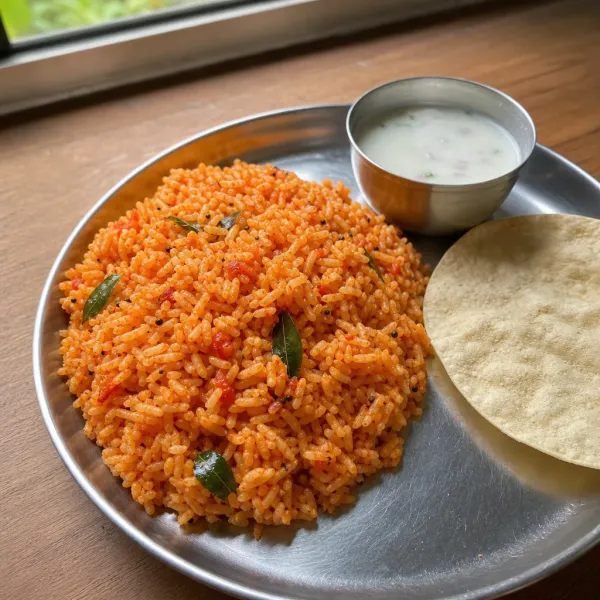
Thakkali Sadam
Authentic Tamil Brahmin thakkali sadam made with gingelly oil, shallots and country tomatoes. A classic variety rice cooked the traditional Iyer way.
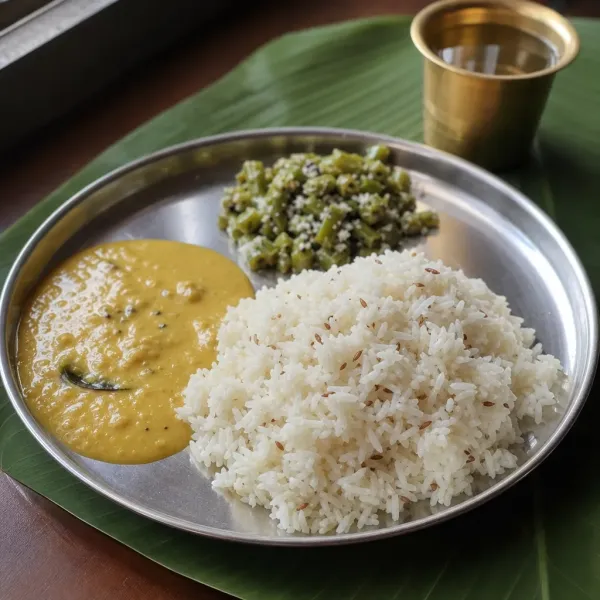
Jeerakasala Rice (Jeera Rice)
Traditional Kerala jeerakasala rice cooked with ghee and cumin in a Brahmin household style. Simple method, exact water ratio, no shortcuts.
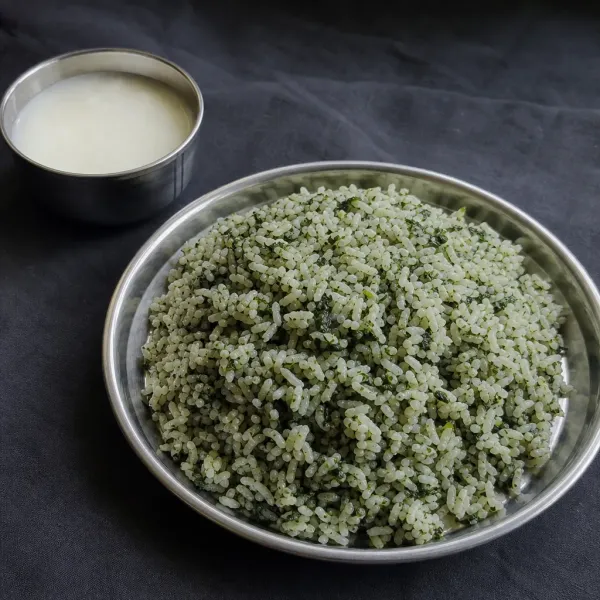
Keerai Sadam (Greens Rice)
Traditional Tamil Iyer keerai sadam made with Amaranth greens, toor dal, fresh coconut paste and gingelly oil. Everyday rice done right.
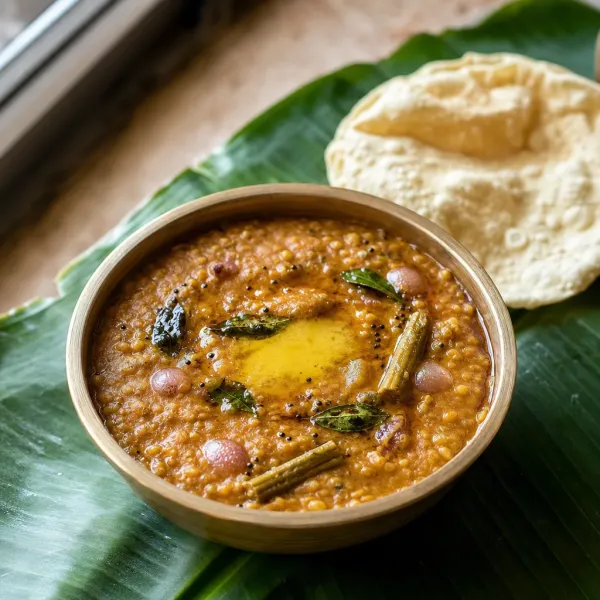
Sambar Sadam (One-Pot Rice and Sambar)
Authentic Tamil Iyer sambar sadam: rice and toor dal cooked with tamarind, drumstick and sambar powder, finished with a ghee tempering. One pot, real…
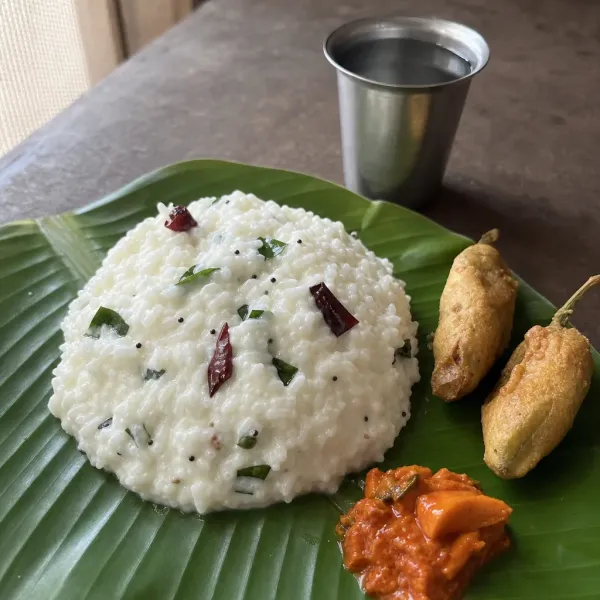
Thayir Sadam
Authentic Iyer-style thayir sadam with gingelly oil tempering, mustard seeds, curry leaves and fresh curd. The traditional Tamil Brahmin curd rice re…
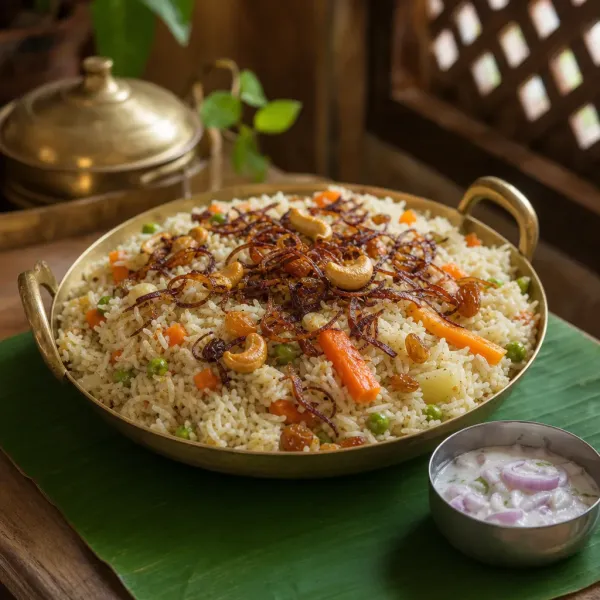
Vegetable Pulao (Mappila Style)
Traditional Malabar Mappila vegetable pulao cooked in coconut milk with whole spices and jeerakasala rice. Authentic Kerala Muslim household recipe.