

Ragi Ambali Recipe
Malayalam റാഗി അംബലിTamil கேழ்வரகு அம்பலிKannada ರಾಗಿ ಅಂಬಲಿTelugu రాగి అంబలి
- Prep10 min
- Soak / ferment12 hr
- Cook25 min
- Serves4
- DifficultyEasy
- DietVegan
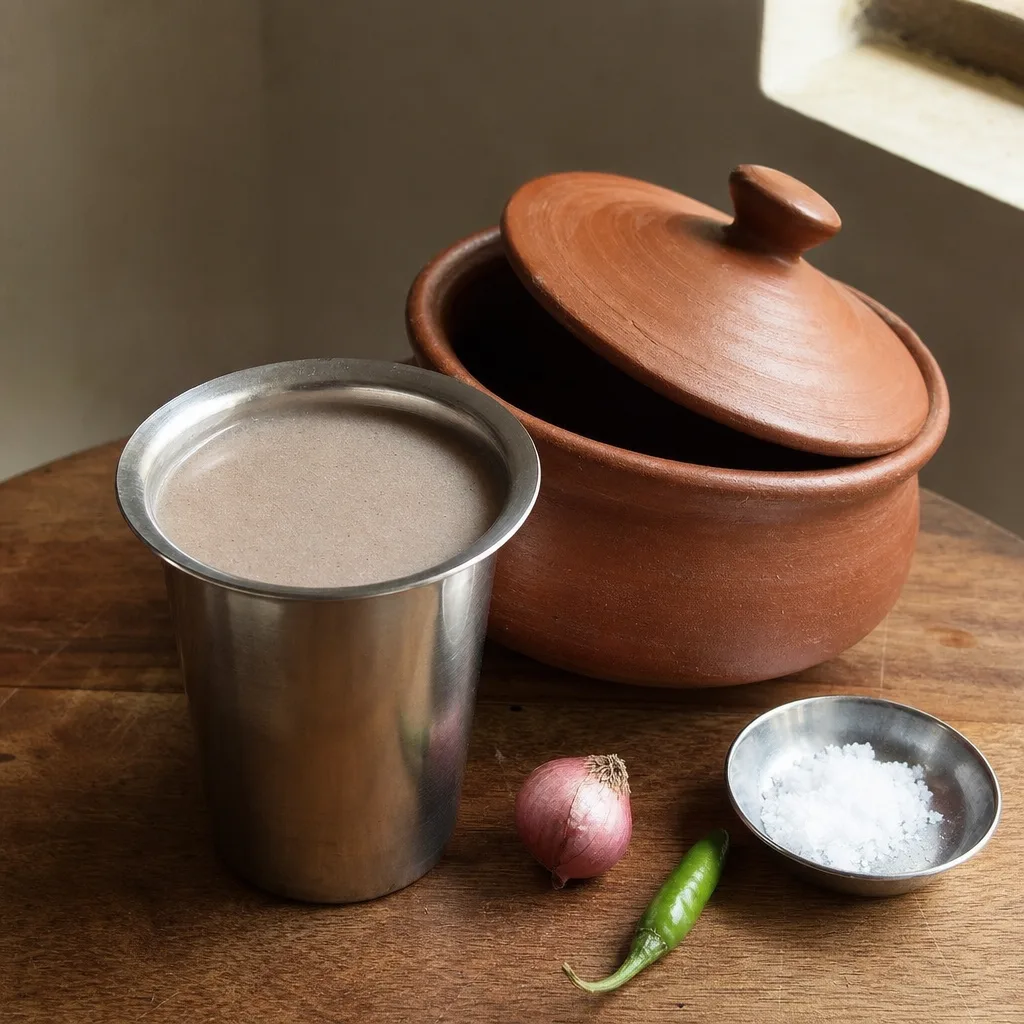
Ragi ambali is a working farmer's drink, made every evening so it is ready by morning. Finger millet flour is cooked into a thick, smooth porridge, then left in a clay pot overnight with a little water over it. By dawn the porridge has soured gently, and it is thinned with more water, seasoned with salt, and drunk from a tumbler or eaten from a bowl. It is cooling, filling, and deeply sustaining through a long morning of physical work.
In North Karnataka households this is not a recipe so much as a rhythm. The clay pot matters: it keeps the temperature steady through the night and contributes a faint mineral quality that a steel vessel does not. Households that do not have a clay pot use a thick-walled vessel and cover it tightly. The degree of sourness is personal. Some families thin it and drink it almost immediately after overnight fermentation; others leave it a second night in summer for a sharper taste.
The only additions at serving are salt and sometimes a small amount of raw onion or green chilli on the side, eaten between sips. Nothing is cooked into the drink itself. In some homes a spoonful of cold-pressed groundnut oil is stirred in just before drinking, which rounds the sourness and adds a little fat for the morning.
Ingredients (serves 4)
For the porridge base
To finish before serving
Method
Mix the flour smooth
Measure 200 g ragi flour into a heavy-bottomed vessel. Add 200 ml of the cooking water gradually, stirring with a wooden spoon or your hand until you have a smooth, lump-free paste. Take your time here. Any lump you leave now will survive the cooking and give you a grainy drink.
Bring the remaining water to a boil
Pour the remaining 500 ml of cooking water into a separate pot and bring it to a full boil. Keep it on high heat.
Cook the porridge
Pour the ragi paste into the boiling water in a steady stream, stirring continuously with a wooden spoon. The moment the paste hits the hot water it will begin to thicken. Keep the heat at medium and stir without stopping, reaching the bottom and sides of the pot. Cook for 12 to 15 minutes. The porridge is ready when it pulls away from the sides of the vessel, turns a shade darker, and no raw flour smell remains. It should be very thick, almost like a soft dough.
Transfer to the fermentation vessel
Scrape the hot porridge into a clean clay pot or thick-walled vessel. Smooth the surface with the back of a wet spoon. Let it cool uncovered at room temperature until it is no longer steaming, about 20 minutes.
Add the fermentation water and cover
Once the porridge is cool to the touch, pour the 400 ml of cool water gently over the top. Do not stir. The water sits as a layer above the porridge. Cover the pot with a lid or a clean cloth tied at the rim. Leave it in a warm corner of the kitchen, not in the refrigerator. In North Karnataka's climate, 10 to 12 hours overnight is enough. In a cold kitchen, 14 to 16 hours may be needed.
Judge the fermentation
In the morning the water layer on top will look slightly cloudy and smell pleasantly sour, like mild buttermilk. The porridge beneath will have softened. If there is any pink or orange discolouration or an unpleasant smell, discard and start again. A clean, gentle sourness is what you are looking for.
Thin and season
Stir the water layer into the porridge with a spoon, breaking the porridge down as you mix. If you want a thinner, drinkable consistency, add a little more cool water and stir until smooth. Add salt and stir again. Taste and adjust. Serve immediately once seasoned.
How to serve
Drunk from a steel tumbler or eaten from a bowl. Alongside: raw shallot, a green chilli, and sometimes a small piece of raw mango or pickle. Some households stir in a spoonful of cold-pressed groundnut oil just before drinking. These accompaniments are not part of the ambali itself.
Served with: Drunk from a steel tumbler or eaten from a bowl. Alongside: raw shallot, a green chilli, and sometimes a small piece of raw mango or pickle. Some households stir in a spoonful of cold-pressed groundnut oil just before drinking. These accompaniments are not part of the ambali itself.
Cook's tips
The clay pot is not decorative
A clay pot keeps the porridge at a stable cool temperature through the night, which encourages a clean lactic fermentation rather than an overly sharp one. If you use a steel vessel, the fermentation can be faster and sometimes more acidic than intended. Keep the steel vessel in the coolest part of the kitchen.
Summer versus winter timing
In hot weather, 8 to 10 hours is often enough. Check at 8 hours: if it smells sour and the water is cloudy, it is ready. Over-fermented ambali becomes very sharp and the porridge can develop an unpleasant edge. In cool weather, 14 to 16 hours may be needed.
Do not add salt during cooking
Salt goes in only at the moment of serving. Adding it during cooking or before fermentation can interfere with the souring process and also makes it impossible to adjust the seasoning once it has thinned.
Flour quality decides everything
Freshly milled ragi flour from a flour mill gives a noticeably better result than flour that has been sitting in a packet for months. Ragi flour goes stale and loses its characteristic slightly nutty, earthy quality. Buy in small quantities and use within four to six weeks.
Leftover ambali
If any thinned ambali remains after the morning, keep it covered in a cool place and drink it the same day. Once salt has been added and it has been thinned, it does not keep well into the next day.
Regional variations
Kongunad (Tamil Nadu) kezhvaragu ambali is thinner and soured with buttermilk; Andhra ragi java is cooked without fermentation and served warm as a health drink.
Glossary
- Ragi ರಾಗಿ
- Finger millet (Eleusine coracana), a small dark-brown grain grown widely across Karnataka and Tamil Nadu, ground into flour for porridges, flatbreads, and drinks.
- Ambali ಅಂಬಲಿ
- A fermented or soured porridge-drink made from millet or ragi flour; the word is used across Karnataka and parts of Tamil Nadu for this category of preparation.
- Java జావ
- The Telugu term for a cooked millet or grain gruel, usually unfermented and served warm; related to but distinct from ambali.
Two things decide whether this works: the porridge must be cooked long enough to lose all raw flour taste, and the fermentation must be stopped at the right moment, when the sourness is clean and mild. Rush the cooking and the drink is starchy and flat. Leave the fermentation too long and the sharpness overwhelms everything else. Get both right and you have something that is genuinely refreshing and sustaining in a way that is hard to explain until you have drunk it on an empty stomach on a warm morning.
More Beverages recipes

Thari Kanji
Traditional Mappila thari kanji made with roasted semolina, coconut milk and jaggery. A Malabar Ramadan iftar recipe from a Kerala kitchen.



Madurai Jigarthanda
Traditional Madurai Jigarthanda with slow-reduced milk, soaked badam pisin, nannari syrup and milk ice cream. Authentic Tamil Nadu summer drink recip…

Rose Milk (Roja Paal)
Classic Tamil Nadu rose milk made with a from-scratch rose syrup, full-fat chilled cow's milk, and optional sabja seeds. Simple, cold, and properly p…
Nannari Sharbat: Sarsaparilla Root Syrup Drink
Traditional Tamil Nadu nannari sharbat made from dried sarsaparilla root and rock sugar. A cooling summer syrup, stored and diluted to drink. Step-by…