

Poori with Potato Masala Recipe
Malayalam പൂരിTamil பூரிKannada ಪೂರಿTelugu పూరీ
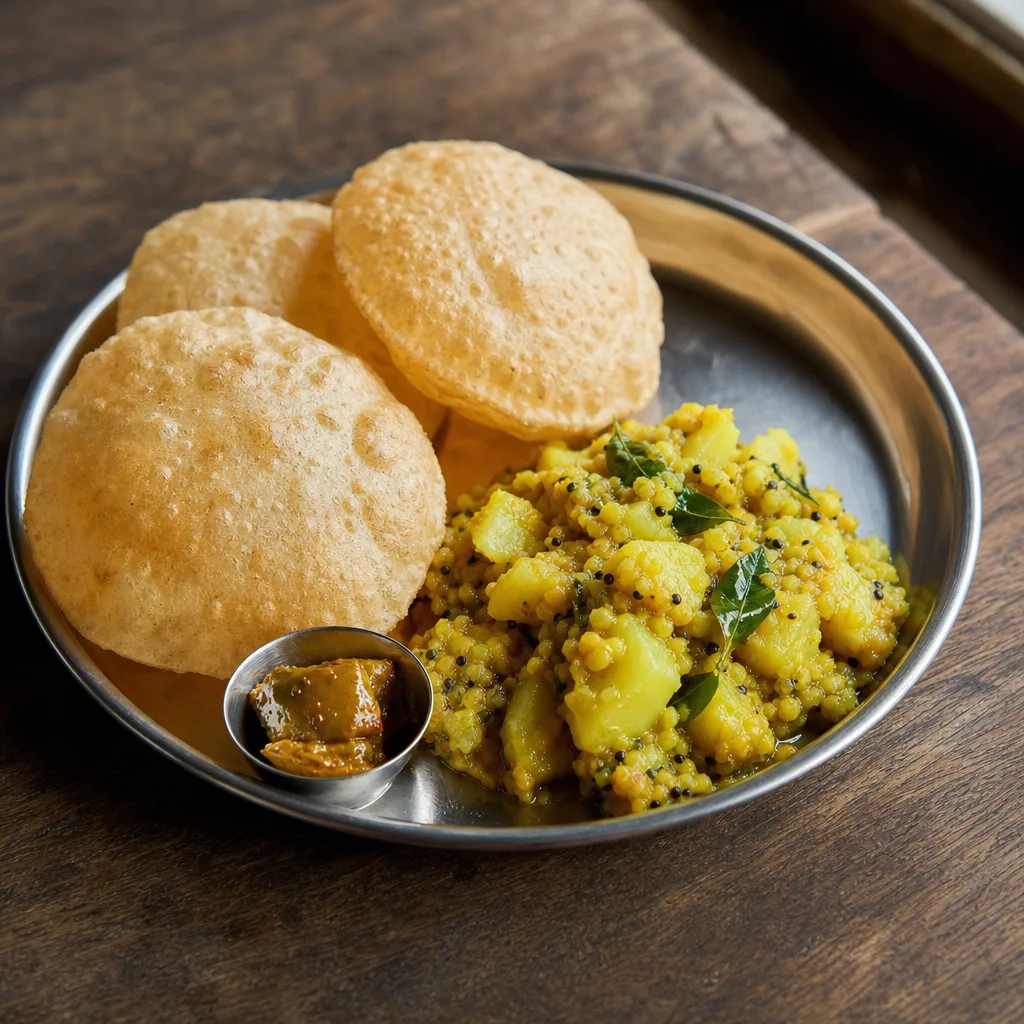
- Prep20 min
- Cook30 min
- Serves4
- DifficultyEasy
- DietVegetarian
In a Tamil Brahmin (Iyer) household, poori is a Sunday morning affair or a festival breakfast. It is made from plain atta — no semolina, no maida — kneaded stiff and fried in refined groundnut oil or occasionally in vanaspati. The dough is stiffer than chapathi dough because a slack dough absorbs oil and turns greasy rather than puffing.
The masala that comes alongside is urulaikilangu masala: boiled potatoes cooked briefly with mustard, curry leaves, green chilli, ginger, turmeric and a little onion. In many strict Brahmin households the onion is left out entirely and the masala is still full-flavoured. The potato is not mashed smooth but broken roughly so it holds some texture.
Households differ on whether to add a little fine rava (sooji) to the dough for crispness. Some do, some do not. Both are traditional. What is not traditional is adding oil to the dough itself — the fat comes entirely from the frying.
Ingredients (serves 4)
For the poori dough
For frying
For the potato masala
Method
Boil the potatoes
Put the potatoes in a pot, cover well with cold water and bring to a boil. Cook until a knife slides in without resistance, about 20 to 25 minutes depending on size. Drain, cool slightly, then peel and break them into rough chunks with your fingers. Do not mash them smooth.
Make the dough
Combine the atta, semolina if using, and salt in a wide bowl. Add warm water a little at a time, mixing as you go. You want a stiff, smooth dough — stiffer than chapathi dough. Knead firmly for 8 to 10 minutes until it is no longer sticky and springs back when you press it. Cover with a damp cloth and rest for 15 minutes.
Cook the masala
Heat 2 tbsp oil in a wide pan over medium heat. Add the mustard seeds and wait for them to pop. Add chana dal and urad dal and stir until they turn pale gold, about 30 seconds. Add curry leaves, green chillies and ginger — they will splutter, so stand back. If using onion, add it now and cook until translucent, about 4 minutes.
Finish the masala
Add turmeric and stir for a few seconds. Add the broken potato pieces and salt, then mix gently so the potato picks up the turmeric colour without turning to paste. Add 3 tbsp water, stir once, cover and cook on low heat for 3 minutes. The masala should be dry enough to scoop but not crumbly. Taste for salt. Set aside, covered.
Heat the oil
Pour groundnut oil into a heavy kadai to a depth of at least 5 cm. Heat over medium-high flame. The oil is ready when a tiny piece of dough dropped in rises to the surface immediately and sizzles briskly. If it sits at the bottom, the oil is too cool; if it browns in seconds, the oil is too hot. Aim for around 180°C.
Roll the pooris
Divide the rested dough into 16 equal balls, each about the size of a large marble (roughly 20 g each). Keep them covered. Roll each ball into a disc about 12 cm across and 2 to 3 mm thick. Use the lightest dusting of dry flour if needed, but the less flour the better — excess flour burns in the oil and darkens it quickly. Roll only a few ahead at a time.
Fry the pooris
Slide one disc gently into the hot oil. Within seconds it will begin to puff. Use the back of a slotted spoon to press it lightly and repeatedly — this encourages even puffing. Turn it once when the underside is pale gold, about 20 to 25 seconds. Fry the other side for another 15 seconds. The finished poori should be puffed, pale golden on both sides and not oily. Lift out and drain on a plate lined with paper.
Fry in batches
Fry one or at most two pooris at a time so the oil temperature does not drop. Between batches, let the oil return to temperature — a 20-second wait is usually enough. If the oil gets too hot, reduce the flame. Serve the pooris immediately; they deflate as they cool and cannot be revived.
How to serve
Urulaikilangu masala (already in this recipe as the side dish). In Tamil Brahmin homes a small portion of mango pickle or lime pickle is often placed on the side. Sweetened banana is common for children.
Served with: Urulaikilangu masala (already in this recipe as the side dish). In Tamil Brahmin homes a small portion of mango pickle or lime pickle is often placed on the side. Sweetened banana is common for children.
Cook's tips
Stiff dough is not optional
If the dough is soft like chapathi dough, the pooris absorb oil and come out heavy. They may still puff but they will be greasy. Add water very gradually and stop as soon as the dough comes together.
Oil temperature is everything
Too cool and the poori sits in oil, turns heavy and does not puff. Too hot and the outside browns before the inside has a chance to steam and balloon. Keep a steady medium-high flame and check with a small dough piece each time you take a break.
Onion in the masala
Strictly observant Brahmin households omit onion. The masala is still good — the chana dal, urad dal and curry leaves carry the flavour. If you do include onion, cook it until fully translucent before adding the potato.
Semolina in the dough
The 2 tbsp of fine rava is genuinely common in Tamil Brahmin households. It gives a slightly crisper texture and helps the poori hold its puff a little longer. If you leave it out, the poori is softer, which many prefer.
Rolling ahead
Do not roll all the discs at once and stack them. They stick together and tear. Roll two or three, fry them, then roll the next batch.
Regional variations
Andhra households make a thinner, crisper poori and pair it with a spicier potato curry (aloo masala with green chillies and curry leaves); Karnataka households, particularly in Udupi, serve poori with a sweeter, coconut-forward sagu.
Glossary
- Atta ஆட்டா
- Whole wheat flour milled from hard wheat; the standard flour for poori and chapathi.
- Kadai கடாய்
- A deep, wide, round-bottomed pan used for deep-frying and stir-frying.
- Urulaikilangu உருளைக்கிழங்கு
- Potato in Tamil.
- Chana dal கடலைப் பருப்பு
- Split Bengal gram; used in small quantities in tempering to add a nutty crunch.
- Urad dal உளுந்து பருப்பு
- Split black gram without husk; used in tempering, turns pale gold quickly.
- Rava ரவை
- Semolina; fine-ground durum wheat used in small quantities here to add crispness to the dough.
Two things decide whether the poori works: the dough must be stiff enough that it does not absorb oil, and the oil must be at the right temperature so the poori puffs the moment it goes in. Get those right and everything else follows.
More Breads & Staples recipes
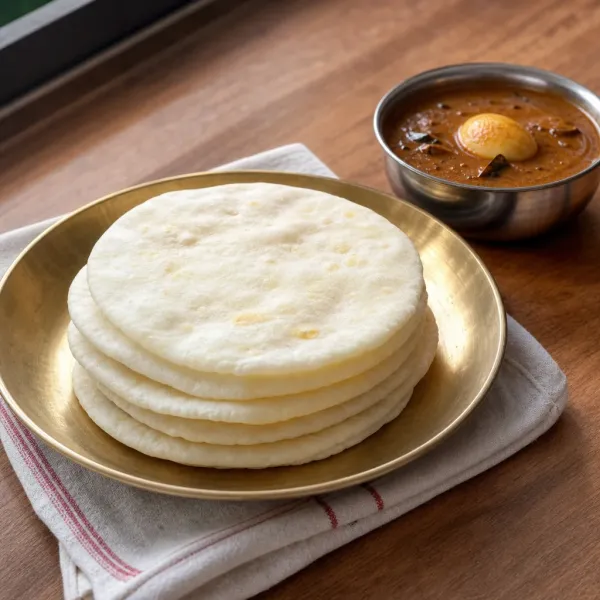
Neypathiri
Traditional Malabar Mappila neypathiri recipe: fine rice flour dough fried in pure ghee. Soft, white, and made for feast-day breakfasts.
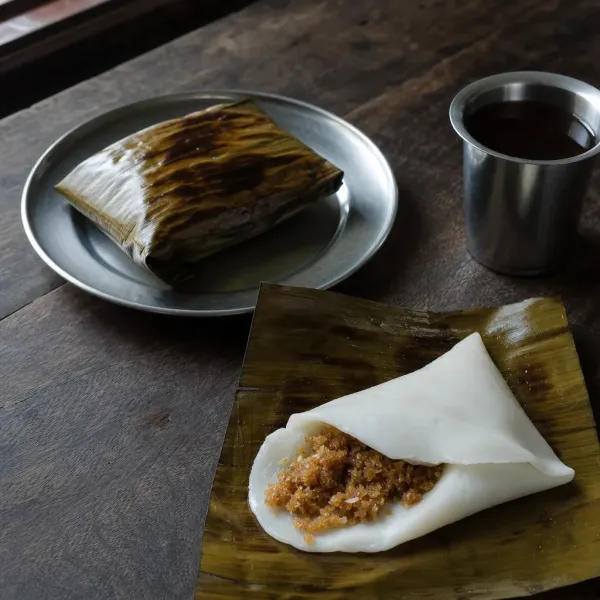
Ottada
Traditional Nasrani ottada recipe: soft rice flour flatbread filled with fresh coconut and jaggery, cooked on a banana leaf. Step-by-step Kerala meth…
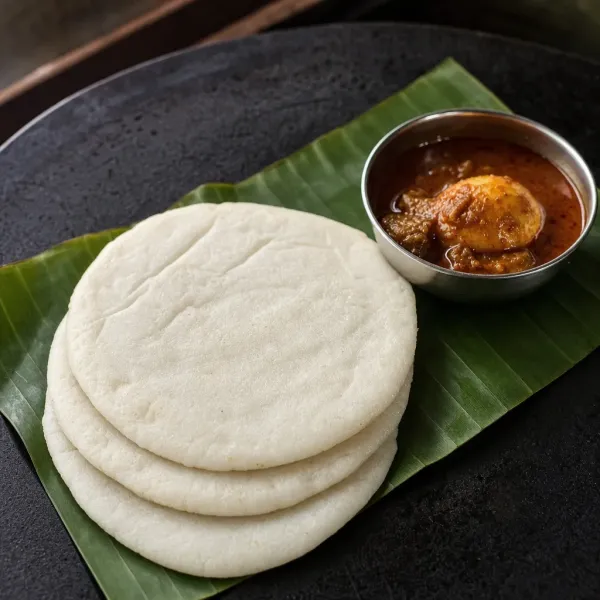
Orotti
Authentic Malabar Mappila orotti recipe: soaked raw rice ground and cooked into a soft dough, shaped by hand and finished on a dry iron griddle. Whit…
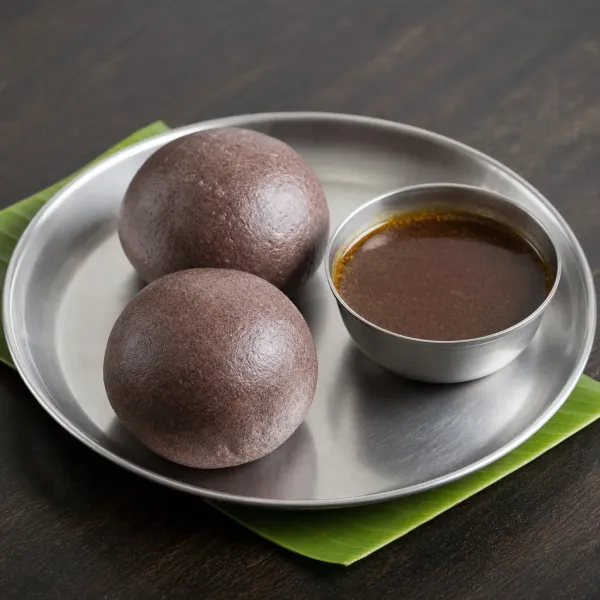
Ragi Mudde (Finger Millet Balls)
Traditional Karnataka ragi mudde recipe: finger millet balls cooked on the stovetop and shaped by hand, eaten with saaru or bassaru. Step-by-step met…
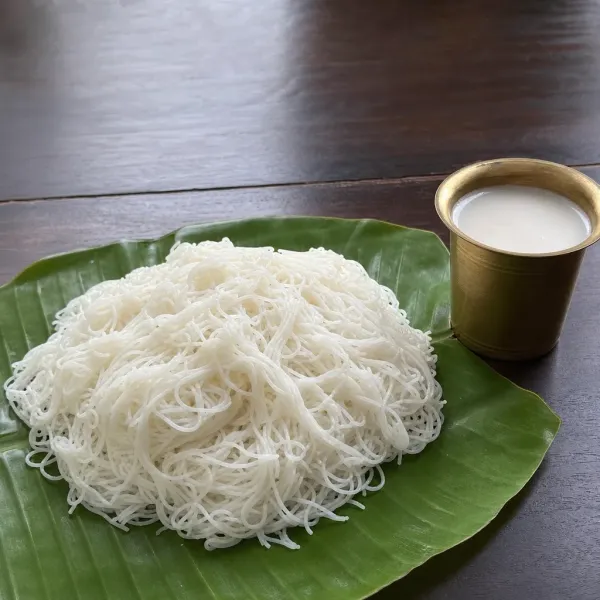
Rice Sevai (Santhakai)
Traditional Kongunad rice sevai made from fresh-ground raw rice dough, pressed and steamed. Step-by-step method with tips for the perfect soft noodle.
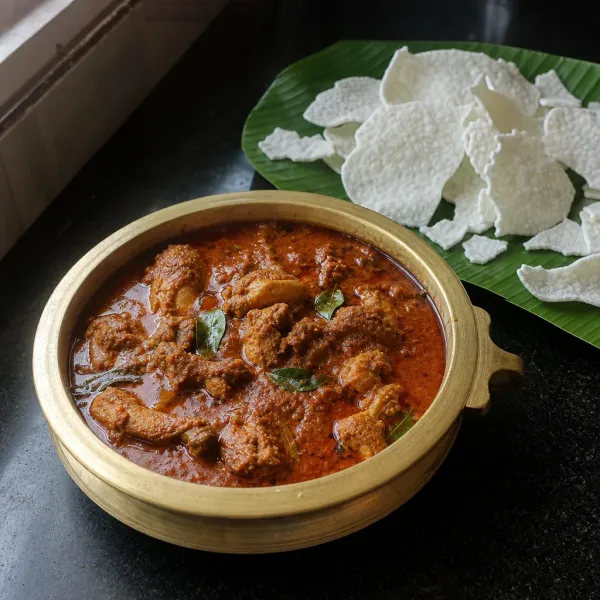
Kori Rotti: Mangalorean Crisp Rice Wafers with Chicken Gassi
Traditional Tulu-style kori rotti from coastal Karnataka: crisp dried rice wafers served with deep red coconut chicken gassi. Home recipe with fresh-…