Parippu Vada Recipe
Malayalam പരിപ്പ് വടTamil பருப்பு வடைKannada ಪರಿಪ್ಪು ವಡೆTelugu పరిప్పు వడ
- Prep20 min
- Soak / ferment3 hr
- Cook40 min
- Serves4
- DifficultyEasy
- DietVegan
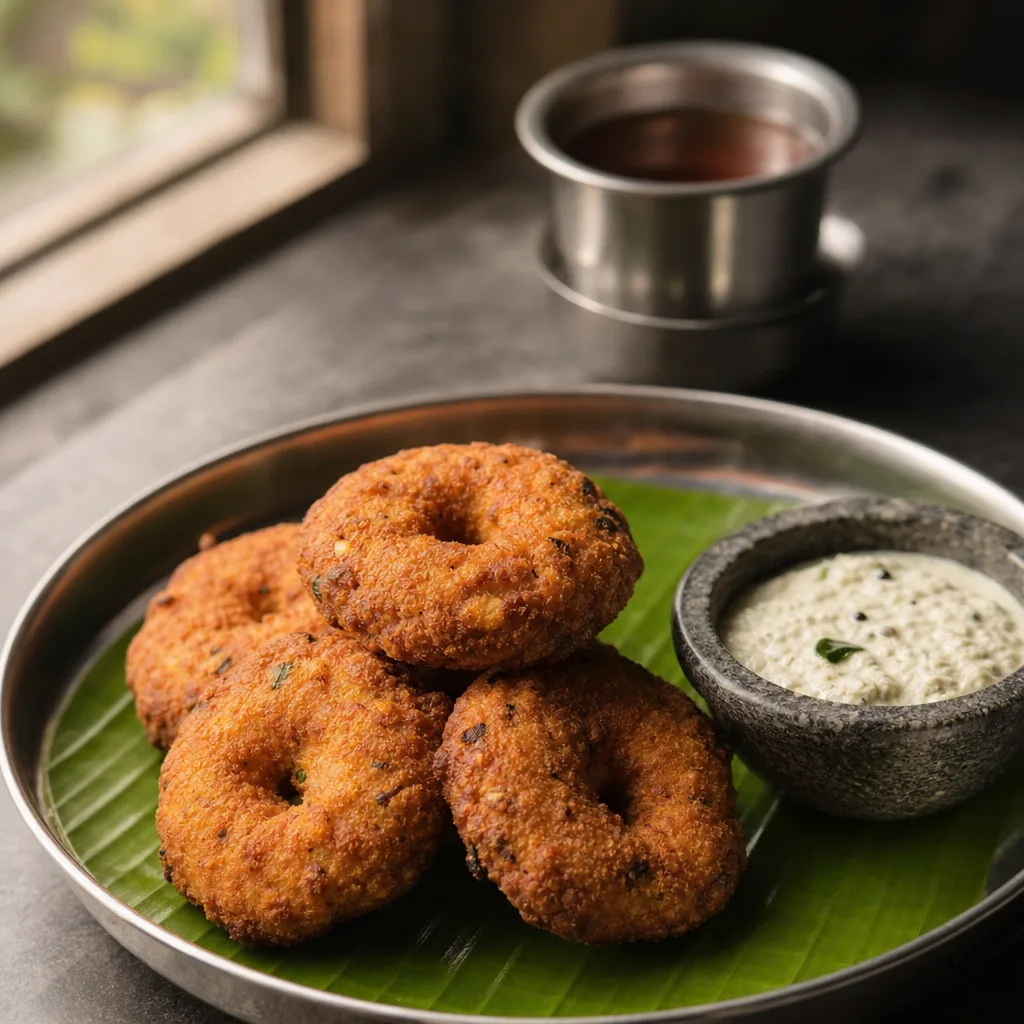
Parippu vada is the vada Kerala claims as its own. It is sold at every tea shop in the state, stacked on a plate beside a glass of black chai, and it is also made at home on rainy afternoons or as a quick evening snack. The batter is chana dal, coarsely ground, barely wet, seasoned with shallots, green chilli, ginger and curry leaves. Nothing else. The result is a flat, rough-edged disc that is crunchy on the outside and slightly dense in the middle.
The technique is straightforward but the ratio of water matters more than almost anything else. Too much water and the vada will not hold its shape in the oil; too little and it cracks badly when you flatten it. Experienced cooks grind the dal almost dry, keeping back a tablespoon of the soaking water at most. The coarse grind is deliberate: some whole dal remains, which gives the finished vada its characteristic bite.
Households differ mainly in the amount of green chilli and ginger. Some families add a pinch of asafoetida; others do not. A few cooks in northern Kerala add a small amount of fennel seed, though this is not universal. What does not change is the fat: coconut oil, hot enough that the vada sizzles the moment it goes in.
Ingredients (serves 4)
For the vada
Method
Soak the dal
Rinse the chana dal twice in cold water, then cover with fresh cold water and leave to soak for 3 hours. The dal is ready when it splits easily between your fingers with no hard centre. Drain it completely in a colander and shake out as much water as you can; surface moisture is the enemy of a crisp vada.
Grind coarsely
Transfer the drained dal to a mixer-grinder. Do not add any water. Pulse in short bursts, scraping down the sides between pulses. You want a rough, grainy paste where perhaps one quarter of the dal is still in recognisable pieces. If the grinder struggles, add no more than one tablespoon of water total. The batter should hold its shape when pressed into a ball; if it is wet enough to drip, it will break in the oil.
Mix in the aromatics
Tip the ground dal into a wide bowl. Add the chopped shallots, green chillies, grated ginger, curry leaves and salt. Mix thoroughly with your hand, pressing and folding so the aromatics are evenly distributed through the stiff batter. Taste a small pinch for salt and heat.
Shape the vadas
Divide the batter into 14 to 16 equal portions, each roughly the size of a large lime. Wet your palm lightly with water. Place one portion in your palm and press it flat with the fingers of your other hand into a disc about 1 cm thick and 6 cm across. The edges will be rough and uneven; that is correct. Set the shaped vadas on a plate as you go.
Heat the oil
Pour the coconut oil into a deep, heavy kadai to a depth of at least 5 cm. Heat over a medium-high flame until a small piece of batter dropped in rises to the surface within two seconds and sizzles steadily. The oil should be around 175°C. If it smokes heavily, lower the flame slightly before adding the vadas.
Fry the first batch
Slide three or four vadas gently into the oil, keeping them apart so they do not stick to each other. Do not crowd the kadai or the oil temperature will drop and the vadas will absorb oil rather than fry. Leave them undisturbed for 2 minutes until the underside is set and pale golden.
Turn and finish frying
Flip each vada carefully using a slotted spoon or spider. Fry the second side for another 2 to 3 minutes. The finished vada should be an even deep golden-brown on both sides, with a dry, crisp surface. Press one lightly with the back of a spoon; it should feel firm, not soft. Lift out and drain on a plate lined with paper.
Fry the remaining batches
Allow the oil to return to temperature between batches; this takes about a minute. Fry the remaining vadas in the same way. If the oil becomes too dark or smells burnt, discard it and use fresh oil for the last batch.
Serve immediately
Parippu vada is at its best within ten minutes of frying, while the crust is still hard and the interior is hot. Transfer to a serving plate and serve at once.
How to serve
Hot black tea (chaya) or milky tea. Often served alongside coconut chutney at home, though at tea shops it is eaten plain.
Served with: Hot black tea (chaya) or milky tea. Often served alongside coconut chutney at home, though at tea shops it is eaten plain.
Cook's tips
The water problem
If your batter is too wet, the vadas will spread flat and break apart in the oil. Spread the drained dal on a clean kitchen cloth for five minutes before grinding to remove extra surface moisture. Do not try to rescue wet batter by adding more dal; it will not bind.
Grinding without a mixer
Traditionally the dal was ground on a wet grinder or a heavy stone. If you have a wet grinder, use it on the coarsest setting. The texture will be better than a mixer-grinder, which can over-process quickly.
Reheating
Leftover vadas lose their crunch quickly. To restore it, place them in a dry pan over medium heat for 3 to 4 minutes per side, or in an oven at 180°C for 8 minutes. Do not microwave them.
Asafoetida variation
Some households add a small pinch of asafoetida (kayam) to the batter. This is a genuine household variation, not a mistake. Add it with the other aromatics in step 3 if your family uses it.
Regional variations
Masala vada (paruppu vadai) in Tamil Nadu uses a similar base but typically adds fennel seeds, curry leaves and sometimes grated coconut; the texture and seasoning differ. Urad dal medu vada is a separate dish entirely.
Glossary
- Kadala parippu കടല പരിപ്പ്
- Chana dal; split Bengal gram, the defining ingredient of this vada.
- Kunjulli കുഞ്ഞുള്ളി
- Small red shallots used throughout Kerala cooking; sweeter and more pungent than large onions.
- Kayam കായം
- Asafoetida; used sparingly as a digestive and flavouring in some Kerala households.
- Kadai കടായി
- Deep, rounded iron or steel cooking vessel used for deep frying and stir-frying.
- Chaya ചായ
- Tea; in the Kerala tea-shop context, usually strong black tea or tea with milk and sugar.
Two things decide whether this works: the grind and the oil temperature. Grind the dal too fine or too wet and the vada will be dense and greasy. Fry at the wrong temperature and the outside will colour before the inside cooks through, or the vada will sit in the oil absorbing fat instead of crisping. Get those two right and everything else follows.
More Snacks recipes
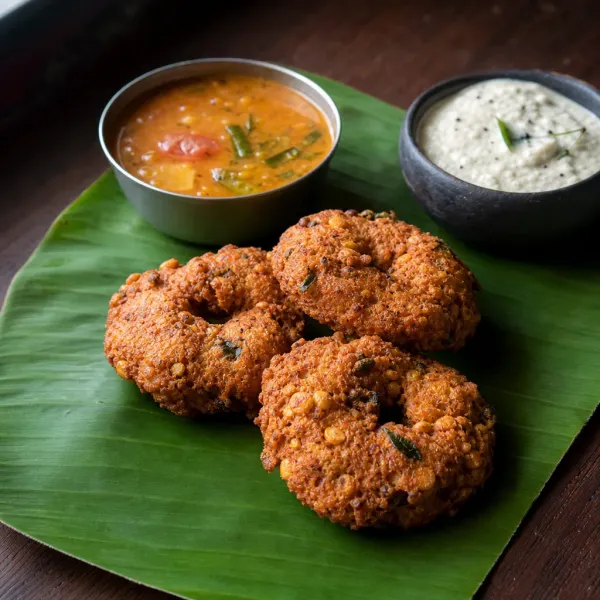
Masala Vada (Paruppu Vadai)
Traditional Tamil Iyer paruppu vadai made with coarse-ground chana dal, shallots, green chillies and curry leaves, deep-fried in gingelly oil.
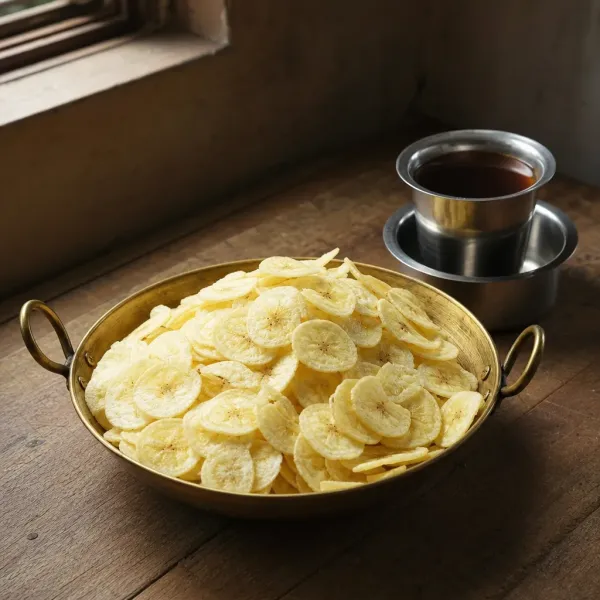
Kaya Upperi
Traditional Kerala kaya upperi recipe: raw nendran banana chips deep-fried in fresh coconut oil and salted the old-fashioned way. Crisp, simple, auth…
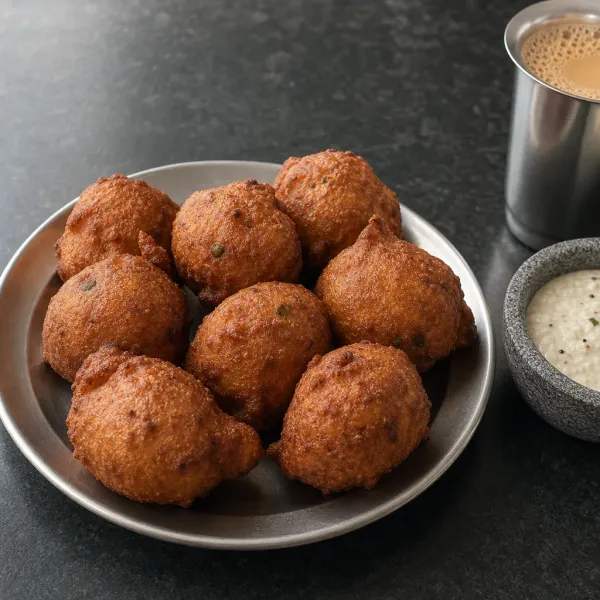
Mysore Bonda
Traditional Mysuru-style maida bonda made with thick sour curd. Crisp shell, soft inside. Step-by-step Karnataka household recipe with tips.
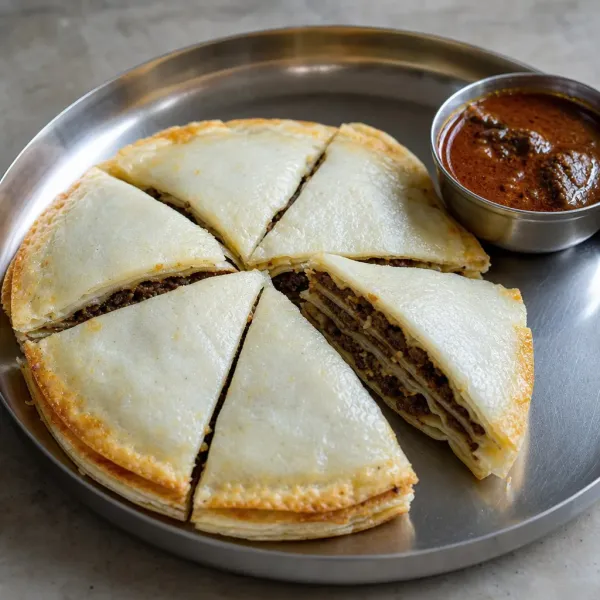
Chattipathiri
Traditional Malabar Mappila chattipathiri: thin rice flour crepes layered with spiced minced beef, sealed with egg, and baked in a chatti. Step-by-st…
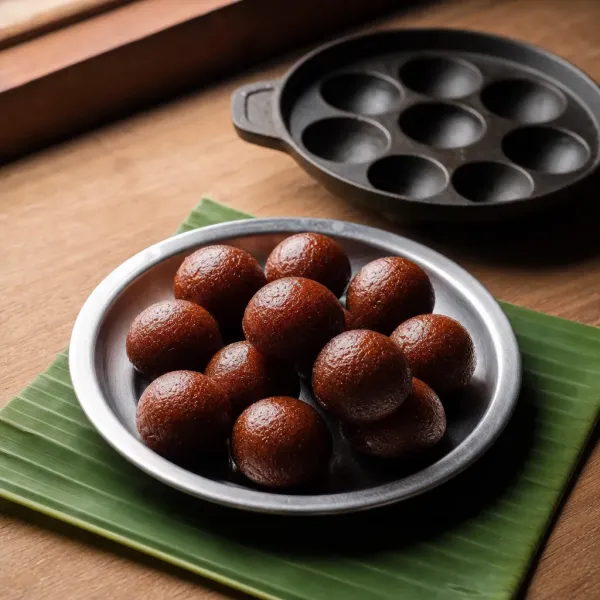
Unniyappam
Traditional Kerala unniyappam made with ground raw rice, dark jaggery, ripe nendran banana and coconut oil in a cast-iron appakaram. Step-by-step hou…