Kaya Upperi Recipe
Malayalam കായ ഉപ്പേരിTamil வாழைக்காய் சிப்ஸ்Kannada ಬಾಳೆಕಾಯಿ ಚಿಪ್ಸ್Telugu అరటికాయ చిప్స్
- Prep20 min
- Cook40 min
- Serves4 to 6 as a snack
- DifficultyMedium
- DietVegan
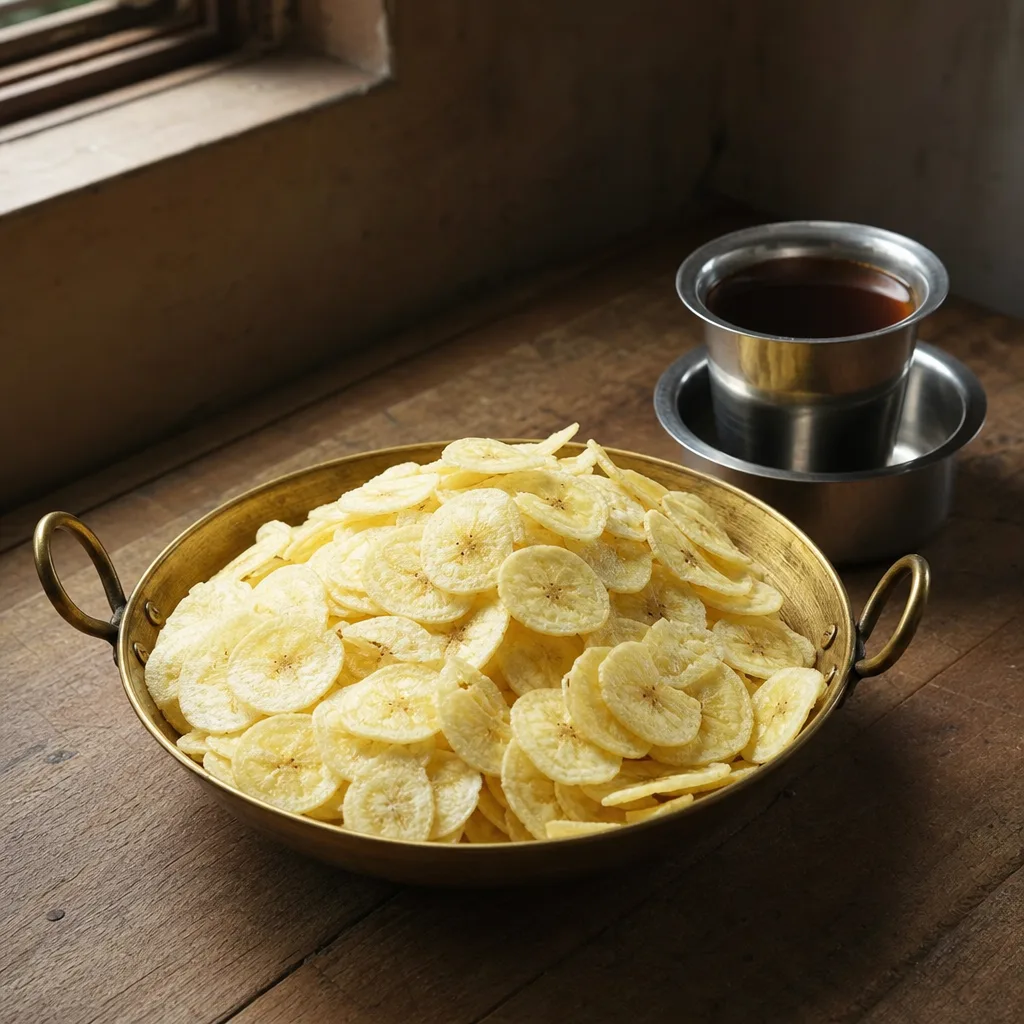
Kaya upperi is made from raw, starchy nendran bananas – the large, firm variety grown all over Kerala. The skin is green and the flesh pale yellow-white. You slice them thin, fry them in fresh coconut oil until they are rigid and snapping-crisp, and season with fine salt dissolved in water that is flicked into the hot oil at the last moment. The result is a chip that tastes unmistakably of coconut oil, with a clean starchy flavour and a faint savoury edge.
In Kerala households this is made for Onam sadya, for Vishu, and whenever a bunch of nendran is ripening too fast and needs to be used. It also appears in every tea-shop and train-station snack packet in the state. Home-fried upperi and the commercial kind are different things: the home version is a little thicker, a little less uniform, and the coconut oil flavour is more pronounced because the oil is fresh.
The only real variables between households are thickness of the slice and how much salt goes in. Some cooks add a pinch of turmeric to the salt water, which gives a faint yellow tint and a very mild earthiness. That is a matter of taste rather than tradition, and both ways are entirely common.
Ingredients (serves 4 to 6 as a snack)
Main
Method
Prepare the salt water
Dissolve 1½ tsp fine salt in 3 tbsp water in a small bowl. If you are using turmeric, stir it in now. Set this beside the stove. You will need it quickly when the chips are nearly done, so it must be ready before you start slicing.
Peel and hold the bananas
Cut off both tips of each banana. Score the skin lengthwise along the ridges with a knife and peel it away. The raw flesh will oxidise and discolour quickly once peeled, so work with one banana at a time and slice directly into the oil as described in the next step. Do not soak in water; moisture is the enemy of a crisp chip and of hot oil.
Heat the oil
Pour 600 ml coconut oil into a wide, deep kadai or uruli and heat over a medium flame. The oil is ready when a thin slice of banana dropped in rises to the surface immediately and begins to sizzle steadily. If it sinks and sits, the oil is too cool; if it browns in under thirty seconds, the oil is too hot. Aim for around 160–165°C if you have a thermometer, but the visual test is reliable.
Slice thin and directly into the oil
Using a mandoline or a sharp knife, slice the peeled banana crosswise into rounds 2 to 2.5 mm thick. Slice directly over the hot oil so each round falls in as it is cut. Do not pile slices on a board and add them in batches – the cut surface oxidises and the slices stick together. Work steadily, one banana at a time.
Fry without crowding
Keep the flame at medium throughout. Stir gently with a slotted spoon every minute or so to separate any slices that have stuck. The chips will look pale and slightly translucent at first, then gradually turn a deeper cream colour. Do not rush this by raising the heat; chips fried too fast brown on the outside before the moisture inside has left, and they will soften as they cool.
Watch for the sizzle to quieten
After 8 to 10 minutes per batch, the vigorous sizzling will die down noticeably. This tells you most of the moisture has cooked out. The chips will feel lighter when you lift them with the spoon. They will still look pale golden rather than deeply brown – that is correct. Do not wait for a deep colour; they continue to crisp as they cool.
Add the salt water
Hold the bowl of salt water at arm's length and flick it into the oil in a thin stream while stirring. The oil will spatter violently for a few seconds – this is expected and is why you stand back. Stir continuously. The water instantly evaporates and deposits a fine film of salt on the chips. This step takes only about 20 seconds.
Finish and drain
Stir for another 30 seconds after the spattering stops, then lift the chips out with the slotted spoon and spread them in a single layer on a plate lined with paper or a clean cloth. Do not stack them while hot. They will feel slightly soft when they come out of the oil; they become fully crisp within two to three minutes of draining.
Fry subsequent batches
Allow the oil to return to temperature between batches. The oil will carry a little starch and salt from the previous batch, which is normal and adds flavour. If the oil darkens excessively or smells burnt, strain it before continuing. A fresh batch of 600 ml coconut oil will comfortably fry four large nendran bananas in three or four rounds.
Cool completely before storing
Spread all the chips in a thin layer and leave them uncovered for at least 15 minutes before transferring to an airtight tin. Storing warm chips traps steam and makes them go limp within hours. Once fully cool and crisp, they keep well for 10 to 12 days in a sealed tin at room temperature.
How to serve
Eaten on their own as a snack with tea, or served as one of the pappadam-and-pickle accompaniments on an Onam sadya banana leaf. They appear alongside rice and curry at everyday meals as a crunchy side.
Served with: Eaten on their own as a snack with tea, or served as one of the pappadam-and-pickle accompaniments on an Onam sadya banana leaf. They appear alongside rice and curry at everyday meals as a crunchy side.
Cook's tips
The banana must be fully raw
Even one day of ripening changes the starch-to-sugar ratio enough that the chips brown too fast and turn soft after cooling. Buy bananas that are hard to the touch and completely green, with no give at all when pressed.
Mandoline versus knife
A mandoline gives even thickness and is the traditional tool in households that make this regularly. A sharp knife works but requires practice to keep slices uniform. Uneven slices mean some chips burn before others are done.
Why the oil must be coconut oil
The flavour of kaya upperi is inseparable from coconut oil. Refined vegetable oil produces a chip that is crisp but tastes of nothing. Use fresh, unrefined coconut oil – the kind that smells distinctly of coconut at room temperature.
Reusing the frying oil
The oil can be strained and reused two or three times for the same purpose. After that it will have absorbed too much starch and the salt water additions will cause it to foam badly. Keep it separate from oil used for other cooking.
If the chips go soft after storage
Spread them on a plate and warm in a low oven (100°C) for five minutes. They will crisp again as they cool. This works once; chips that have absorbed moisture repeatedly will not recover well.
Regional variations
Jaggery-coated sharkkara upperi (sweet banana chips) is a distinct preparation made for Onam sadya; Kozhikodan banana chips are thicker and sometimes spiced with turmeric.
Glossary
- Kaya കായ
- Raw, unripe banana; specifically nendran in this context, the large starchy variety used for cooking rather than eating fresh.
- Upperi ഉപ്പേരി
- A category of Kerala fried snacks, both savoury and sweet; the word covers both banana chips and jackfruit chips.
- Nendran നേന്ത്രൻ
- A specific cultivar of banana grown widely in Kerala, large and starchy when raw, used for chips, chips, and banana flour.
- Kadai കടായി
- A wide, deep, round-bottomed cooking vessel used for frying; in Kerala households often a heavy iron or brass uruli is used instead.
- Uruli ഉരുളി
- A wide, shallow, bell-metal or brass vessel traditional to Kerala kitchens, used for frying, making payasam, and cooking large quantities.
- Sharkkara upperi ശർക്കര ഉപ്പേരി
- The sweet variant of banana chips coated in jaggery syrup; a separate dish from the savoury kaya upperi written here.
Two things decide whether kaya upperi works: the ripeness of the banana and the temperature of the oil. A banana with even a trace of yellow in its skin will give you soft, sweet chips that will not stay crisp. Oil that is too hot burns the outside before the moisture escapes; oil that is too cool gives greasy chips that never properly crisp. Keep the flame steady at medium, watch the sizzle, and the rest takes care of itself.
More Snacks recipes
Masala Vada (Paruppu Vadai)
Traditional Tamil Iyer paruppu vadai made with coarse-ground chana dal, shallots, green chillies and curry leaves, deep-fried in gingelly oil.
Parippu Vada
Traditional Kerala parippu vada made with coarsely ground chana dal, shallots, green chilli and curry leaves, deep-fried in coconut oil until crisp.
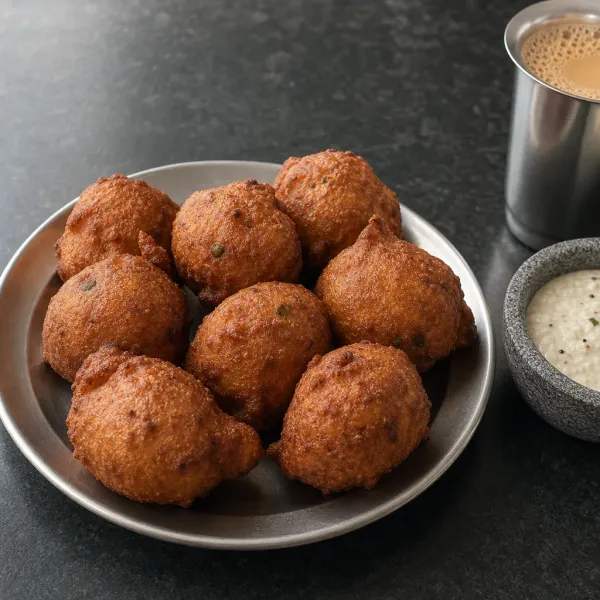
Mysore Bonda
Traditional Mysuru-style maida bonda made with thick sour curd. Crisp shell, soft inside. Step-by-step Karnataka household recipe with tips.
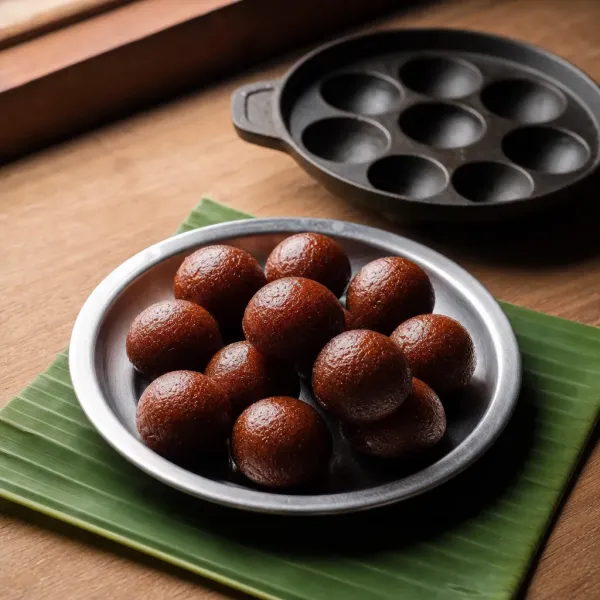
Unniyappam
Traditional Kerala unniyappam made with ground raw rice, dark jaggery, ripe nendran banana and coconut oil in a cast-iron appakaram. Step-by-step hou…
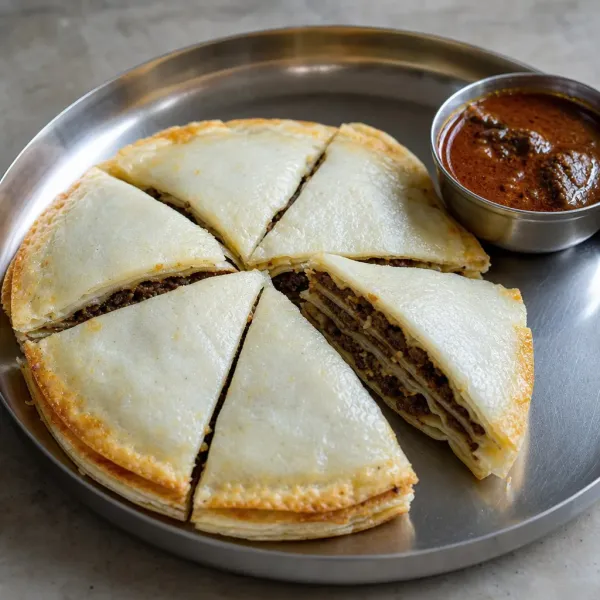
Chattipathiri
Traditional Malabar Mappila chattipathiri: thin rice flour crepes layered with spiced minced beef, sealed with egg, and baked in a chatti. Step-by-st…