

Mutta Mappas Recipe
Malayalam മുട്ട മാപ്പാസ്Tamil முட்டை மாப்பாஸ்Kannada ಮುಟ್ಟ ಮಾಪ್ಪಾಸ್Telugu ముట్ట మాప్పాస్
- Prep20 min
- Cook35 min
- Serves4
- DifficultyEasy
- DietEgg
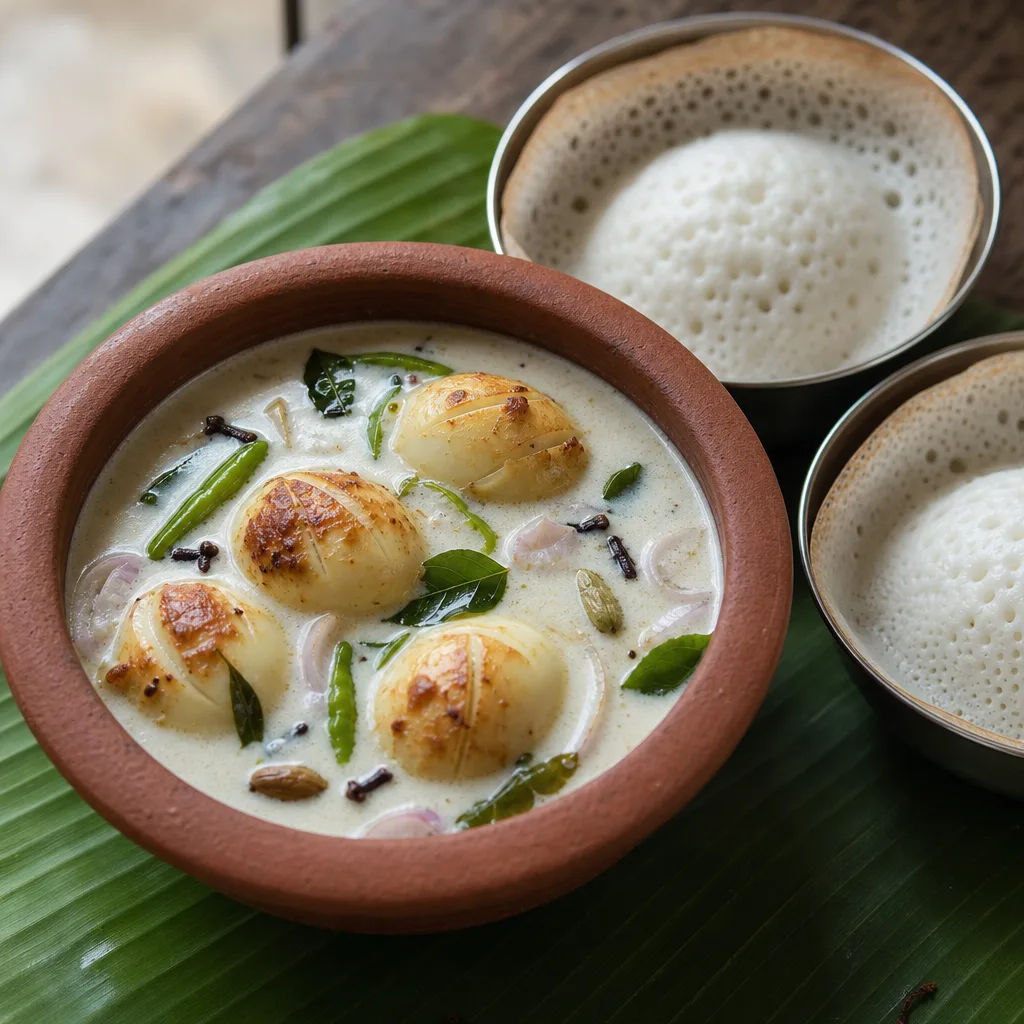
Mutta mappas is a Mappila Muslim dish from the Malabar coast – Kozhikode, Kannur, Malappuram – eaten at breakfast or for the morning meal after Fajr prayer, almost always with appam. It is a gently spiced egg curry cooked in coconut milk, fragrant with whole spices, and it sits somewhere between a stew and a gravy: not thin like a soup, not thick like a dry masala, but a loose, ivory-coloured sauce that soaks into the lacy bowl of an appam perfectly.
The eggs are hard-boiled, then shallow-fried briefly in coconut oil until the whites blister and take a little colour. That step is not decoration; it gives the egg a skin that holds together in the gravy and adds a faint roasted note that balances the sweetness of the coconut milk. The base is shallots, ginger, green chillies and whole spices – no tomato, no garam masala, no coriander powder. The Mappila kitchen keeps this dish clean and aromatic rather than heavily spiced.
Households differ mainly on heat: some families add four green chillies, some add seven. A few cooks add a small piece of pandan leaf (rampe) to the oil at the start, which is a Malabar habit with a faint Moplah-Arab lineage. The coconut milk is added in two stages – thin milk first to cook the shallots through, thick milk last and off the heat or on the lowest flame so it does not split. Rushing that final stage is the one thing that ruins the dish.
Ingredients (serves 4)
Eggs
For frying the eggs
For the gravy
Curry leaf tempering (kariveppila thalikkal)
Method
Hard-boil the eggs
Place the eggs in a saucepan, cover with cold water and bring to a boil over medium heat. Once boiling, cook for exactly 10 minutes. Drain and transfer immediately to a bowl of cold water. Leave for 5 minutes, then peel. The yolks should be fully set with no grey ring – a grey ring means they were overcooked and the yolk will be chalky in the gravy.
Score and fry the eggs
Make three or four shallow cuts through the white of each peeled egg with a knife – this lets the gravy penetrate later. Heat 3 tbsp coconut oil in a wide pan over medium-high heat. Add a pinch of salt to the oil. Slide in the eggs and fry, turning gently, until the whites are golden-blistered and lightly browned in patches, about 3 to 4 minutes. Remove and set aside. The inside stays soft; only the surface colours.
Bloom the whole spices
In a wide, heavy-bottomed pan, heat 2 tbsp coconut oil over medium heat. Add the cardamom, cloves, cinnamon and bay leaf. Let them sizzle for about 30 seconds until the oil smells fragrant. Do not let them darken or the gravy will taste bitter.
Cook the shallots
Add the sliced shallots and a pinch of salt. Cook over medium heat, stirring often, for 8 to 10 minutes until the shallots are soft, translucent and just beginning to turn pale gold at the edges. They should not brown deeply – this is not a brown-onion base. Soft, sweet, just-golden shallots give the gravy its mild sweetness.
Add ginger, garlic and chillies
Add the ginger matchsticks, sliced garlic and slit green chillies. Stir and cook for 3 to 4 minutes until the raw smell of the ginger and garlic is gone. The mixture should look soft and fragrant, not dry or stuck to the pan. Add a splash of water if it catches.
Pour in the thin coconut milk
Add the thin coconut milk and salt. Stir well, scraping up anything from the bottom of the pan. Bring to a gentle simmer over medium-low heat. Do not let it boil hard. Simmer uncovered for 8 minutes until the gravy reduces slightly and the shallots are completely tender.
Add the fried eggs
Slide the fried eggs into the simmering gravy. Spoon the liquid over them. Let them sit in the thin coconut milk over low heat for 5 minutes so the scored whites absorb the spiced gravy. Turn them once, gently.
Finish with thick coconut milk
Lower the heat to the absolute minimum or take the pan off the heat entirely. Pour in the thick coconut milk and stir it in slowly. If you are on the flame, keep it on the lowest setting and do not let the gravy bubble at all once the thick milk is in. Simmering thick coconut milk causes it to split and turn grainy. Stir for one minute, taste for salt, then take off the heat.
Temper the curry leaves
In a very small pan, heat 1 tsp coconut oil until it shimmers. Add the curry leaves – they will crackle and spit, so stand back. Pour this immediately over the mappas. Add a final teaspoon of raw coconut oil directly over the surface of the gravy. This last raw oil is a Mappila habit that gives the dish a fresh coconut fragrance.
Rest and serve
Cover the pan and let the mappas rest for 5 minutes before serving. The gravy will be ivory-coloured, loose and lightly fragrant with whole spices. The eggs will have absorbed the flavour through their scored surface. Serve warm, not piping hot.
How to serve
Appam (lacy rice hoppers). Also eaten with pathiri (thin rice flatbread) in some Malabar households, or with plain white rice at lunch.
Served with: Appam (lacy rice hoppers). Also eaten with pathiri (thin rice flatbread) in some Malabar households, or with plain white rice at lunch.
Cook's tips
Extracting coconut milk at home
Grate one medium coconut. Add 200 ml warm water, squeeze through a muslin cloth – this is your thick milk. Add another 300 ml water to the same grated coconut, squeeze again – this is the thin milk. If using canned coconut milk (400 ml can), use the top thick layer (about 200 ml) as thick milk and dilute the rest with water to get 300 ml thin milk.
Why the thick milk splits
Thick coconut milk breaks when it boils: the fat separates and the gravy looks curdled and oily. Always add it off the heat or on the lowest possible flame, and stir it in gently. If it does split, there is no easy fix – the texture is lost.
Scoring the eggs
The cuts through the white are shallow – just 3 to 4 mm deep. They let the gravy in without breaking the egg apart. Some cooks halve the eggs lengthwise instead; that works but the presentation is different.
Heat level
Five green chillies gives a moderate heat that most households would call normal. Malabar cooking can go higher – up to eight chillies in some homes. Taste one chilli before you start; if they are very hot, use three.
Storing leftovers
Mappas keeps well for one day in the refrigerator. Reheat very gently over low heat, stirring slowly. Do not microwave on high or the coconut milk will split. The gravy thickens as it sits; add a splash of water when reheating.
Regional variations
Nasrani (Syrian Christian) households in central Kerala make a similar egg stew called mutta ishtu, which is milder, uses thin and thick coconut milk in two stages, and adds no whole spices beyond cardamom and cloves; the Mappila mappas is spicier, uses shallots and green chillies more generously, and the coconut milk is not separated into two pressings in the same way.
Glossary
- Mappas മാപ്പാസ്
- A Mappila Muslim curry style using coconut milk and whole spices; applied to meat, fish or eggs.
- Cheriya ulli ചെറിയ ഉള്ളി
- Small South Indian shallots, the standard allium in Kerala cooking; sweeter and more aromatic than large onions.
- Kariveppila കറിവേപ്പില
- Curry leaf (Murraya koenigii); added fresh to hot oil as a tempering at the end of many Kerala dishes.
- Thalikkal തളിക്കൽ
- The act of tempering – crackling spices or leaves in hot fat and pouring it over a finished dish.
- Pathiri പത്തിരി
- Thin unleavened rice flour flatbread from Malabar, a common alternative to appam with Mappila curries.
Two things decide whether this mappas works: the shallots must be cooked all the way to soft and sweet before the liquid goes in, and the thick coconut milk must never see a rolling boil. Get those two right and the gravy will be smooth, fragrant and exactly the right consistency to pool in the hollow of an appam.
More Egg recipes
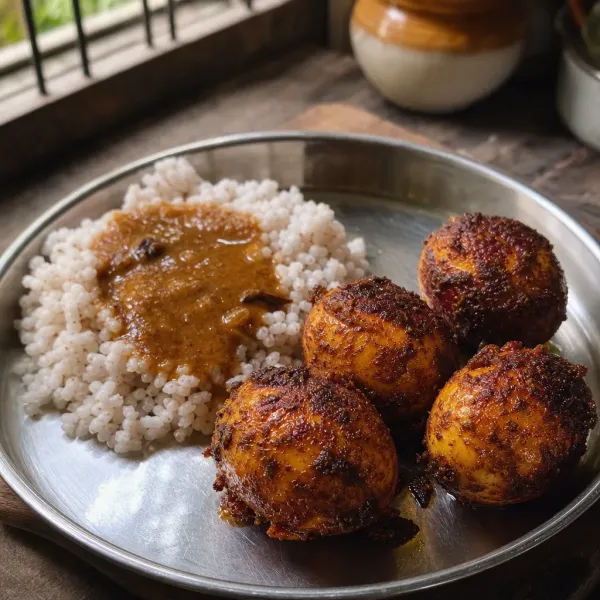
Mutta Porichathu
Traditional Kerala hard-boiled egg fried in coconut oil with a Kashmiri chilli and pepper masala coating. Ready in 25 minutes, perfect with matta ric…
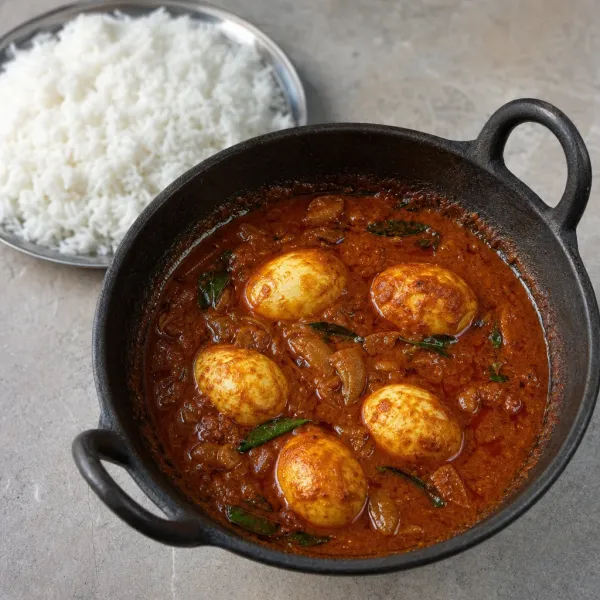
Muttai Kuzhambu
Traditional Kongunad muttai kuzhambu: eggs poached in a tamarind, shallot and fresh coconut gravy cooked in gingelly oil. Step-by-step Tamil home rec…
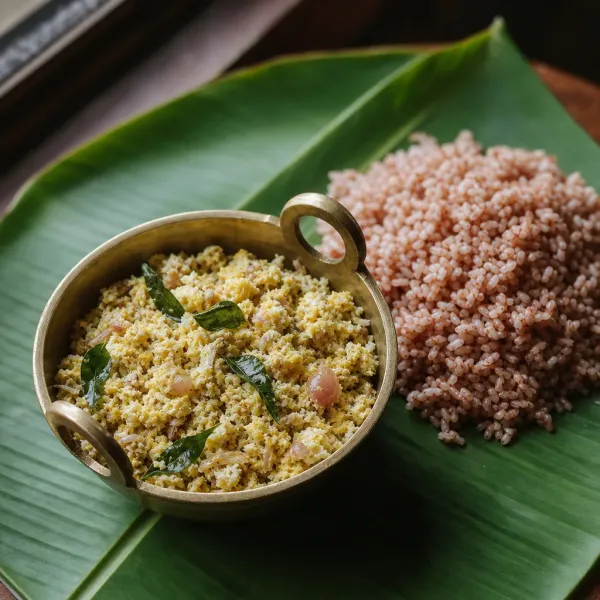
Nadan Mutta Thoran
Traditional Kerala egg thoran with shallots, fresh coconut and curry leaves. A dry, homestyle scramble cooked in coconut oil — ready in 20 minutes.
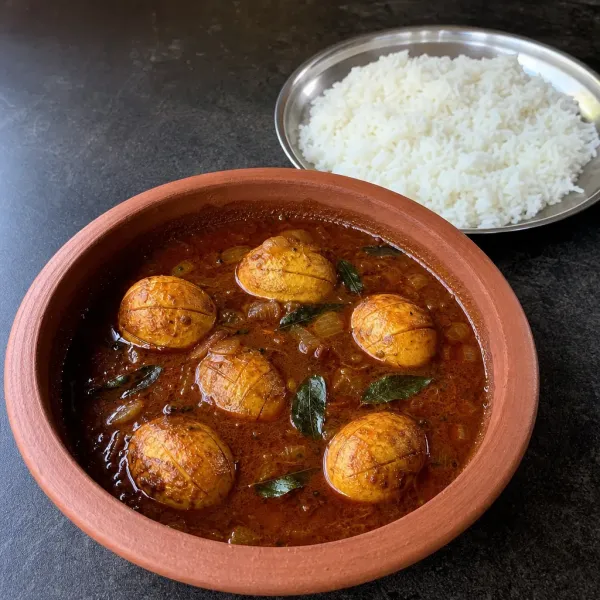
Kodi Guddu Pulusu
Traditional Rayalaseema-style Kodi Guddu Pulusu: hard-boiled eggs simmered in a hot, sour tamarind gravy with Guntur chillies and gingelly oil.
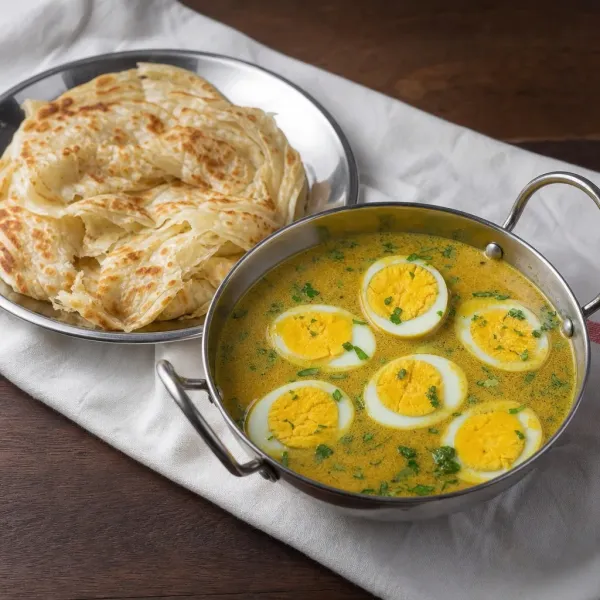
Egg Kurma for Parotta
Traditional Tamil Nadu egg kurma with fresh coconut paste, poppy seeds and whole spices. The classic pairing for layered parotta, cooked the home kit…