

Nadan Kozhi Curry Recipe
Malayalam നാടൻ കോഴി കറിTamil நாடன் கோழி கறிKannada ನಾಡನ್ ಕೋಳಿ ಕರಿTelugu నాడన్ కోడి కూర
- Prep25 min
- Cook45 min
- Serves4
- DifficultyMedium
- DietNon-vegetarian
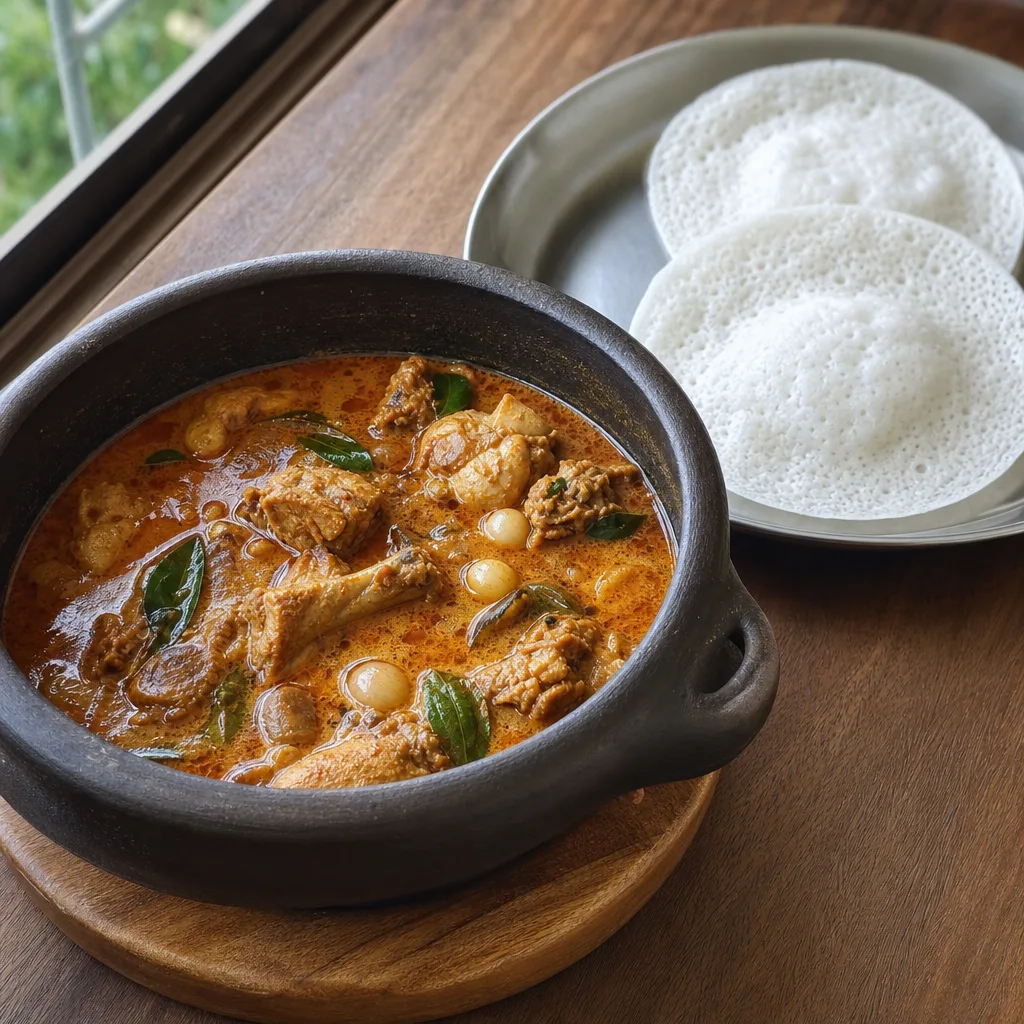
This is the curry that appears at a Nasrani table on Sundays and feast days, made with a free-range country bird that takes longer in the pot than a broiler and rewards the extra time. The gravy is deep and rust-brown at the edges of the pan but ivory where the thick coconut milk folds in at the end. It is not a thin soup and it is not a dry roast; it sits comfortably between the two.
The spice paste is ground fresh each time. Coriander, black pepper, and fennel do most of the work; Kashmiri chilli gives colour without blinding heat. Kudampuli is not used here — that is Mappila territory and fish kuzhambu — but a small piece of green mango or a little vinegar sometimes appears in Kottayam households to cut the richness of the milk. This recipe takes the more common route: no souring agent, the coconut milk alone balancing the spice.
At the table it goes with appam on feast mornings and with matta rice at midday. Leftover curry thickens overnight and is considered better the next day, eaten folded into bread or spooned over rice with a fried egg alongside.
Ingredients (serves 4)
For the chicken
For the spice paste (ground fresh)
For the base
Coconut milk
Method
Extract the coconut milk
Blend the grated coconut with 200 ml warm water for two minutes, then squeeze firmly through a clean muslin cloth. This first pressing gives thick coconut milk (onnaam paal); set it aside in a bowl. Return the squeezed coconut to the blender, add another 200 ml warm water, blend again and squeeze. This thinner second milk (randaam paal) goes into a separate bowl. Do not mix them.
Dry-roast the whole spices
In a heavy pan over low heat, dry-roast the coriander seeds, black pepper, and fennel seeds separately, a minute or two each, until fragrant and just beginning to colour. In the same pan, lightly toast the Kashmiri chillies for thirty seconds, pressing them flat. Do not scorch any of them; bitterness comes quickly. Tip onto a plate and let them cool completely before grinding.
Grind the spice paste
Grind the roasted spices and chillies to a coarse powder first, then add the turmeric, ginger, and garlic and grind to a smooth paste, adding two to three tablespoons of water as needed. The paste should be thick enough to hold its shape on a spoon. Set aside.
Fry the shallots
Heat 2 tbsp coconut oil in a wide, heavy-bottomed pot or manchatti (clay pot) over medium heat. Add the curry leaves and let them crackle for a few seconds, then add the halved shallots. Fry, stirring often, for 12 to 15 minutes until they are deep golden brown at the edges and soft through. Do not rush this; undercooked shallots leave a raw sweetness that never cooks out later.
Cook the spice paste
Add the ground spice paste to the shallots. Stir constantly over medium-low heat for 6 to 8 minutes until the oil separates and appears at the edges of the paste and the raw smell of ginger and garlic is gone. If the paste sticks, add a splash of water and scrape the bottom. The colour deepens to a reddish brown.
Add the chicken
Add the chicken pieces and the remaining 3 tbsp coconut oil, and turn everything to coat the pieces in the paste. Increase heat to medium-high and sear for 4 to 5 minutes, turning once, until the outer surface of the chicken has sealed and no longer looks raw. Season with salt at this point.
Add the thin coconut milk and simmer
Pour in the thin second-press coconut milk (randaam paal). Stir to lift any paste from the bottom of the pot. Bring just to a boil, then reduce heat to low, cover with a lid slightly ajar, and cook for 25 to 30 minutes, turning the pieces once halfway through. A country bird needs this time; a broiler will be done in 15 minutes but the flavour is thinner. The gravy should reduce by about a third.
Check the chicken
Pierce the thickest piece to the bone with a thin knife. The juices should run clear and there should be no resistance at the joint. If the meat is still firm at the bone, cover and cook for another 10 minutes on the lowest flame before checking again.
Finish with thick coconut milk
Reduce the heat to the lowest setting. Pour in the thick first-press coconut milk (onnaam paal) slowly, stirring as you pour. Do not let the curry boil after this addition; boiling will cause the thick milk to split and the gravy will look curdled and greasy. Warm gently for two to three minutes, stirring, until the curry is uniformly heated through. Taste for salt.
Rest before serving
Take the pot off the heat and let it rest, covered, for ten minutes before serving. The gravy will thicken slightly as it stands and the spices will settle into the meat. Serve directly from the pot if using a manchatti.
How to serve
Appam (lacy rice hoppers) for a feast or Sunday breakfast; matta rice (red Kerala rice) at a midday meal; plain white rice on weekdays. A side of raw sliced shallots and a wedge of lime are common at the table but are not part of the dish.
Served with: Appam (lacy rice hoppers) for a feast or Sunday breakfast; matta rice (red Kerala rice) at a midday meal; plain white rice on weekdays. A side of raw sliced shallots and a wedge of lime are common at the table but are not part of the dish.
Cook's tips
Country chicken vs broiler
Nadan kozhi (free-range, locally reared) has firmer, more flavourful meat and genuinely needs the full cooking time. If using a broiler, reduce the simmering time in Step 7 to 15 minutes and check early; it overcooks quickly and becomes stringy.
The manchatti difference
Clay pots conduct heat gently and hold it longer, which suits the final coconut milk stage well. If using a manchatti, season it before first use and always rest it on a flat trivet rather than directly on a gas flame.
Fresh coconut milk is not optional here
Tinned coconut milk can be used as a weekday shortcut: use 160 ml full-fat tinned milk diluted with 200 ml water in place of the thin press, and 160 ml undiluted tinned milk in place of the thick press. The gravy will be a little flatter and slightly sweeter.
Why the thick milk splits
Boiling after the thick milk is added causes the fat and water in the milk to separate. Keep the flame at its lowest and stir continuously. If it does split, take the pot off the heat immediately and stir in a tablespoon of cold coconut milk; it will not fully recover but will improve.
Overnight improvement
The curry tastes noticeably better the next day. Store covered in the refrigerator. Reheat very gently over low heat, stirring, and do not boil.
Regional variations
Mappila (Malabar) version uses fennel seed and less coconut milk, finishes with fried onions; Nair household version often skips the second coconut milk addition and is drier; Kodambally-style adds kalpasi (stone flower).
Glossary
- Nadan kozhi നാടൻ കോഴി
- Country chicken; locally reared, free-range bird, smaller and firmer than a commercial broiler.
- Chuvannulli ചുവന്നുള്ളി
- Pearl shallots (small red shallots); the correct allium for most Kerala curries, sweeter and more pungent than large onions.
- Perumjeerakam പെരുംജീരകം
- Fennel seeds; used in small quantities in Nasrani and Mappila chicken dishes for a faintly sweet, anise-like note.
- Onnaam paal ഒന്നാം പാൽ
- First-press coconut milk; thick, rich, added at the end and never boiled.
- Randaam paal രണ്ടാം പാൽ
- Second-press coconut milk; thin, used for the main cooking liquid.
- Manchatti മൺചട്ടി
- Traditional unglazed clay cooking pot; imparts a faint earthy character and cooks gently.
- Nasrani നസ്രാണി
- Kerala Syrian Christian community; one of the oldest Christian communities in the world, with a distinct cooking tradition centred on Kottayam, Ernakulam, and Thrissur.
Two things decide this curry: the patience to fry the shallots all the way to deep gold before the spice paste goes in, and the discipline to keep the heat low enough after the thick coconut milk is added that it never reaches a boil. Both are quiet steps that are easy to shortcut and impossible to correct after the fact.
More Non-Vegetarian recipes
Karimeen Pollichathu
Traditional Nasrani karimeen pollichathu from central Travancore: pearl spot fish coated in a shallot-coconut oil masala, wrapped in banana leaf and…
Kerala Meen Curry with Kudampuli
Traditional Kerala fish curry from Travancore, cooked in a clay pot with kudampuli, shallots and coconut oil. No coconut milk, no shortcuts.
Nandu Masala (Crab Masala)
Authentic Chettinad nandu masala made with fresh-ground kalpasi and marathi mokku masala, gingelly oil, and mud crab. Traditional household recipe fr…
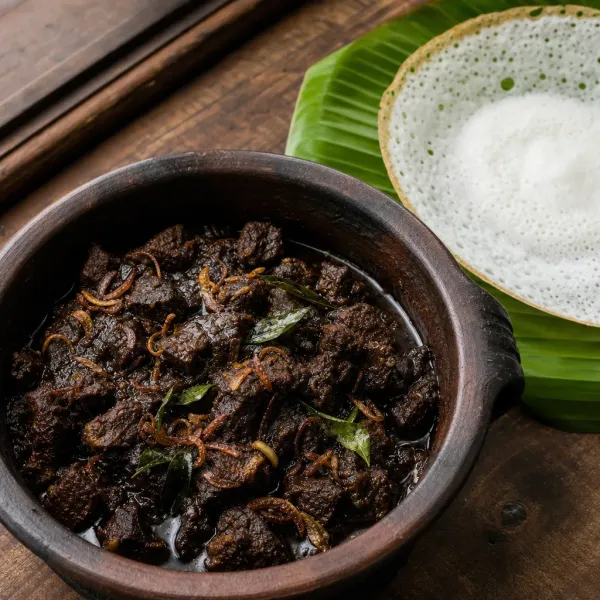
Kerala Nasrani Beef Curry (Irachi Olathiyathu Style Gravy)
Authentic Nasrani beef curry from Central Travancore: slow-cooked with black pepper, whole spices, shallots, and coconut oil. Traditional household r…
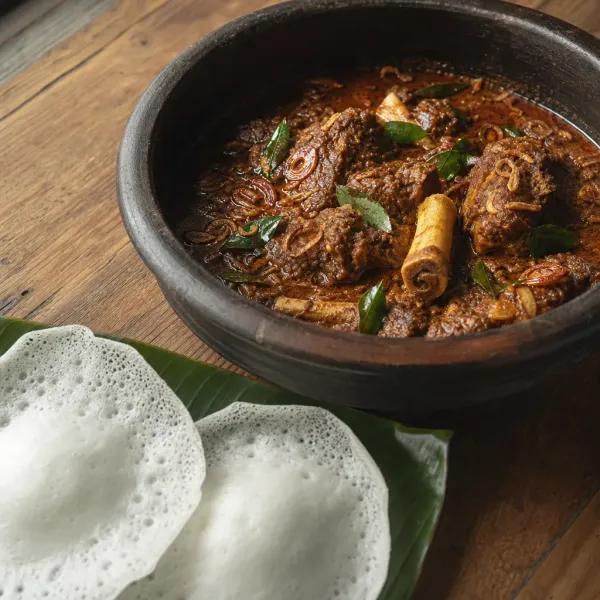
Kerala Nasrani Mutton Curry
Traditional Syrian Christian mutton curry from central Kerala, built on roasted spices and slow-fried shallots. Served with appam or matta rice.
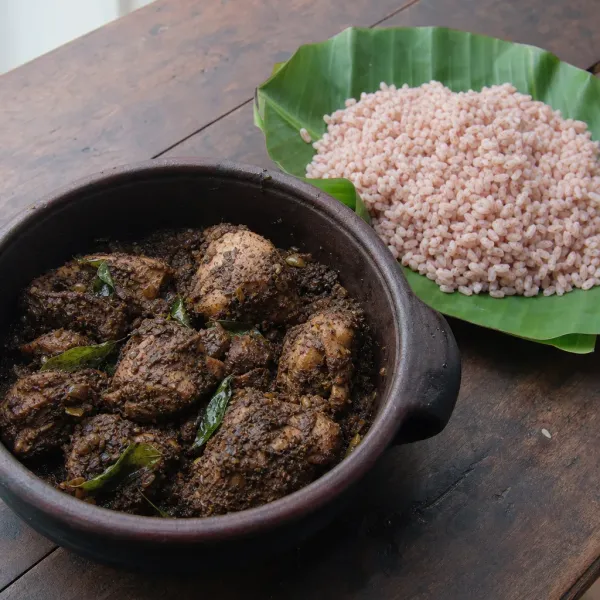
Kurumulaku Kozhi (Kerala Pepper Chicken)
Traditional Kerala Nasrani pepper chicken cooked with freshly cracked black pepper, shallots, curry leaves and coconut oil. A semi-dry Travancore Syr…