

Kara Kuzhambu Recipe
Malayalam കാര കുഴമ്പ്Tamil கார குழம்புKannada ಕಾರ ಕುಳಂಬುTelugu కార కుళంబు
- Prep20 min
- Cook40 min
- Serves4
- DifficultyMedium
- DietVegan
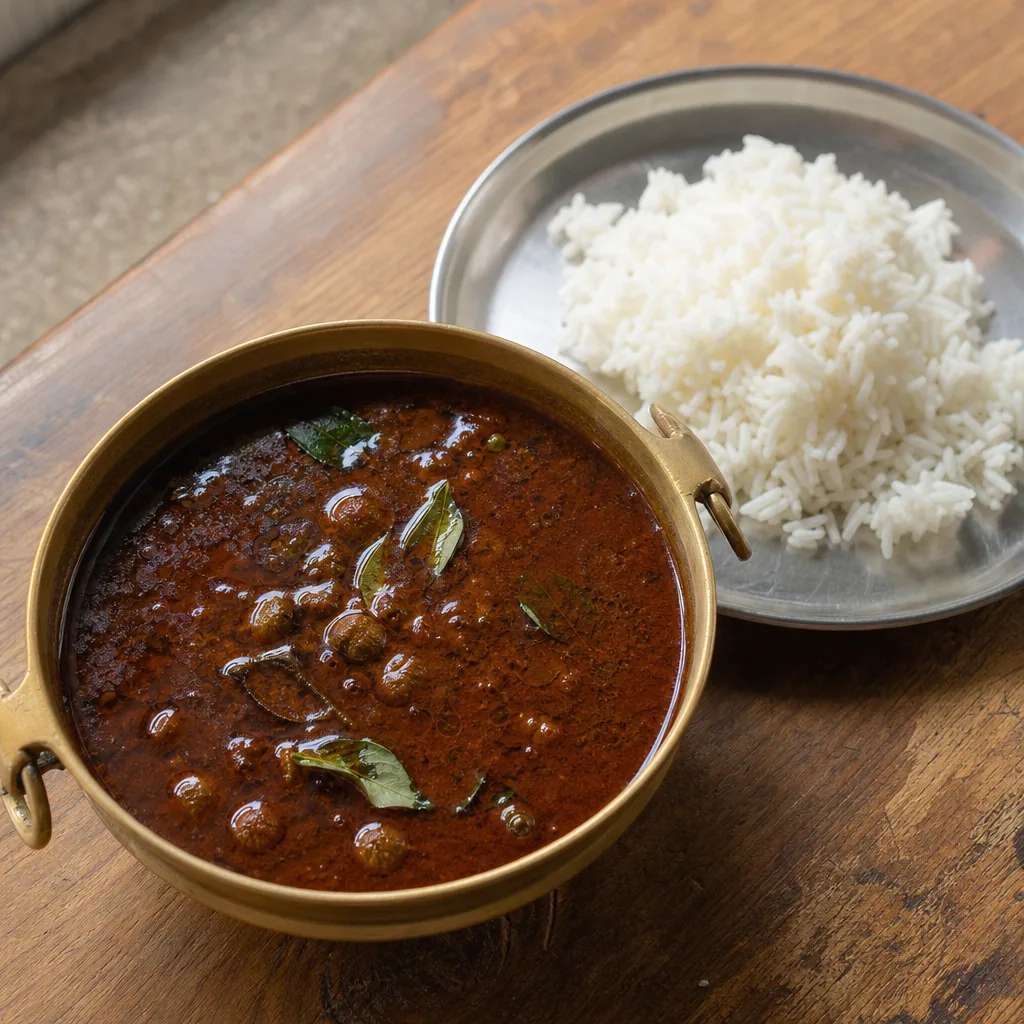
Kara kuzhambu is a deeply spiced, thick tamarind gravy that belongs to everyday Tamil cooking. It is not a festival dish and not a special-occasion dish. It is what gets cooked on a weekday when the household wants something that works hard. The heat comes from dried red chillies and black pepper, the body from the tamarind itself, and the whole thing is built in gingelly oil, which is not optional.
In Iyer households this is almost always vegetarian, built around a single main ingredient: small drumstick pieces, brinjal, raw plantain, or sundakkai (turkey berry). The version here uses sundakkai because that is the most traditional pairing in this kitchen. The kuzhambu should be thick enough to coat the back of a spoon but still pour slowly. It is not a thin rasam-style liquid and it is not a dry masala.
Households differ mainly in the ratio of coriander to pepper in the freshly ground masala, and in how long they reduce the tamarind. Some grandmothers reduce it much longer for a darker, more concentrated result. The dish improves the next day once the tamarind and spices settle into each other.
Ingredients (serves 4)
For the tamarind base
For the freshly ground masala
For the main ingredient
For the tempering
Method
Soak the tamarind
Break the tamarind into the warm water and leave it for 15 minutes. Squeeze it thoroughly with your fingers until the pulp is fully dissolved into the water. Strain through a sieve, pressing the solids hard. You want a smooth, thin extract with no fibres or seeds. Discard the solids.
Dry-roast and grind the masala
Set a small heavy pan over medium-low heat. Add the half teaspoon of gingelly oil, then add the chana dal and urad dal. Stir constantly for about a minute until they turn pale gold. Add the coriander seeds, peppercorns, and dried red chillies and continue stirring for another minute until the chillies darken slightly and the coriander smells toasty. Remove from heat and cool completely. Grind this with the grated coconut and 3 to 4 tablespoons of water to a smooth, fine paste. It should not feel gritty between your fingers.
Fry the shallots and garlic
Heat the 4 tablespoons of gingelly oil in a wide, heavy-bottomed vessel over medium heat. Add the shallots and garlic. Fry, stirring occasionally, for 8 to 10 minutes until the shallots are soft, translucent, and beginning to colour at the edges. Do not rush this step; undercooked shallots make the kuzhambu taste raw.
Add the tomato
Add the chopped tomato to the pan and stir well. Cook for 4 to 5 minutes over medium heat, pressing the tomato pieces down until they fully break down and the oil begins to separate at the sides of the pan. The mixture should look jammy, not wet.
Add the sundakkai
Add the lightly crushed sundakkai berries and stir to coat them in the shallot-tomato base. Fry for 2 to 3 minutes. The berries will turn from pale green to a slightly darker, more olive shade. This brief frying removes some of their bitterness.
Pour in the tamarind extract
Add the strained tamarind extract and salt. Stir everything together and bring to a boil over medium-high heat. Once it boils, reduce to a steady simmer. Cook uncovered for 12 to 15 minutes, stirring every few minutes. The raw tamarind smell will gradually disappear and the colour will deepen from pale brown to a rich, dark reddish-brown. This reduction matters; if you stop too early the kuzhambu will taste sour and thin.
Stir in the ground masala
Add the ground masala paste and stir it in thoroughly so there are no lumps. Add 100 ml of water to loosen it slightly. The kuzhambu will thicken quickly as the coconut cooks. Simmer for another 8 to 10 minutes over low heat, stirring often to prevent the coconut paste from catching at the bottom. It is ready when the oil floats visibly on the surface and the gravy coats a spoon thickly.
Check the seasoning and consistency
Taste for salt and heat. The kuzhambu should be intensely spiced, sour from the tamarind, and thick. If it is too thick, add a splash of water and stir. If it is too thin, continue simmering uncovered for a few more minutes.
Temper and finish
In a small tempering pan, heat the 1 tablespoon of gingelly oil over high heat until it shimmers. Add the mustard seeds and wait for them to splutter fully. Add the broken red chilli, curry leaves, and asafoetida. The curry leaves will crackle immediately. Pour this tempering straight into the kuzhambu, stir once, and cover the pan for 2 minutes so the aromas infuse.
How to serve
Hot plain rice (sona masuri or raw rice), with a small amount of ghee stirred into the rice at the table if the household is not vegan. Papad and a dry vegetable poriyal alongside.
Served with: Hot plain rice (sona masuri or raw rice), with a small amount of ghee stirred into the rice at the table if the household is not vegan. Papad and a dry vegetable poriyal alongside.
Cook's tips
Sundakkai bitterness
Sundakkai is naturally bitter. Crushing the berries lightly before frying, rather than leaving them whole, helps the bitterness cook out more evenly. If your berries are very bitter, you can soak them in salted water for 10 minutes before using.
Gingelly oil is not optional
Coconut oil or refined oil will produce a different-tasting kuzhambu. The nuttiness of gingelly oil is part of what this dish is. Use cold-pressed gingelly oil if you can find it.
The kuzhambu the next day
This tastes noticeably better after resting overnight. The tamarind mellows and the spices settle. Reheat gently and add a little water if it has thickened too much.
Substitute for sundakkai
If sundakkai is not available, small brinjal pieces (about 200 g, cut into quarters) or drumstick pieces (2 drumsticks, cut into 5 cm lengths) work well in the same method. Brinjal cooks faster; drumstick takes a few minutes longer.
Tamarind concentration varies
Block tamarind varies in sourness. Taste your extract before adding it. If it is very sour, use 40 g instead of 50 g. If it is mild, add a little more. The kuzhambu should be distinctly sour but not mouth-puckeringly so.
Regional variations
Chettinad households add kalpasi and marathi mokku to the spice base; Mudaliar kitchens often include small onions in greater quantity and finish with more pepper; some Brahmin households omit shallots entirely and use only garlic.
Glossary
- Kuzhambu குழம்பு
- A Tamil word for a cooked gravy or sauce, thicker than rasam and thinner than a dry curry.
- Sundakkai சுண்டைக்காய்
- Turkey berry; small, pale green, slightly bitter berries used widely in Tamil cooking, especially in kuzhambu.
- Nallennai நல்லெண்ணெய்
- Gingelly oil, also called sesame oil; the traditional cooking fat for Tamil kuzhambu and pickles.
- Perungayam பெருங்காயம்
- Asafoetida; a resin used in small quantities for its pungent, savoury aroma, especially in Brahmin cooking where onion and garlic are sometimes avoided.
- Kadalai paruppu கடலை பருப்பு
- Split Bengal gram, also called chana dal; used here in small quantity in the roasted masala for body and a mild nuttiness.
- Sambar onions சின்ன வெங்காயம்
- Small shallots, the standard allium in Tamil cooking; sweeter and more pungent than large onions, they are not interchangeable with them in this dish.
Two things decide whether this kuzhambu works. The first is reducing the tamarind long enough that the raw sourness cooks out and the colour deepens; stop too early and the dish tastes sharp and flat. The second is the freshly ground masala with real coconut: it gives the gravy its body and rounds the heat in a way that a dry powder simply cannot.
More Vegetarian Gravies recipes
Mor Kuzhambu
Traditional Tamil Brahmin mor kuzhambu with ash gourd, fresh coconut-cumin paste and a ghee tempering. Step-by-step method with tips on keeping the c…
Kalan
Traditional Kerala kalan with raw banana and elephant yam in thick sour curd. A sadya essential from Travancore kitchens, spiced with black pepper an…
Pulissery (Kerala Yogurt and Coconut Curry)
Traditional Kerala pulissery with ripe banana or ash gourd, fresh coconut paste and soured yogurt. Step-by-step sadya recipe with coconut oil temperi…
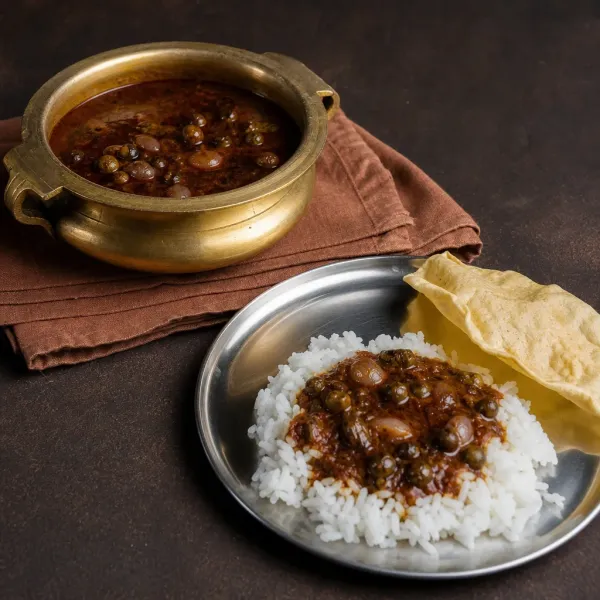
Sundakkai Vathal Kuzhambu
Traditional Tamil Brahmin vatha kuzhambu with sundakkai vathal, tamarind, and gingelly oil. Sour, spiced, and cooked the slow household way.
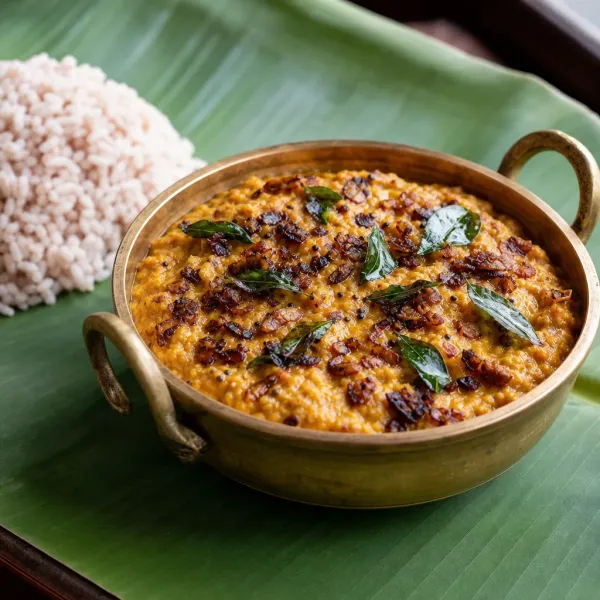
Erissery
Traditional Kerala erissery with yellow pumpkin, vanpayar, and deeply roasted coconut. Step-by-step sadya recipe with fresh coconut paste.
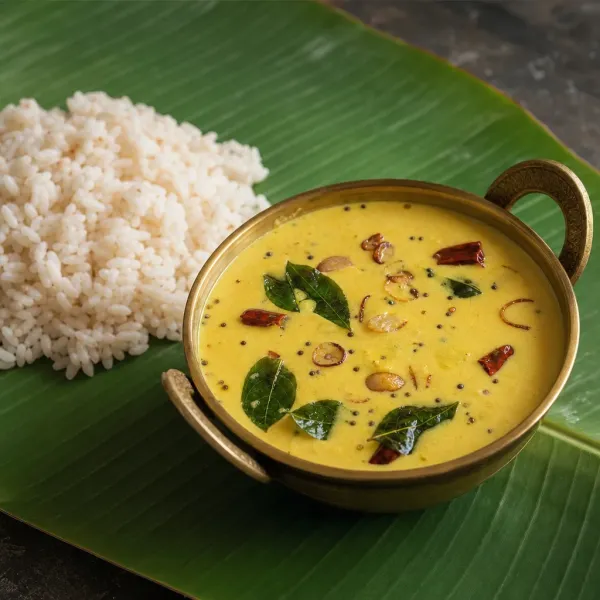
Mambazha Pulissery
Traditional Kerala Mambazha Pulissery made with whole ripe country mangoes, fresh coconut paste and sour yogurt. A classic sadya dish, step by step.