

Kalan Recipe
Malayalam കാളൻTamil காளன்Kannada ಕಾಳನ್Telugu కాళన్
- Prep20 min
- Cook40 min
- Serves6
- DifficultyMedium
- DietVegetarian
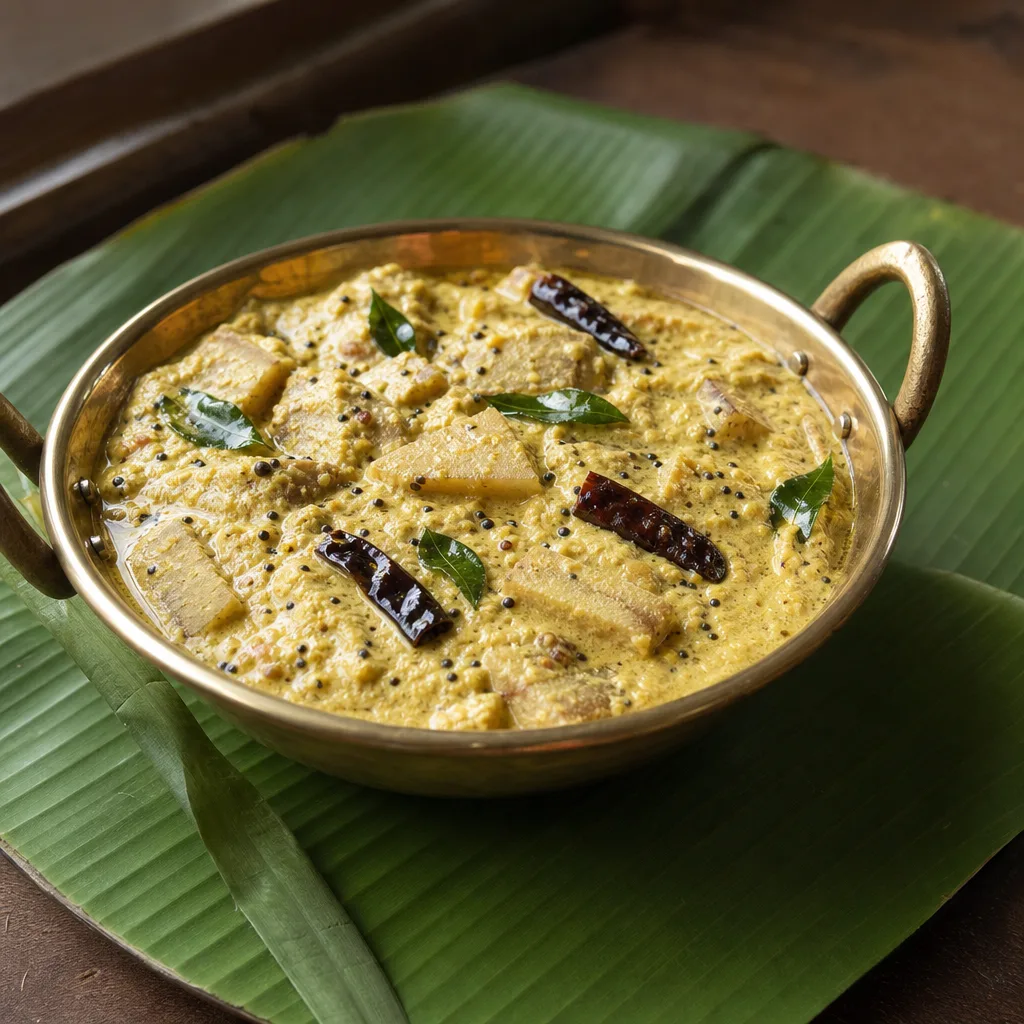
Kalan is one of the anchor dishes of the Kerala sadya, that long banana-leaf meal served at Onam, Vishu, and weddings. It sits in the top-left section of the leaf alongside other yogurt-based curries, and its particular job is to be thick, sour, and deeply spiced with black pepper. It is not a light curry. It is meant to be dense, almost paste-like by the time it reaches the leaf.
The two vegetables that belong here are raw banana (pachakaya) and elephant yam (chena). Both are cooked until just tender and then finished in a coconut paste, and then the whole thing is folded into thick, well-soured curd and dried over a low flame until the curry thickens to the point where it barely moves when you tilt the pan. That drying step is what most people rush, and it is exactly what you must not rush.
Households differ mainly on the ratio of banana to yam and on how sour the curd is. In Travancore homes, the curd used is often a full day old, noticeably sour, not the mild fresh curd you might use in a raita. The black pepper here is not background seasoning — it is the dominant spice, and you will use more of it than feels comfortable the first time you make this.
Ingredients (serves 6)
Vegetables
For cooking the vegetables
Coconut paste
Yogurt base
Tempering
Method
Prepare the vegetables
Peel the raw banana and yam and cut both into 2 cm cubes. Drop the banana pieces into a bowl of water with a pinch of turmeric as you cut them — they darken quickly. The yam does not need soaking but oil your hands before handling it raw.
Cook the vegetables together
Drain the banana and put it in a wide, heavy-bottomed pan with the yam. Add 150 ml water, ½ tsp turmeric, 1 tsp coarsely crushed black pepper, and salt. Cover and cook on medium heat for about 15 minutes, until both vegetables are just cooked through — a knife should go in without resistance but the pieces must hold their shape. If water remains, cook uncovered for a minute or two to evaporate it. The pan should be nearly dry before the next step.
Grind the coconut paste
While the vegetables cook, grind the fresh grated coconut with the whole black pepper, cumin seeds, and turmeric to a fine, smooth paste in a stone grinder or wet grinder. Add just enough water — a tablespoon at a time — to keep the grinder moving. The paste should be thick, not watery. Grinding it fine is important; a coarse paste will not coat the vegetables evenly.
Add the coconut paste to the vegetables
Add the ground coconut paste to the pan with the cooked vegetables and stir well to coat everything. Cook on low heat for 4 to 5 minutes, stirring often, until the raw smell of the coconut disappears and the mixture is fragrant. Do not let it scorch on the bottom.
Whisk the curd and add it
Whisk the sour curd until completely smooth — no lumps. Reduce the heat to the lowest setting your stove allows. Add the curd to the pan and stir it in immediately and continuously. The curd must never boil or it will split into grainy curds and watery whey. Keep stirring on low heat.
Dry the curry down — the essential step
Continue stirring on the lowest heat for 12 to 18 minutes. The curry will look thin at first. As the moisture evaporates, it will thicken gradually and deepen in colour to a pale yellow-ochre. It is ready when it is thick enough to mound slightly on a spoon and does not run when you tilt the pan. This step cannot be hurried with higher heat — the curd will curdle. If it begins to bubble at all, lift the pan off the heat for a moment and keep stirring.
Taste and adjust
Taste for salt and sourness. Kalan should be noticeably sour and peppery. If it tastes flat, the curd was too mild — there is nothing to add at this stage, so the sourness of the curd you start with matters. Adjust salt now.
Temper and finish
Heat coconut oil in a small tempering pan over medium heat. When the oil is hot, add the mustard seeds and let them splutter fully. Add the dried red chillies and curry leaves — stand back, the leaves will spit. Pour the entire tempering over the curry immediately and stir it in. Serve at once or keep covered; it thickens further as it cools, which is correct.
How to serve
Served as part of a Kerala sadya on a banana leaf, alongside rice, parippu curry, sambar, rasam, pachadi, olan, avial, thoran, and payasam. It is not served as a standalone dish.
Served with: Served as part of a Kerala sadya on a banana leaf, alongside rice, parippu curry, sambar, rasam, pachadi, olan, avial, thoran, and payasam. It is not served as a standalone dish.
Cook's tips
The curd must be sour
Mild supermarket curd produces a flat, sweet curry that tastes nothing like kalan. Set curd the night before and leave it at room temperature for a few hours on a warm day to develop sourness. Taste it before you start — it should make you wince slightly.
Do not rush the drying step
The long, slow stirring on low heat is what gives kalan its characteristic thick, almost paste-like body. Raising the heat to speed it up causes the curd proteins to seize and the curry becomes grainy and watery at the same time. There is no way to fix a split kalan.
Yam can be itchy
Raw elephant yam contains calcium oxalate crystals that irritate the skin and throat. Always oil your hands before peeling and cutting it. Cooking it fully eliminates the itch entirely.
Kalan thickens as it sits
Made for a sadya, kalan is often cooked an hour or two ahead. It will be very thick by the time it is served, which is correct. Do not thin it with water.
Stone grinder versus mixer
A stone grinder gives a finer, creamier coconut paste. A mixer-grinder works but produces a slightly coarser result. If using a mixer, grind in two or three short bursts with a little water, scraping down between each, and grind longer than you think necessary.
Regional variations
Some households use only raw banana without yam; a few central Kerala kitchens add a small piece of green chilli to the coconut paste for extra heat.
Glossary
- Pachakaya പച്ചക്കായ
- Raw unripe banana, a staple cooking vegetable in Kerala.
- Chena ചേന
- Elephant yam (Amorphophallus paeoniifolius), used widely in Kerala cooking.
- Kudampuli കുടംപുളി
- Gamboge or Malabar tamarind (Garcinia cambogia), the souring agent used in Kerala fish curries — not used in kalan, noted here because it is sometimes confused with tamarind.
- Jeerakam ജീരകം
- Cumin seeds.
- Kollamulaku കൊല്ലമുളക്
- Dried red chilli, used whole in tempering across Kerala cooking.
- Sadya സദ്യ
- The traditional Kerala feast served on a banana leaf, associated with Onam, Vishu, and weddings.
Two things decide whether this curry works: the sourness of the curd and the patience of the drying step. Get both right and the kalan will be thick, fragrant, and deeply peppery — exactly what it needs to be on the leaf.
More Vegetarian Gravies recipes
Mor Kuzhambu
Traditional Tamil Brahmin mor kuzhambu with ash gourd, fresh coconut-cumin paste and a ghee tempering. Step-by-step method with tips on keeping the c…
Kara Kuzhambu
Traditional Tamil Iyer kara kuzhambu with sundakkai, freshly ground spice-coconut masala, and gingelly oil. Thick, spiced tamarind gravy for rice.
Pulissery (Kerala Yogurt and Coconut Curry)
Traditional Kerala pulissery with ripe banana or ash gourd, fresh coconut paste and soured yogurt. Step-by-step sadya recipe with coconut oil temperi…
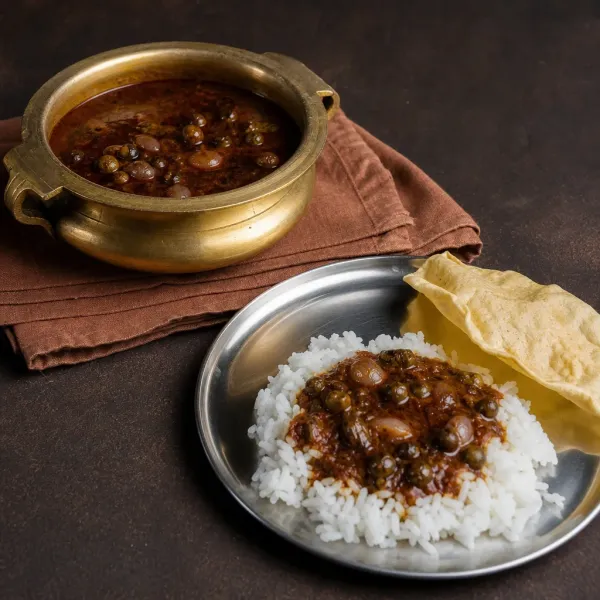
Sundakkai Vathal Kuzhambu
Traditional Tamil Brahmin vatha kuzhambu with sundakkai vathal, tamarind, and gingelly oil. Sour, spiced, and cooked the slow household way.
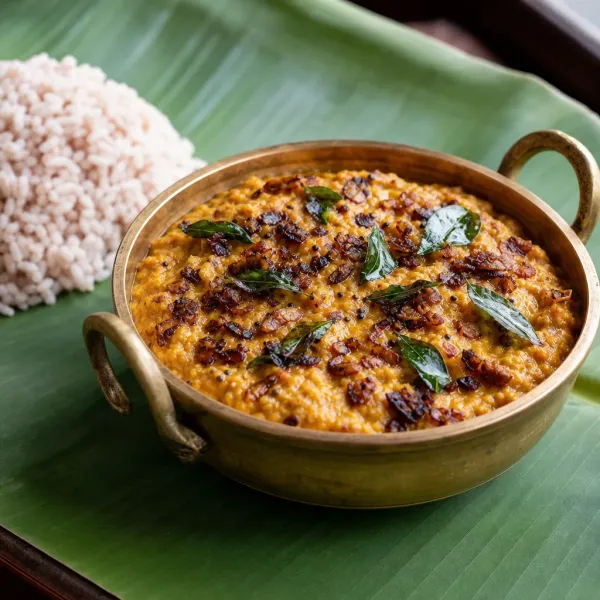
Erissery
Traditional Kerala erissery with yellow pumpkin, vanpayar, and deeply roasted coconut. Step-by-step sadya recipe with fresh coconut paste.
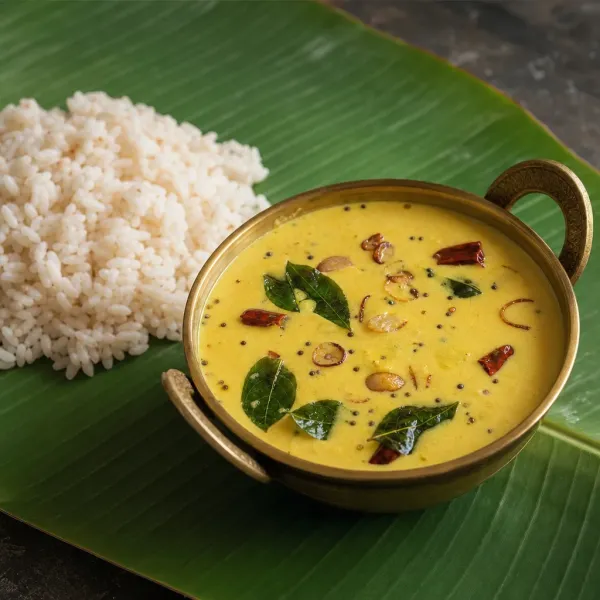
Mambazha Pulissery
Traditional Kerala Mambazha Pulissery made with whole ripe country mangoes, fresh coconut paste and sour yogurt. A classic sadya dish, step by step.