

Boondi Ladoo Recipe
Malayalam ബൂന്ദി ലഡ്ഡുTamil பூந்தி லட்டுKannada ಬೂಂದಿ ಲಡ್ಡುTelugu బూందీ లడ్డు
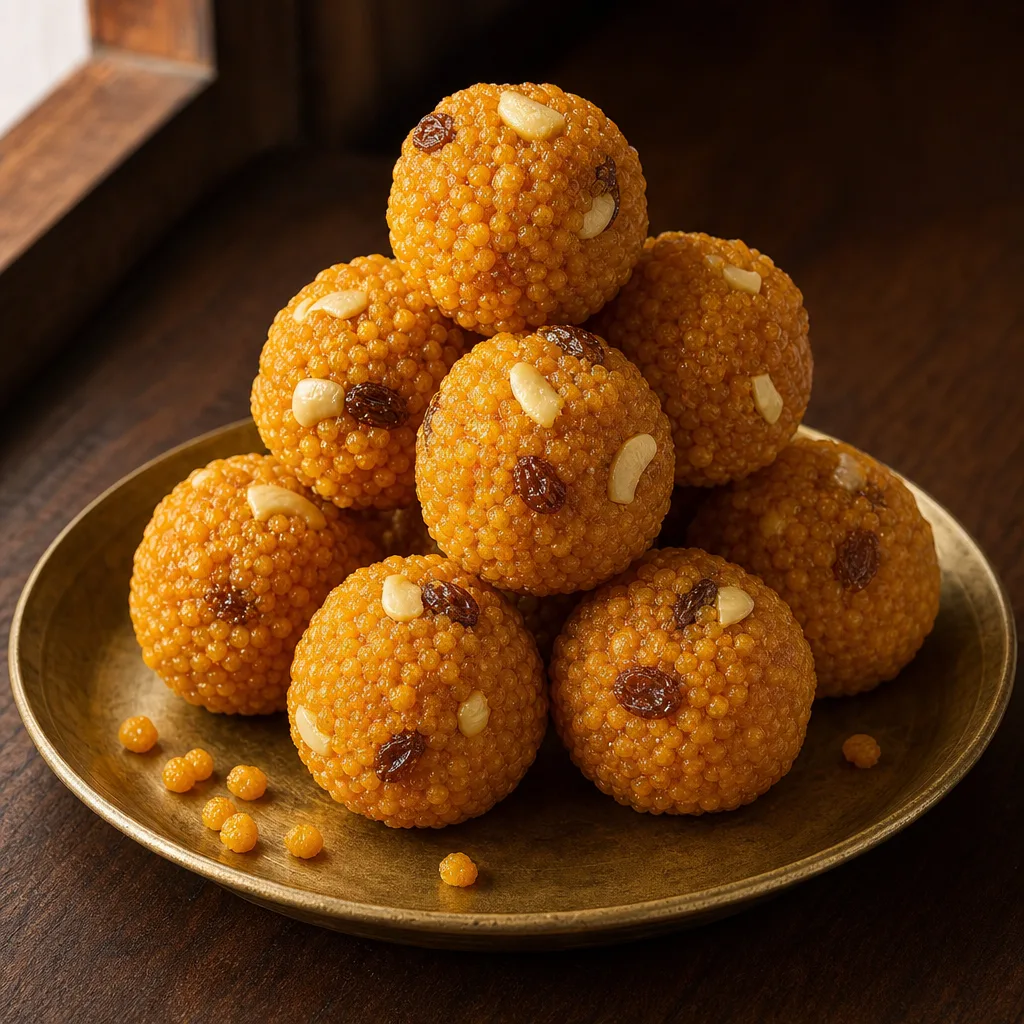
- Prep20 min
- Cook1 hr
- Serves20 ladoos
- DifficultyHard
- DietVegetarian
Boondi ladoo is made for weddings, festivals and temple offerings across Telangana and Andhra Pradesh. In most households it appears at Ganesh Chaturthi and Diwali, and at no other time of year, which is why it still feels like a serious undertaking. The method has three moving parts that must stay in sync: the batter consistency, the oil temperature, and the sugar syrup stage. If any one of them drifts, the ladoos will not hold.
The boondi are tiny beads of fried gram-flour batter, dropped through a perforated ladle into hot oil. They must be fried just enough to cook through but not so long that they crisp up, because a crisp boondi will not absorb the syrup and the ladoo will crumble. The syrup must be at exactly one thread when the boondi go in. Work fast from that point: the mixture sets as it cools and you have perhaps eight to ten minutes to shape all the ladoos before it stiffens.
Household cooks differ on edible camphor: some add a small crystal, some skip it entirely. Cloves are standard in Telangana; some families grind them with the cardamom, others add them whole to the syrup. The quantities here make twenty medium ladoos, roughly 50 grams each.
Ingredients (serves 20 ladoos)
For the boondi batter
For frying
For the sugar syrup
For the garnish folded in
Method
Make the batter
Sift the besan into a wide bowl. Add water gradually, whisking constantly, until you have a smooth, lump-free batter the consistency of dosa batter — it should flow easily but coat the back of a spoon. If you are using food colour, dissolve it in a tablespoon of water and add it now. The batter must not be thick or the boondi will be heavy; must not be thin or they will spread and join together in the oil. Test it: hold the perforated ladle over the bowl and pour a little batter through. The drops should fall cleanly and separately.
Fry the cashews and raisins
Heat 1 tsp ghee in a small pan over low heat. Fry the cashew halves, stirring, until pale gold — about 2 minutes. Add the raisins and stir for 30 seconds until they puff. Remove immediately and set aside on a plate. The raisins burn in seconds if you look away.
Heat the oil
Pour the oil or ghee into a wide, deep kadai and heat over medium flame to 170–175°C. You can test without a thermometer: drop a tiny bead of batter in. It should rise to the surface within 2 seconds without browning immediately. If it rises instantly and browns at once, the oil is too hot; lower the flame and wait.
Fry the boondi
Hold the perforated ladle (jhara) about 8 cm above the oil. Pour a ladleful of batter onto it and use a second spoon or your fingers to push the batter through quickly. The boondi will fall into the oil as small beads. Fry for 60–75 seconds, stirring gently, until they are cooked through but still soft — they should give slightly when pressed between finger and thumb. Do not let them colour or crisp. Lift them out with a slotted spoon, drain briefly, and transfer to a large plate. Wipe the perforated ladle between batches if batter builds up around the holes. Fry all the batter this way.
Begin the sugar syrup
In a wide, heavy-bottomed pan, combine the sugar, water, cloves and edible camphor (if using). Stir once to dissolve the sugar, then bring to the boil over medium-high heat without stirring again. Let it boil steadily.
Reach one-thread consistency
After 7–9 minutes of boiling, test the syrup. Dip a clean spoon in, let it cool for a few seconds, then touch the syrup between your thumb and index finger and pull them apart slowly. A single thread should form and hold for a moment before breaking. This is the one-thread stage (ek taar). If the thread breaks immediately, cook another minute and test again. If two threads form, add a tablespoon of hot water and stir quickly. Remove the cloves at this point if you prefer.
Add the boondi to the syrup
The moment the syrup reaches one thread, remove the pan from the heat. Tip in all the fried boondi at once and fold gently with a large spoon until every bead is coated. Add the cardamom powder and fold again. Add the fried cashews and raisins. The mixture will look wet and loose at first; within 2–3 minutes it will begin to thicken as the syrup cools and the boondi absorb it. Work quickly.
Shape the ladoos
Grease your palms lightly with ghee. Take a portion of the warm mixture — about 50 g, roughly the size of a large lime — and press it firmly between both palms, rotating to form a round ball. The warmth of your hands helps. Press with real pressure; a gentle roll will give you a ladoo that falls apart once it cools. Set each shaped ladoo on a plate without touching the others. If the mixture cools and stiffens before you finish, set the pan over the lowest possible heat for 30 seconds and fold once — this buys you a little more time.
Cool and store
Leave the ladoos undisturbed at room temperature for at least 30 minutes. They will firm up as they cool. Once completely cool, they can be stacked and stored in an airtight tin for up to 10 days in a cool, dry place.
How to serve
Offered as prasad or served on their own as a sweet. No accompaniment.
Served with: Offered as prasad or served on their own as a sweet. No accompaniment.
Cook's tips
The perforated ladle
The size of the holes in your jhara determines the size of your boondi. A ladle with 3–4 mm holes gives the standard medium boondi for ladoos. Larger holes make boondi that are harder to press into a tight ball.
Batter consistency is everything
If the boondi come out with tails (like comets), the batter is too thick — add a teaspoon of water and test again. If they spread and join into flat discs, the batter is too thin — add a pinch of besan. Always test one small batch in the oil before frying the full quantity.
Syrup that has gone too far
If your syrup reaches two threads or begins to crystallise at the edges of the pan, add 2 tablespoons of hot water, stir well, and bring back to one thread. Do not panic; it is recoverable at this stage.
Edible camphor
Pacha karpooram (edible camphor) is not the same as the camphor used in puja lamps, which is toxic. Buy it from a reputable spice shop labelled for culinary use. The quantity here is tiny — it gives a faint, clean fragrance. Too much makes the ladoo taste medicinal.
If the ladoos crumble
This usually means the syrup was under-cooked (below one thread) or the boondi were over-fried and too crisp to absorb the syrup. There is no fix once the mixture cools, but you can press the crumbled pieces into rough clusters and eat them as boondi — they will still taste good.
Regional variations
Tamil Nadu version uses more cardamom and sometimes saffron; Karnataka version is similar but often omits edible camphor; North Indian versions use a thinner syrup and a softer boondi.
Glossary
- Besan బేసన్
- Flour milled from chana dal (split Bengal gram); the base of the boondi batter.
- Jhara జారా
- A flat, perforated ladle used to drop batter into oil as small beads and to drain fried food.
- Pacha karpooram పచ్చ కర్పూరం
- Edible camphor; a culinary-grade flavouring used in tiny amounts in South Indian sweets and some rice dishes.
- Ek taar ఒక తీగ
- One-thread stage of sugar syrup; the point at which a single thread forms when syrup is pulled between thumb and finger.
- Kadai కడాయి
- A deep, round-bottomed iron or steel wok used for deep-frying.
Two things decide this ladoo: the syrup must be at exactly one thread when the boondi go in, and the boondi must be soft enough to absorb it. Get those two right and the shaping takes care of itself.
More Sweets & Payasam recipes
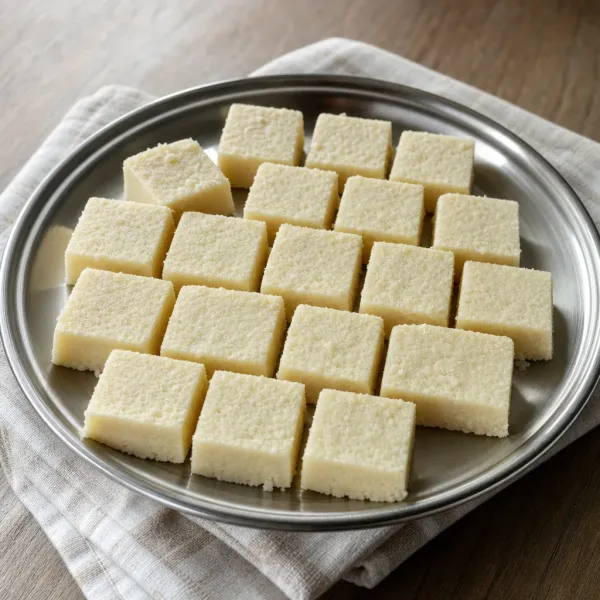
Paal Kova
Authentic Kongunad paal kova made by slowly reducing full-fat cow's milk with sugar. Pale, grainy, soft fudge — no condensed milk shortcut.
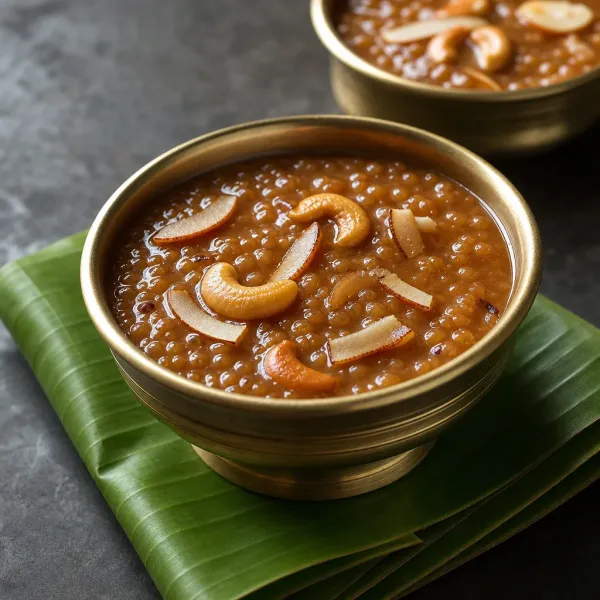
Gothambu Payasam
Traditional Nasrani broken wheat payasam from Travancore made with dark jaggery and fresh coconut milk. A classic Kerala sadya sweet.
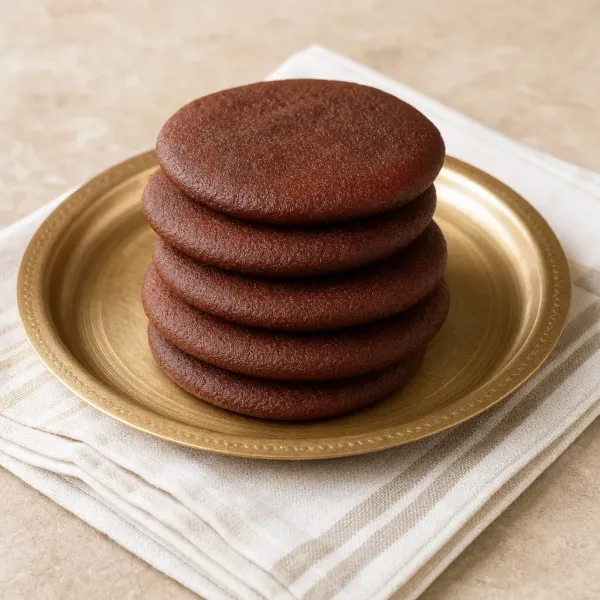
Adhirasam
Authentic Tamil Iyer adhirasam made with freshly ground pacharisi and dark jaggery syrup. Festival sweet for Karthigai Deepam and Diwali, with step-b…
Neyyappam
Traditional Kerala neyyappam made with soaked raw rice, dark jaggery, and pure ghee. Step-by-step temple-style recipe with tips on batter and heat.
Dharwad Peda
Authentic Dharwad peda made at home with khoya and sugar. The traditional Karnataka sweet with its signature brownish-grey colour, step by step.
Ari Unda
Traditional Kerala Ari Unda made with roasted raw rice, dark jaggery and fresh coconut. Step-by-step method with tips on roasting and syrup consisten…