

Ambur Biryani Recipe
Malayalam അംബൂർ ബിരിയാണിTamil ஆம்பூர் பிரியாணிKannada ಅಂಬೂರ್ ಬಿರಿಯಾನಿTelugu అంబూర్ బిర్యానీ
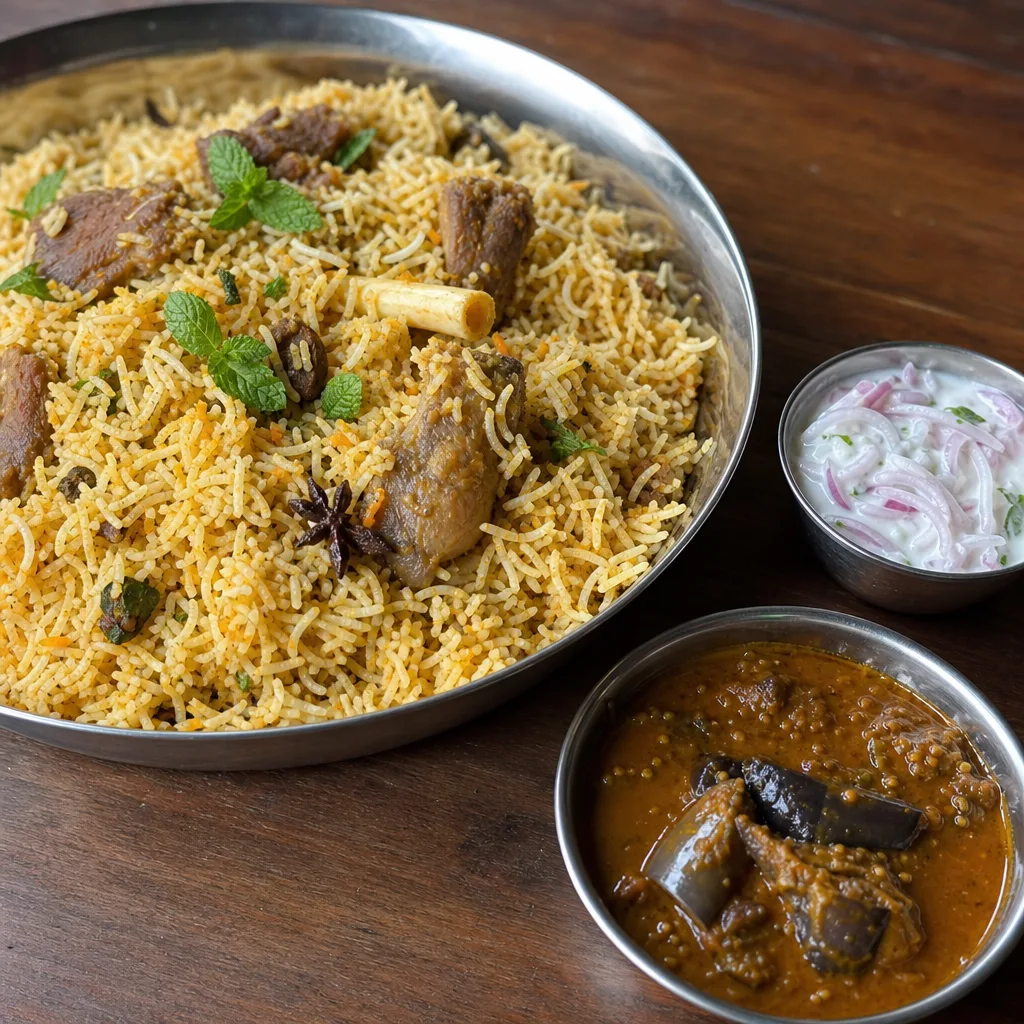
- Prep30 min
- Cook1 hr 15 min
- Serves4
- DifficultyHard
- DietNon-vegetarian
Ambur is a small town in Vellore district, and its biryani has fed travellers on the Chennai–Bangalore highway for generations. It comes from the kitchens of the Arcot Nawayath Muslim community, descendants of Arab and Persian traders who settled in the Carnatic region. The cooking style is older than the Mughal-influenced biryanis of the north: less fragrant with flower waters, more direct with dried red chillies and whole spices, and built around seeraga samba, the short-grained, intensely aromatic rice that absorbs flavour without becoming mushy.
The method is a pakki dum: the mutton is cooked almost completely in its own juices and curd before the parboiled rice goes in for the final steam. There is very little added water at any stage. The rice cooks in the steam trapped inside the vessel and in the fat and moisture released by the meat. This is what gives the rice its particular clinging quality, each grain coated rather than wet.
In Ambur households, mint does most of the herb work; coriander leaves are used sparingly or not at all. The colour is a pale gold to light orange, not the deep saffron of Hyderabadi biryani. It is eaten with a thin, sour brinjal curry called kathirikai gravy and raita on the side.
Ingredients (serves 4)
For the rice
For the mutton
Whole spices for the mutton
Method
Soak and drain the rice
Wash the seeraga samba rice in two or three changes of cold water until the water runs mostly clear. Soak in fresh cold water for 20 minutes, then drain completely in a colander. This short soak is enough for seeraga samba; longer soaking makes the grains fragile.
Parboil the rice
Bring 1.2 litres of water to a rolling boil in a large pot. Add salt generously, the bay leaves, cloves and bruised cardamom. Tip in the drained rice and cook on high heat, uncovered, for exactly 6 to 7 minutes. The grains should be about 70 percent cooked: they will bend slightly but still have a firm, chalky centre when you press one between your fingers. Drain immediately through a colander and spread on a wide tray to stop the cooking. Do not rinse.
Fry the shallots
Heat the gingelly oil and ghee together in a heavy-bottomed pot or a thick aluminium vessel large enough to hold everything. When the oil shimmers, add all the whole spices for the mutton and let them sizzle for 30 seconds. Add the sliced shallots and fry on medium heat, stirring regularly, for 18 to 20 minutes until they are deep golden brown and beginning to crisp at the edges. If you rush this step, the biryani will taste raw and sharp.
Add ginger, garlic and red chilli paste
Add the ginger paste and garlic paste to the browned shallots and fry on medium heat for 3 to 4 minutes, scraping the bottom of the pot, until the raw smell is completely gone. Add the ground red chilli paste and fry for another 3 minutes, stirring constantly, until the oil begins to separate around the edges.
Cook the tomatoes
Add the chopped tomatoes and half the torn mint. Cook on medium heat, mashing the tomatoes as they soften, for about 8 minutes until the tomatoes have completely broken down and the masala is thick and the oil has risen to the surface again.
Add mutton and curd
Add the mutton pieces and turn them in the masala to coat well. Add the whisked curd and mix thoroughly. Increase the heat to medium-high and cook uncovered for 5 minutes, stirring, so the curd is absorbed into the masala rather than splitting. Then add salt, reduce the heat to medium-low, cover tightly and cook for 35 to 40 minutes, until the mutton is nearly tender and the gravy has thickened considerably. Check once or twice; if it sticks, add a splash of hot water. The mutton should be cooked through but the gravy should not be watery.
Check the mutton gravy
Before layering, taste the mutton for salt and heat. The gravy should be thick, coating the meat, with visible oil on the surface. This oil is what will steam up through the rice during dum. If there is standing water rather than thick gravy, cook uncovered on medium heat for a few more minutes to reduce it.
Layer the rice over the mutton
Spread the remaining torn mint over the mutton in the pot. Gently spoon the parboiled rice over the mutton in an even layer, covering it completely. Do not stir. The rice sits on top; the mutton and its gravy stay below.
Seal and dum
Cover the pot with a tight-fitting lid. If your lid does not seal well, place a piece of aluminium foil under it and press down. Place the pot on a tawa or flat griddle over the lowest possible flame. Cook on this indirect, very low heat for 20 to 25 minutes. You will see wisps of steam escaping at the edges after about 10 minutes; that tells you the dum is working. Do not lift the lid before 20 minutes.
Rest and open
Remove from the heat and leave the pot sealed for a further 5 minutes. Open the lid away from you. The rice on top will be fully cooked, pale gold, and fragrant with mint and whole spices. Use a wide, flat spoon to gently fold the rice and mutton together from the sides and bottom, trying not to break the grains. Serve immediately.
How to serve
Thin kathirikai (brinjal) gravy cooked with tamarind and dried red chillies; plain onion raita made with sliced shallots, curd and green chilli.
Served with: Thin kathirikai (brinjal) gravy cooked with tamarind and dried red chillies; plain onion raita made with sliced shallots, curd and green chilli.
Cook's tips
Seeraga samba is not substitutable
Basmati will not give you this biryani. Seeraga samba is shorter, stickier and more aromatic; it clings to the meat in a way that basmati does not. It is available in Tamil Nadu grocery stores across South India. If you cannot find it, the recipe does not work the same way.
Gingelly oil is correct here
Ambur biryani is cooked in gingelly oil (sesame oil), not in refined oil and not in pure ghee. A small amount of ghee is added alongside, but gingelly oil is the primary fat and contributes a subtle nuttiness that is part of the flavour. Use cold-pressed gingelly oil, not the toasted kind.
The 70 percent rule for parboiling
If you parboil the rice past 70 percent, it will turn to mush during dum. Seeraga samba cooks faster than basmati, so 6 to 7 minutes at a rolling boil is usually enough. Start tasting at 5 minutes. The grain should feel firm with a visible white core when you bite it.
Kalpasi and Marathi mokku
These two spices are characteristic of Ambur and Chettinad cooking and are sold in Tamil Nadu spice shops as a matter of course. Kalpasi is a lichen with a smoky, mossy flavour; Marathi mokku (dried kapok buds) adds a faint bitterness. Both are used whole and not eaten. If you cannot source them, leave them out rather than substituting; the biryani will still be recognisable.
Do not add food colour
Ambur biryani is pale. The colour comes from the fried shallots and the red chilli paste, giving a light orange-gold to the lower layers. It is not dyed with saffron water or food colouring. A deep orange or yellow colour indicates a different style of biryani.
Regional variations
Vaniyambadi biryani from the same region is closely related but uses slightly different spice proportions; some families add a small amount of coconut milk in the final dum, which Ambur households typically do not.
Glossary
- Seeraga samba சீரக சம்பா
- A short-grained, intensely aromatic rice variety native to Tamil Nadu, named for its resemblance to cumin (seeragam) seeds.
- Kalpasi கல்பாசி
- Stone flower, a lichen (Parmotrema perlatum) used as a whole spice in Ambur and Chettinad cooking for its smoky, earthy aroma.
- Marathi mokku மரத்தி மொக்கு
- Dried flower pods of the kapok tree, used whole in Tamil Muslim and Chettinad biryanis for a faint bitter depth.
- Nallennai நல்லெண்ணெய்
- Cold-pressed gingelly oil (sesame oil), the traditional cooking fat for Tamil Nadu biryanis and kuzhambus.
- Dum தம்
- The technique of sealing a pot and cooking on very low indirect heat so that food steams in its own moisture; from the Persian word for breath.
- Pakki dum பக்கி தம்
- A dum biryani method in which the meat is fully or nearly fully cooked before the parboiled rice is layered on top for the final steam, as opposed to kacchi dum where raw meat and raw rice cook together.
Two things decide whether this biryani works. The first is stopping the parboiling at exactly 70 percent, because seeraga samba is unforgiving: a minute too long and the dum turns it to paste. The second is getting enough oil to rise to the surface of the mutton gravy before layering, because it is that fat, not added water, that creates the steam to finish the rice. If the gravy looks watery when you open the pot after the mutton is done, reduce it before you layer. Everything else follows from those two moments.
More Rice Dishes recipes
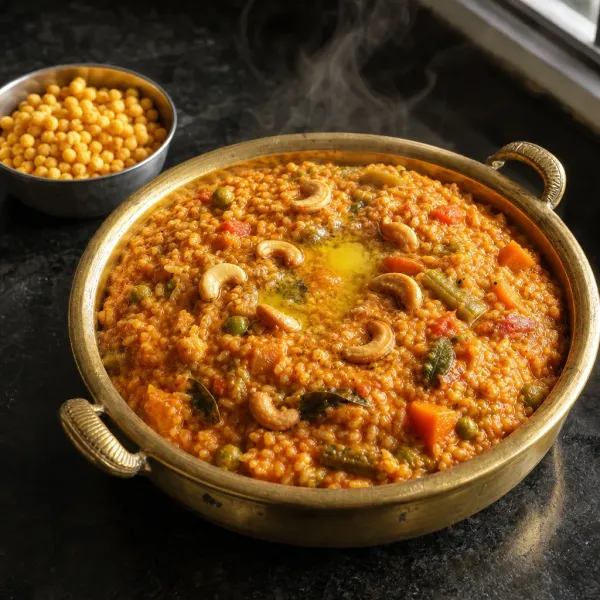
Bisi Bele Bath
Authentic Karnataka bisi bele bath with homemade spice powder, toor dal, seasonal vegetables, tamarind, and a hot ghee tempering. Traditional househo…
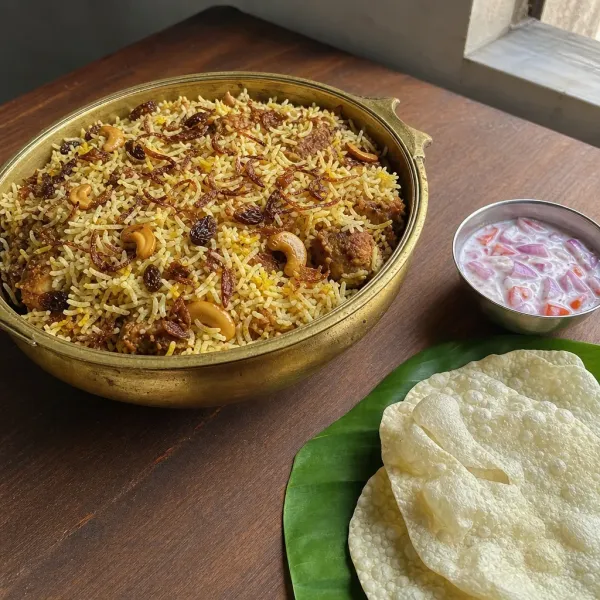
Thalassery Chicken Biryani
Authentic Thalassery chicken biryani with Kaima rice, Mappila masala, and dum method. Step-by-step traditional Kerala Malabar household recipe.
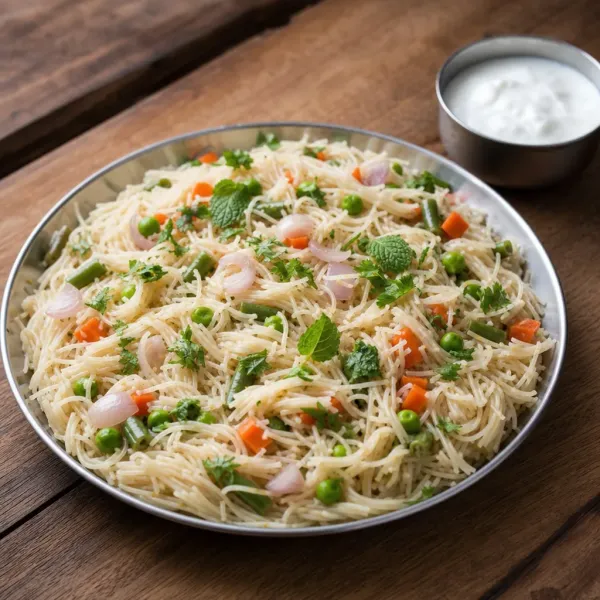
Semiya Biryani (Vermicelli Biryani)
Traditional Tamil Nadu semiya biryani made with roasted vermicelli, shallots, and gingelly oil. A quick, spiced weekday dish from Kongunad home kitch…
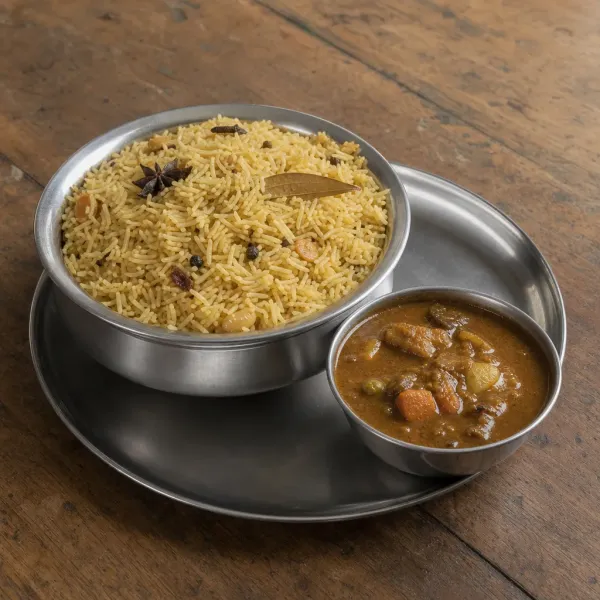
Kuska
Traditional Tamil Muslim kuska: fragrant seeraga samba rice cooked with whole spices and golden shallots. Stovetop method, no meat, no food colour.
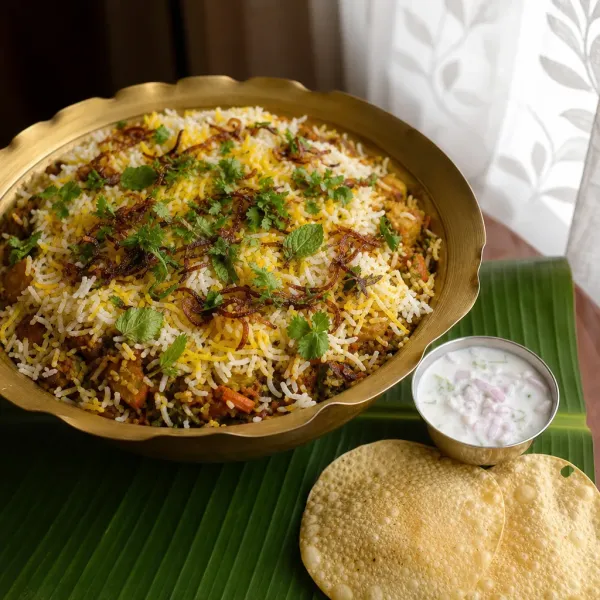
Malabar Vegetable Dum Biryani
Traditional Mappila-style vegetable dum biryani with Kaima rice, whole spices, and a layered masala sealed and slow-cooked on a tawa. Kerala home rec…
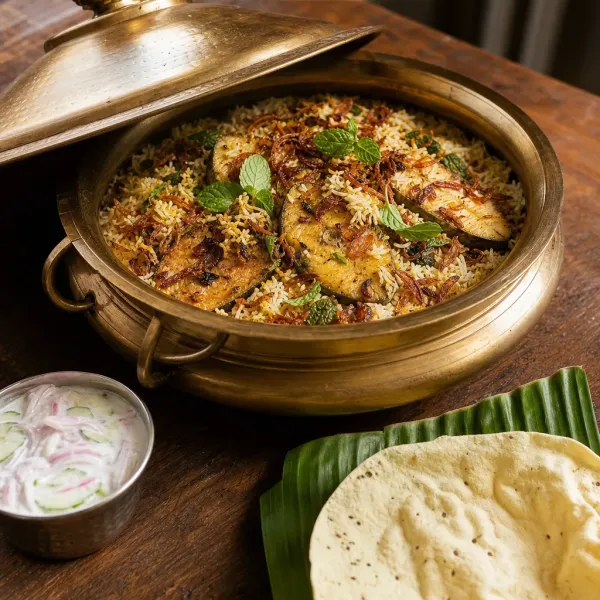
Malabar Meen Biryani
Traditional Mappila Malabar Meen Biryani with king fish, Kaima rice and coconut oil masala. Authentic Kerala fish biryani recipe with dum method.