

Filter Coffee: Decoction and the Metal Filter Recipe
Malayalam ഫിൽറ്റർ കാപ്പിTamil ஃபில்டர் காபிKannada ಫಿಲ್ಟರ್ ಕಾಫಿTelugu ఫిల్టర్ కాఫీ
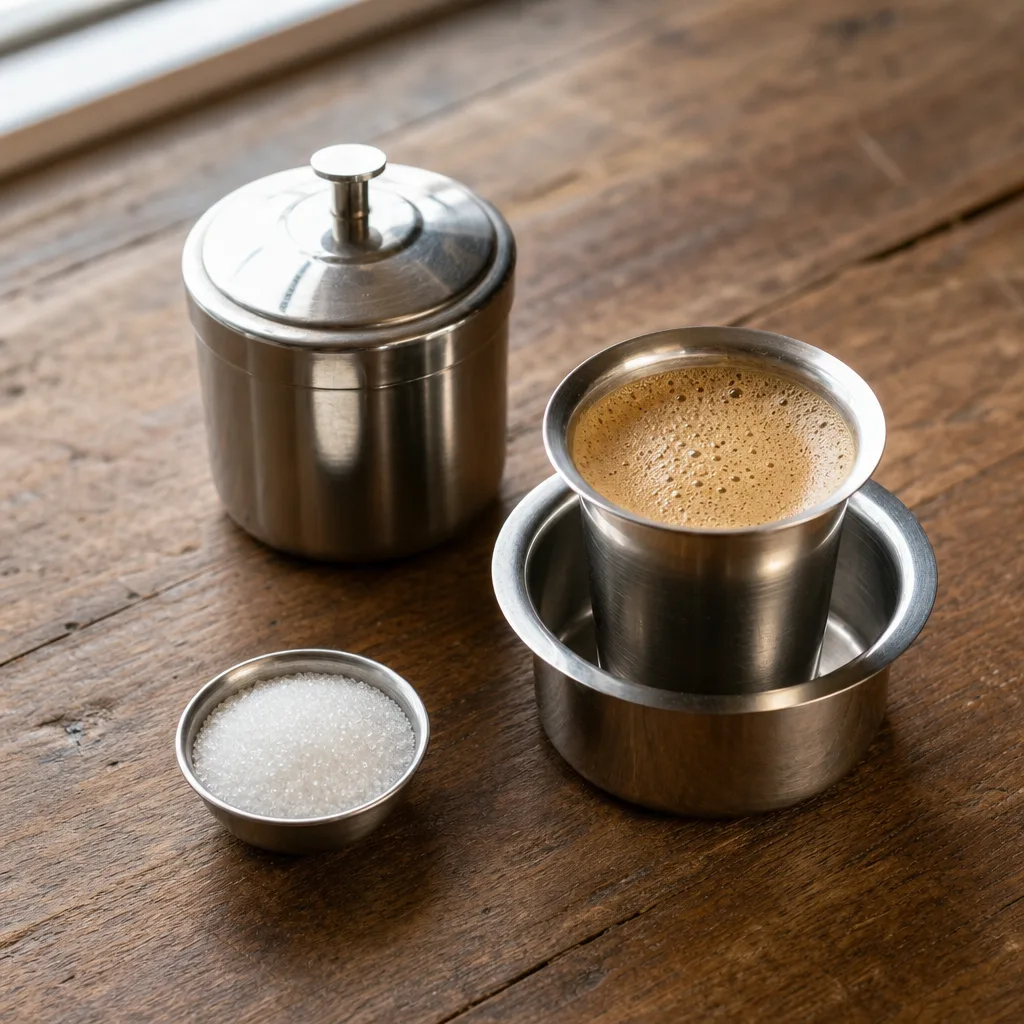
- Prep5 min
- Cook20 min
- Serves2
- DifficultyEasy
- DietVegetarian
This is the coffee of Tamil Brahmin households, made every morning in a two-part stainless steel filter that sits on the kitchen counter like a small tower. The upper chamber holds the ground coffee; the lower chamber collects the slow drip of decoction over twenty to thirty minutes. Nothing is rushed. The decoction is dark, dense and barely pourable, and it is this concentration that gives the drink its character.
The blend matters enormously. A traditional Iyer kitchen uses a mix of roasted coffee and chicory, usually in a ratio of eighty parts coffee to twenty parts chicory, sometimes seventy to thirty. The chicory adds a slight bitterness and body that pure coffee alone does not give, and it helps the decoction drip more cleanly. Families buy their blend from a specific coffee shop and stay loyal to it for decades.
The decoction is mixed with hot, frothed milk in a dabara and tumbler, poured back and forth between the two vessels to cool it to drinking temperature and to raise a foam. The ratio of decoction to milk varies by household and by person. Strong coffee drinkers use more decoction; children and elders often get a weaker cup. No sugar goes into the filter or the milk; it is added by each person at the table.
Ingredients (serves 2)
For the decoction
For the cup
Method
Assemble the filter
Take the two-part stainless steel coffee filter. The upper chamber has a perforated disc at the bottom and a pressing disc with a handle. Set the upper chamber on top of the lower chamber. Make sure the filter is dry; moisture left from washing will affect the drip.
Load the coffee
Spoon 4 tablespoons of the ground blend into the upper chamber. Spread it level with a gentle shake. Place the pressing disc on top of the grounds and press down lightly with your palm — firm enough to compact the grounds slightly, not so hard that you seal them. The disc should rest on the surface, not be forced down. Over-pressing will slow the drip to almost nothing.
Pour the hot water
Bring 200 ml of water to a boil, then let it sit for 30 seconds. Pour it slowly and evenly over the pressing disc. The disc distributes the water across the grounds. Put the lid on the upper chamber. Do not stir, do not press again.
Wait for the decoction to drip
Set the filter aside and leave it undisturbed for 20 to 30 minutes. The decoction will drip slowly into the lower chamber. It should be very dark brown, almost black, and viscous. If it drips through in under 10 minutes the grind is too coarse; if nothing has dripped after 40 minutes the grind is too fine or the grounds are packed too hard. A good decoction from 4 tablespoons of coffee and 200 ml of water yields roughly 120 to 150 ml of liquid in the lower chamber.
Heat the milk
While the decoction drips, heat 300 ml of full-fat milk in a small heavy-bottomed vessel over medium flame. Bring it to a full boil, stirring occasionally so it does not catch at the bottom. Let it rise once, then reduce the heat and hold it just below boiling for 2 minutes. This thickens the milk slightly and improves the froth.
Measure the decoction into the dabara
Pour the collected decoction into the dabara (the wide, flat-bottomed metal cup). For a strong cup, use 3 to 4 tablespoons of decoction per serving. For a milder cup, use 2 tablespoons. Do not dilute the decoction with water; adjust strength through the milk ratio instead.
Add the hot milk
Pour the hot milk over the decoction in the dabara. The cup will now be full and very hot. Do not stir.
Froth by pouring between dabara and tumbler
Hold the dabara in one hand and the tumbler in the other. Pour the coffee from the dabara into the tumbler, lifting the dabara high so the stream falls from a height of 20 to 30 cm. Pour it back from the tumbler into the dabara, again from a height. Repeat this four to six times. Each pour cools the coffee slightly and raises a light foam on the surface. Stop when the coffee is at drinking temperature and a thin layer of foam sits on top. This pouring is not decorative; it is how the coffee is cooled without ice and how the decoction and milk are fully combined.
Serve immediately
Pour the finished coffee into the tumbler and set the dabara underneath it as a saucer. Serve at once with sugar on the side. Filter coffee does not wait; it loses its foam and cools unevenly if left standing.
How to serve
Plain Marie biscuits or cream crackers in many households; sometimes alongside idli, dosa or pongal at breakfast, but the coffee itself stands alone and needs no food pairing.
Served with: Plain Marie biscuits or cream crackers in many households; sometimes alongside idli, dosa or pongal at breakfast, but the coffee itself stands alone and needs no food pairing.
Cook's tips
The grind is the most common failure point
If you grind at home, err on the slightly coarser side rather than finer. A grind that is too fine will block the perforated disc entirely and you will wait an hour for a trickle. Ask the coffee shop to grind specifically for a metal filter, not for a paper filter.
Chicory is not optional
Pure coffee without chicory produces a thinner decoction that drips too fast and lacks the characteristic body. If you cannot find a pre-blended coffee-chicory mix, the traditional ratio is 80 g coffee to 20 g chicory by weight.
The filter needs to be cleaned properly
After each use, discard the spent grounds, rinse all parts with hot water and dry thoroughly. Coffee oils left in the filter turn rancid and will make the next decoction bitter in the wrong way. Do not use soap; it leaves a residue that affects flavour.
Storing leftover decoction
Decoction keeps in a closed container in the refrigerator for up to two days. Reheat gently without boiling. The flavour is slightly flatter than fresh but perfectly acceptable for a second-day cup.
The pressing disc pressure
Some filters come with a screw-down pressing disc. Do not screw it tight. Rest it on the grounds and turn it only until it sits level. A tightly screwed disc is the single most common reason a home filter produces no decoction at all.
Regional variations
Degree coffee of roadside kadais and Udupi hotels in Karnataka; Mysorean filter coffee with a slightly different chicory ratio; Andhra households who use a higher milk ratio and serve it very sweet.
Glossary
- Dabara தம்ளர்-டபரா
- The wide, flat-bottomed stainless steel cup used to hold filter coffee; paired with the tumbler and used for the pouring-and-frothing action.
- Tumbler தம்ளர்
- The tall, narrow stainless steel cup into which the coffee is finally poured for drinking; the dabara sits beneath it as a saucer.
- Degree coffee டிகிரி காபி
- A term used in Tamil Nadu for coffee made with full-fat, unadulterated milk; 'degree' originally referred to milk tested with a lactometer and found undiluted.
- Chicory சிக்கரி
- The roasted and ground root of Cichorium intybus, blended with coffee in South Indian filter blends to add body, slight bitterness and to help the decoction drip cleanly.
- Decoction காபி டிகாக்ஷன்
- The concentrated dark liquid that drips through the metal filter; it is not the finished drink but the base that is mixed with hot milk.
Two things decide whether this cup works: the quality and freshness of the coffee-chicory blend, and the patience to let the decoction drip at its own pace without pressing or hurrying it. Everything else — the milk ratio, the sweetness, the number of pours — is personal preference that each household settles over years.
More Beverages recipes
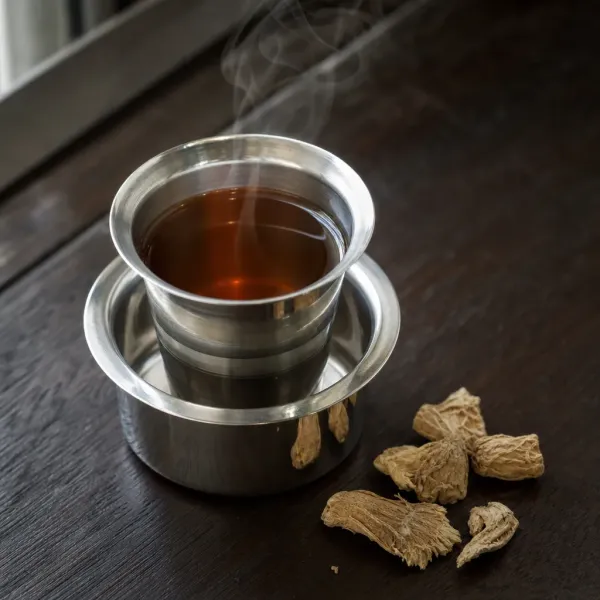
Sukku Malli Coffee
Traditional Kongunad sukku malli coffee made with dry ginger, coriander seeds and jaggery. A warming medicinal drink, ready in 15 minutes.
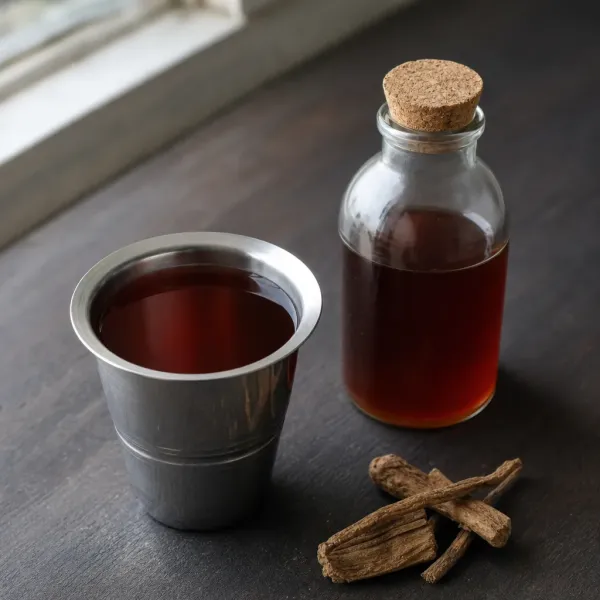
Nannari Sharbat: Sarsaparilla Root Syrup Drink
Traditional Tamil Nadu nannari sharbat made from dried sarsaparilla root and rock sugar. A cooling summer syrup, stored and diluted to drink. Step-by…

Rose Milk (Roja Paal)
Classic Tamil Nadu rose milk made with a from-scratch rose syrup, full-fat chilled cow's milk, and optional sabja seeds. Simple, cold, and properly p…