

Thakkali Kuzhambu Recipe
Malayalam തക്കാളി കുഴമ്പ്Tamil தக்காளி குழம்புKannada ತಕ್ಕಾಳಿ ಕುಳಂಬುTelugu టమాటా కుళంబు
- Prep15 min
- Cook35 min
- Serves4
- DifficultyEasy
- DietVegan
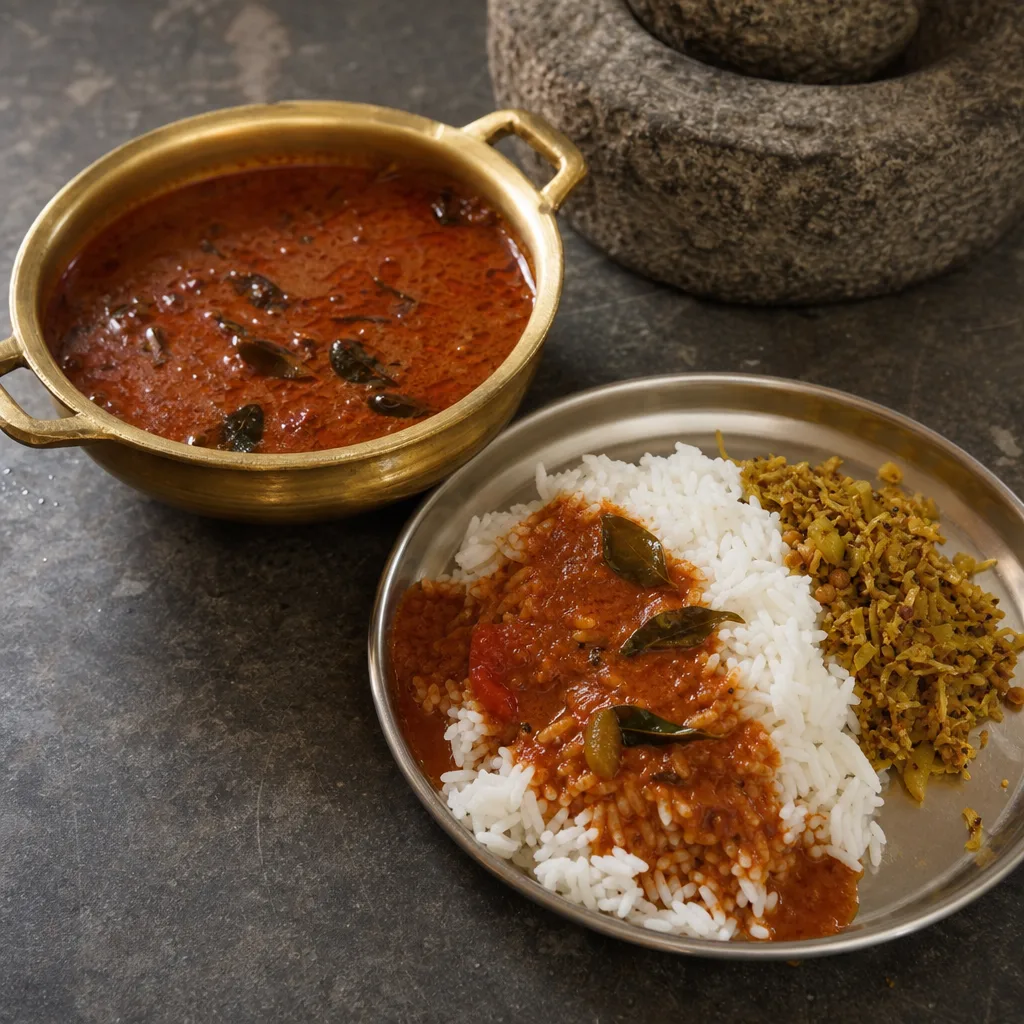
Thakkali Kuzhambu is a daily-cooking dish in Tamil Iyer homes, made when the pantry is simple and the meal needs a tangy, thin gravy to go over rice. It is not a festive dish. It is the kind of thing a grandmother makes on a Tuesday, and it is better for that ordinariness.
The base is ripe tomatoes cooked down with tamarind, shallots, and a freshly ground or dry-roasted spice mix. In Iyer kitchens the onion is almost always shallots, the fat is gingelly oil, and the tempering is unhurried. The kuzhambu should be thin enough to pool around a mound of rice, deeply red, and sharp at the edges with tamarind balanced by the natural sweetness of well-cooked tomato.
Households differ mainly on the spice paste: some grind fresh coconut into it to give body, others keep it entirely coconut-free and rely on the tomato alone to thicken as it reduces. Both are genuine. This recipe is the coconut-free version, which is the more common weekday approach. The tomatoes must be truly ripe; under-ripe ones leave a raw, green-edged sourness that no amount of tamarind corrects.
Ingredients (serves 4)
For the kuzhambu
For the kuzhambu podi (spice powder)
Method
Dry-roast the spice powder
Set a small heavy pan over low heat with no oil. Add the chana dal and urad dal first and stir continuously for about two minutes until they turn pale gold. Add the coriander seeds, cumin, black pepper, and dried red chillies and keep stirring for another two minutes until the coriander seeds smell nutty and the chillies darken slightly. Tip everything onto a plate and let it cool completely before grinding to a coarse powder in a dry grinder. Do not grind while hot or it will clump.
Extract the tamarind pulp
Break the tamarind into the warm water and work it with your fingers until the pulp dissolves and you have a thin, slightly cloudy liquid. Strain through a sieve, pressing the fibres, and discard the seeds and skin. You need about 150 ml of thin tamarind water.
Temper the oil
Heat the gingelly oil in a wide, heavy-bottomed pan over medium heat until it shimmers but does not smoke. Add the mustard seeds and wait for them to pop fully, about 30 seconds. Add the broken dried red chillies and curry leaves and stand back — they will splutter. Let them sizzle for 15 seconds. Add the asafoetida and stir once.
Cook the shallots
Add the halved shallots to the tempered oil and reduce the heat to medium-low. Cook, stirring occasionally, for 8 to 10 minutes until the shallots are soft, translucent, and beginning to colour at the edges. Do not rush this step; undercooked shallots give the kuzhambu a sharp, raw bite.
Add turmeric and tomatoes
Stir in the turmeric powder, then add all the chopped tomatoes. Increase the heat to medium and cook, stirring every couple of minutes, for 12 to 15 minutes until the tomatoes have completely collapsed, released their water, and the oil begins to separate at the edges of the pan. The mixture should look like a thick, dark-red paste at this point, not watery.
Add the spice powder
Add the freshly ground kuzhambu podi and stir it through the tomato paste. Cook for two minutes over medium heat so the raw smell of the ground spices cooks off. The paste will darken a little and smell deeply savoury.
Pour in the tamarind water
Add the strained tamarind water and 200 ml of plain water. Stir well, scraping up anything stuck to the base of the pan. Add salt. Bring to a boil over medium-high heat, then reduce to a steady simmer.
Simmer until the kuzhambu thickens
Simmer uncovered for 12 to 15 minutes, stirring occasionally. The kuzhambu is ready when it has reduced to a thin but not watery gravy, the oil floats visibly on the surface, and the raw tamarind smell has completely cooked out. The colour should be a deep brick-red. Taste and adjust salt.
Rest before serving
Turn off the heat and let the kuzhambu sit for five minutes before serving. It thickens slightly as it rests and the flavours settle. If it thickens too much on standing, stir in a splash of hot water.
How to serve
Hot plain rice (pacharisi or boiled rice), a dry poriyal such as beans or raw banana, papad, and a small spoon of ghee poured over the rice at the table. Pairs well with mor (buttermilk) on the side.
Served with: Hot plain rice (pacharisi or boiled rice), a dry poriyal such as beans or raw banana, papad, and a small spoon of ghee poured over the rice at the table. Pairs well with mor (buttermilk) on the side.
Cook's tips
Tomato choice matters
Large, pale, commercial tomatoes do not give the same depth. Country tomatoes (nattu thakkali) are smaller, more acidic, and cook down to a much richer colour. If you cannot find them, use the ripest tomatoes available and increase the quantity by 100 g.
Adjusting sourness
The balance between tomato acidity and tamarind is the whole point of this dish. Taste after the tamarind goes in. If it is too sharp, a pinch of jaggery rounds it without sweetening the kuzhambu noticeably. Do not add more tomato at this stage.
The oil must separate
If the oil does not visibly float on the surface by the end of cooking, the kuzhambu will taste raw and flat. Simmer a little longer, uncovered, until you see the red oil pooling at the edges.
Using ready-made kuzhambu podi
Many Iyer households keep a batch of homemade kuzhambu milagai thool in the pantry and use 1½ to 2 tsp of it in place of the freshly roasted podi. Store-bought versions vary widely in salt and chilli content, so taste before adding.
Storage
Thakkali Kuzhambu keeps well. It tastes better the next day once the spices have had time to settle into the gravy. Store in a clean, dry container and refrigerate for up to three days. Reheat gently with a splash of water.
Regional variations
Chettinad version uses more dried chillies and kalpasi; Kongu households add small shallots and a heavier tamarind hand; Iyengar version omits onion entirely and uses only asafoetida for the base.
Glossary
- Kuzhambu குழம்பு
- A thin, tangy Tamil gravy made with tamarind, spices, and a vegetable or legume base, served over rice.
- Nallennai நல்லெண்ணெய்
- Gingelly oil; cold-pressed sesame oil used as the primary cooking fat in Tamil Nadu for gravies and pickles.
- Perungayam பெருங்காயம்
- Asafoetida; a pungent dried resin used in small quantities as a digestive and flavour base in Tamil Brahmin cooking, often replacing onion in strictly vegetarian preparations.
- Chinna vengayam சின்ன வெங்காயம்
- Small shallots; the preferred allium in Tamil cooking, sharper and more aromatic than large onions.
- Nattu thakkali நாட்டு தக்காளி
- Country or native tomatoes; small, deeply red, more acidic varieties grown locally, preferred over commercial hybrid tomatoes for their flavour concentration.
- Kuzhambu milagai thool குழம்பு மிளகாய் தூள்
- A pre-mixed spice powder used specifically for Tamil gravies, typically including coriander, cumin, pepper, dried chilli, and lentils.
Two things decide this kuzhambu: whether the tomatoes are cooked all the way down to a paste before the tamarind water goes in, and whether the oil separates fully by the end. Skip either of those and the gravy tastes thin and raw, however long you simmer it afterwards.
More Vegetarian Gravies recipes
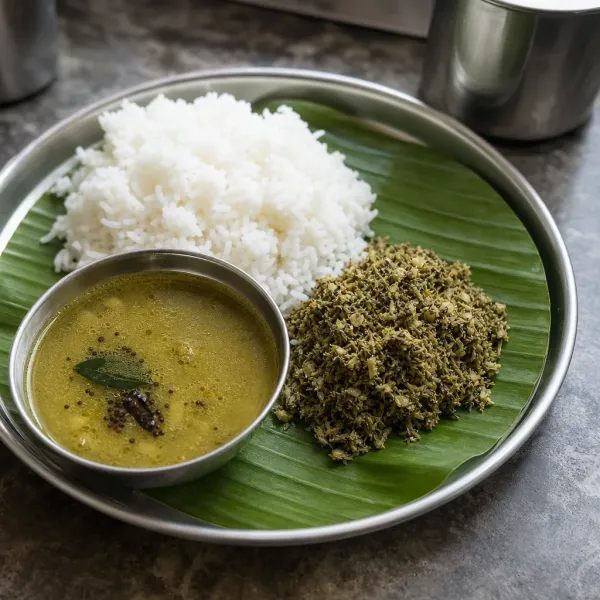
Bassaru
Traditional Karnataka bassaru: toor dal and dill cooked together, strained into a spiced coconut broth and a dry palya. Vokkaliga household recipe.
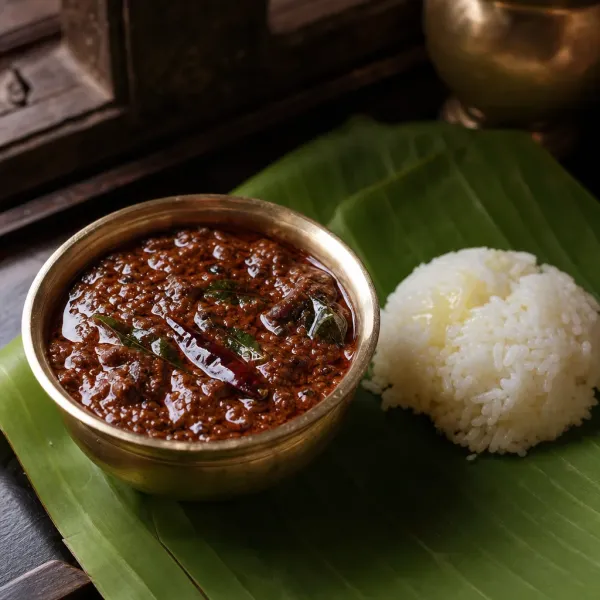
Menthya Gojju
Traditional Karnataka menthya gojju: dry-roasted fenugreek seeds in tamarind, jaggery and fresh coconut paste. Balanced bitter, sour and sweet.
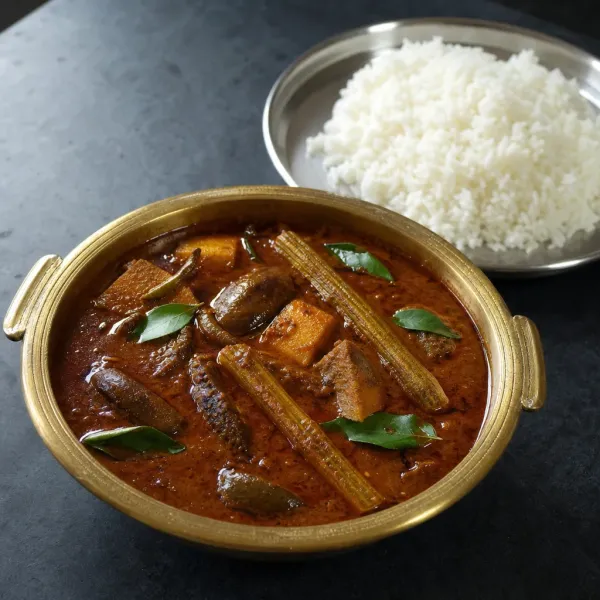
Kadamba Kuzhambu
Traditional Tamil Brahmin kadamba kuzhambu with many vegetables, toor dal, tamarind, and a freshly ground coconut-spice paste. Temple-day recipe.
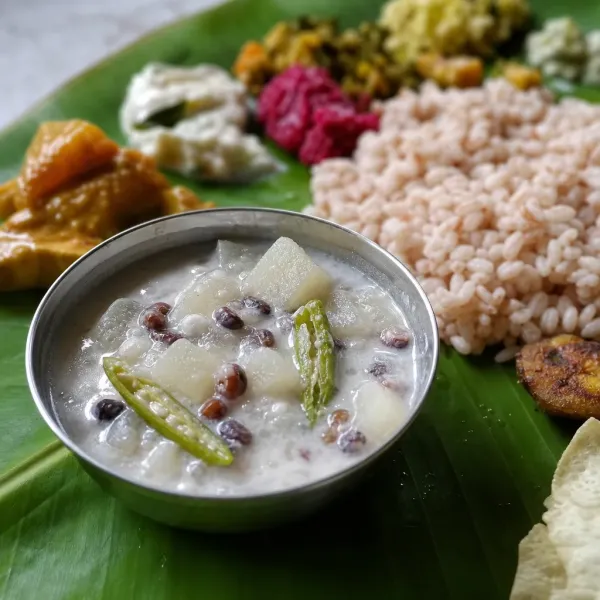
Olan
Traditional Kerala Olan recipe with ash gourd, vanpayar, and fresh coconut milk. A Sadya essential from the Travancore kitchen, cooked the household…
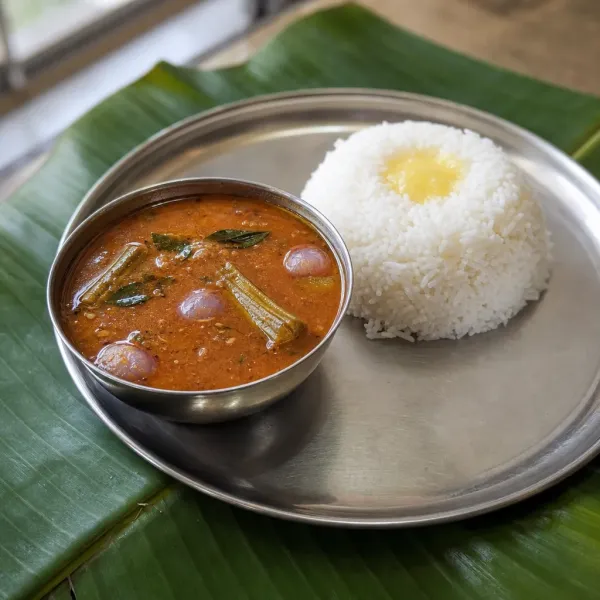
Arachuvitta Sambar (Tamil Brahmin Style, Freshly Ground Masala)
Traditional Tamil Brahmin arachuvitta sambar with freshly ground coconut masala, toor dal, drumstick, and tamarind. No sambar powder, no tomato.
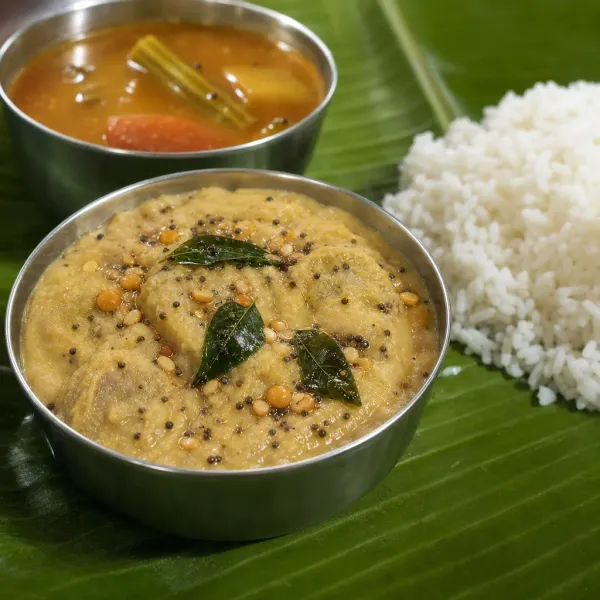
Kootu
Traditional Tamil Brahmin kootu with raw banana and toor dal, bound with a freshly ground coconut and cumin paste. A daily Iyer lunch dish.