

Bassaru Recipe
Malayalam ബസ്സാരുTamil பஸ்சாருKannada ಬಸ್ಸಾರುTelugu బస్సారు
- Prep20 min
- Cook50 min
- Serves4
- DifficultyMedium
- DietVegan
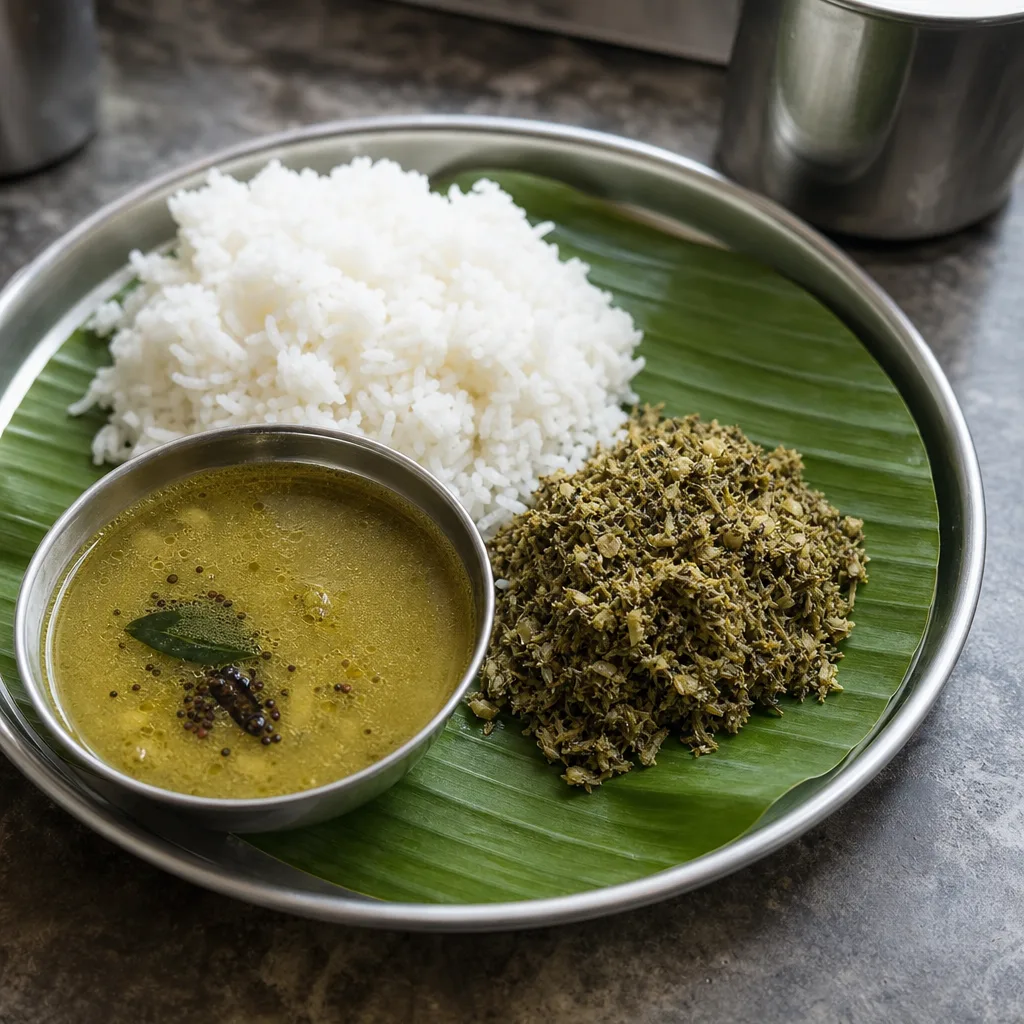
Bassaru is one of those dishes that makes use of everything twice. You cook toor dal with greens until both are completely soft, then squeeze out the liquid. That liquid becomes the rasam-like broth — the bassaru proper — seasoned with a fresh coconut-and-spice paste and tempered. The solids that remain become the palya, a dry stir-fry finished in its own tempering. Two dishes from one pot of dal.
In Karnataka homes this is everyday food, not occasion food. It appears at lunch with rice, and the two preparations — broth and palya — are served together on the same plate. The broth is poured over rice and the palya sits alongside. Shepu soppu (dill leaves) is the most traditional green for this preparation in the Old Mysore belt, though methi and amaranth leaves are also used depending on the season and what the kitchen garden offers.
The bassaru masala is what distinguishes this from a plain dal. It is ground fresh — coconut, dried red chilli, cumin, garlic — and stirred into the strained broth just before the final tempering. Do not cook it long after adding the paste; a brief simmer is all it needs, or the raw brightness of the coconut disappears.
Ingredients (serves 4)
For cooking the dal and greens
For the bassaru masala (ground fresh)
For tempering the bassaru (broth)
For tempering the palya (dry stir-fry of the cooked solids)
Method
Cook the dal and greens together
Put the rinsed toor dal, chopped dill leaves, turmeric, and 700 ml water into a pressure cooker. Cook on medium heat for 4 whistles, then turn off the heat and let the pressure drop on its own. When you open the cooker, the dal should be completely soft and the dill fully wilted and dark — nothing should be firm.
Separate the broth from the solids
Set a fine sieve or a clean muslin cloth over a large bowl. Pour the cooked dal and greens through it. Press the solids gently with the back of a spoon to extract as much liquid as possible. You should get roughly 400 to 500 ml of greenish-yellow broth. Set the broth aside in the bowl. Transfer the pressed solids to a separate plate — this is your palya base.
Grind the bassaru masala
In a small wet grinder or mixer, combine the grated coconut, dried red chillies, cumin seeds, and garlic. Add 3 to 4 tablespoons of water and grind to a smooth paste. It should have no gritty coconut pieces remaining. This paste is added raw to the broth, so grind it fine.
Finish the bassaru (broth)
Pour the strained broth into a saucepan and bring it to a gentle simmer over medium-low heat. Stir in the ground masala paste and add salt. Let it simmer for 4 to 5 minutes only — you want the rawness of the garlic to cook out but the coconut flavour to stay fresh. The broth will be thin, a little cloudy, and pale greenish-yellow. Do not boil it hard.
Temper the bassaru
Heat 1½ teaspoons of coconut oil in a small tempering pan until it shimmers. Add the mustard seeds and let them pop fully. Add the broken dried red chilli and curry leaves — they will crackle and spit. Pour this tempering immediately into the simmering broth. Stir and take the pan off the heat.
Make the palya tempering
In a wide kadai, heat 2 teaspoons of coconut oil over medium heat. Add the mustard seeds and wait for them to pop. Add the urad dal and let it turn pale gold — this takes about 30 seconds. Add the broken red chilli and curry leaves and fry for a few seconds until fragrant.
Stir-fry the cooked solids
Add the pressed dal-and-dill solids to the kadai. Sprinkle salt over them. Stir everything together over medium heat, breaking up any lumps. Cook for 3 to 4 minutes, stirring often, until the mixture is dry and no longer steaming. It should look like a loose, slightly crumbly dry stir-fry, not wet or paste-like.
Finish the palya with coconut
Take the kadai off the heat. Stir in 2 tablespoons of fresh grated coconut. Taste for salt and adjust. The palya is done — pale green-grey, dry, and faintly fragrant from the dill and tempering.
How to serve
Steamed rice (sona masuri or matta rice). The bassaru broth is poured over the rice like a rasam, and the palya is placed alongside on the same plate. A small amount of ghee on the rice is common in some households.
Served with: Steamed rice (sona masuri or matta rice). The bassaru broth is poured over the rice like a rasam, and the palya is placed alongside on the same plate. A small amount of ghee on the rice is common in some households.
Cook's tips
Greens you can use
Shepu soppu (dill) is traditional in the Old Mysore belt. Fresh methi (fenugreek) leaves and tender amaranth (harive soppu) are also used in Karnataka households. Each gives a different character — methi is slightly bitter, amaranth is milder. Do not use spinach; it makes the broth too dark and the flavour flat.
Pressing the solids
Press firmly but not so hard that you force fine dal particles through the sieve into the broth. The broth should be liquid, not thick. If it looks more like dal soup than a thin broth, you have pressed too hard or the sieve holes are too large.
Byadagi chillies
Byadagi dried red chillies give colour without extreme heat. If you cannot find them, use Kashmiri dried red chillies. Do not use guntur or other very hot varieties, or the broth will be unbalanced.
Do not overcook after adding the masala
The coconut in the masala paste turns dull and slightly sour if simmered too long. Four to five minutes is the maximum. If the broth sits and cools before serving, reheat it gently — do not boil it again.
Without a pressure cooker
You can cook the dal and greens in an open pot with more water (about 1 litre) over low heat for 40 to 50 minutes until the dal is completely soft. The result is the same; it just takes longer.
Regional variations
North Karnataka version uses more dried red chillies and sometimes adds groundnuts to the palya; some Kodava-adjacent households use a thicker coconut-based masala; green moong (hesarukalu) bassaru is a distinct and common variant.
Glossary
- Bassaru ಬಸ್ಸಾರು
- The strained cooking liquid from dal and greens, seasoned with a coconut-spice paste and tempered; the name also refers to the complete two-dish meal.
- Palya ಪಲ್ಯ
- A dry vegetable or lentil stir-fry in Karnataka cooking, equivalent to thoran or poriyal in other South Indian kitchens.
- Shepu soppu ಶೆಪ್ಪು ಸೊಪ್ಪು
- Fresh dill leaves; the traditional green used in bassaru in the Old Mysore and Vokkaliga belt.
- Toor dal ತೊಗರಿ ಬೇಳೆ
- Split pigeon peas; the most common pulse base for bassaru in central and south Karnataka.
- Byadagi ಬ್ಯಾಡಗಿ
- A variety of dried red chilli from Byadagi town in Haveri district, Karnataka; known for deep red colour and moderate heat.
- Soppu ಸೊಪ್ಪು
- Leafy greens in Kannada; used as a suffix to name the specific green — shepu soppu, harive soppu, and so on.
Two things decide whether bassaru works. The first is pressing the cooked solids firmly enough to get a genuinely liquid broth — if you are timid with the sieve, the broth stays thick and the palya stays wet, and you have neither thing properly. The second is the masala paste: grind it fine and add it late, simmering only briefly, so the coconut stays alive in the broth rather than cooking away to nothing.
More Vegetarian Gravies recipes
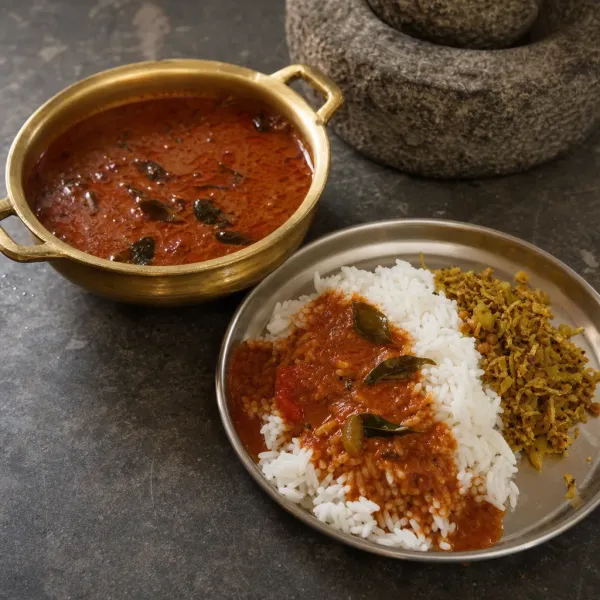
Thakkali Kuzhambu
Traditional Tamil Iyer thakkali kuzhambu with ripe country tomatoes, tamarind, shallots, and freshly roasted kuzhambu podi in gingelly oil.
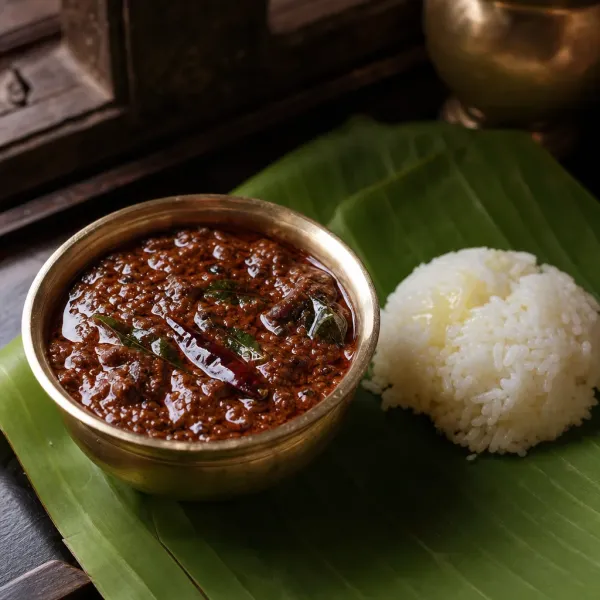
Menthya Gojju
Traditional Karnataka menthya gojju: dry-roasted fenugreek seeds in tamarind, jaggery and fresh coconut paste. Balanced bitter, sour and sweet.
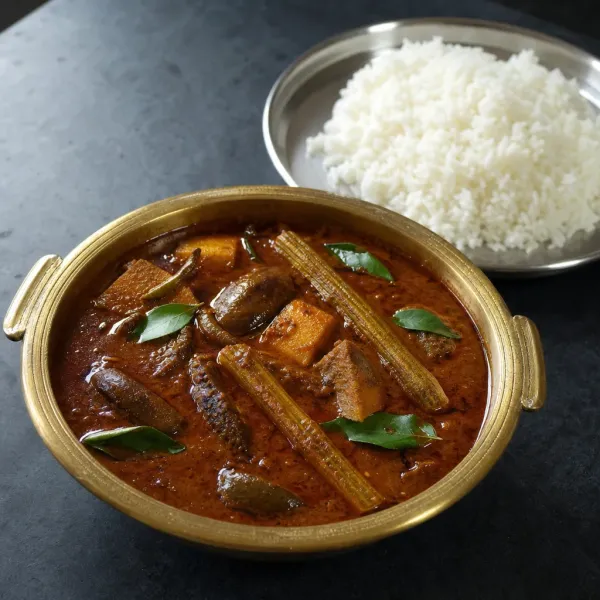
Kadamba Kuzhambu
Traditional Tamil Brahmin kadamba kuzhambu with many vegetables, toor dal, tamarind, and a freshly ground coconut-spice paste. Temple-day recipe.
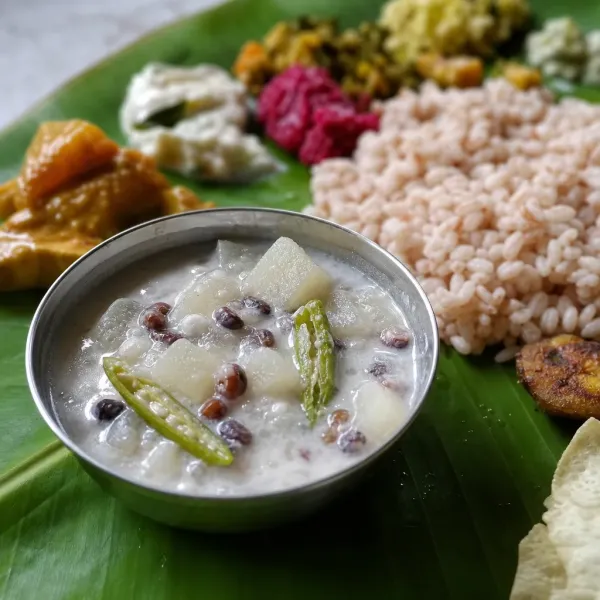
Olan
Traditional Kerala Olan recipe with ash gourd, vanpayar, and fresh coconut milk. A Sadya essential from the Travancore kitchen, cooked the household…
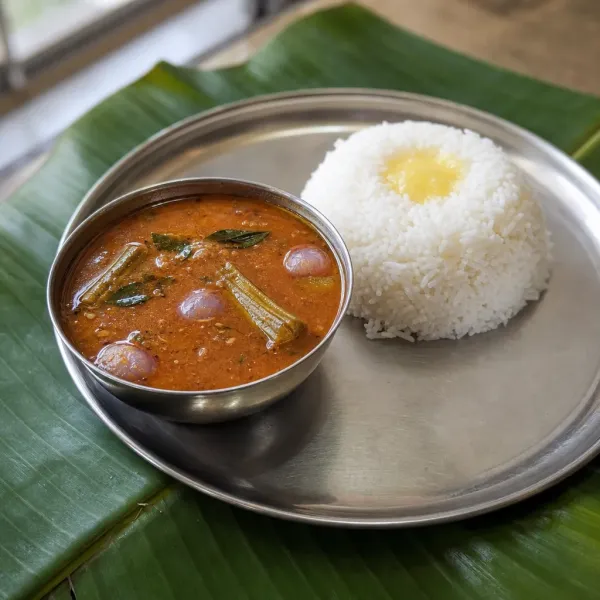
Arachuvitta Sambar (Tamil Brahmin Style, Freshly Ground Masala)
Traditional Tamil Brahmin arachuvitta sambar with freshly ground coconut masala, toor dal, drumstick, and tamarind. No sambar powder, no tomato.
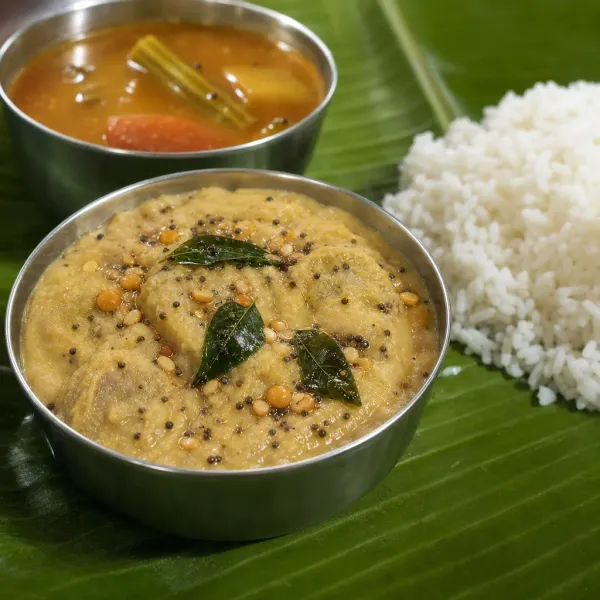
Kootu
Traditional Tamil Brahmin kootu with raw banana and toor dal, bound with a freshly ground coconut and cumin paste. A daily Iyer lunch dish.