

Ellu Sadam Recipe
Malayalam എള്ള് സാദംTamil எள்ளு சாதம்Kannada ಎಳ್ಳು ಸಾದಂTelugu నువ్వుల సాదం
- Prep15 min
- Cook20 min
- Serves4
- DifficultyEasy
- DietVegan
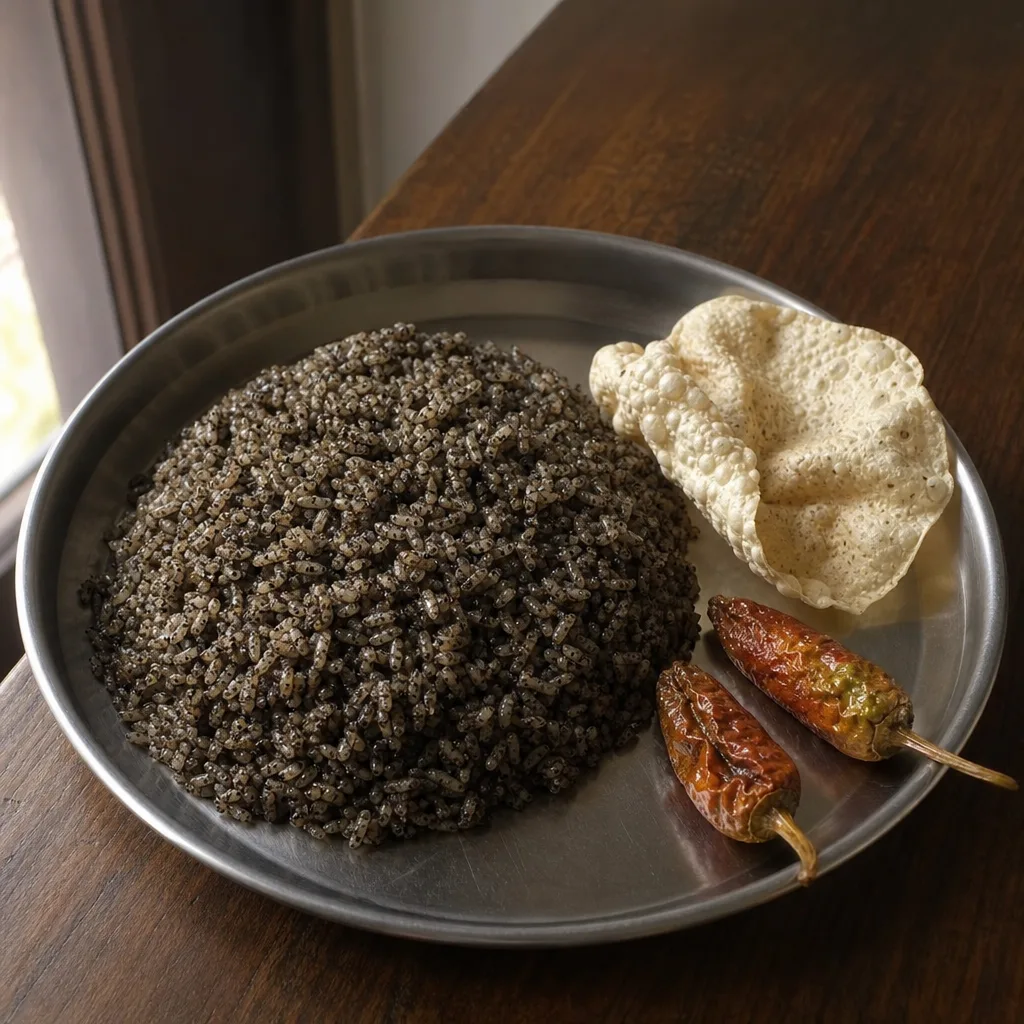
Ellu sadam is made in Tamil Iyer homes most often for Karthigai Deepam, Amavasai and other occasions when a simple, sattvic rice is called for. It travels well in a box and keeps its flavour for hours, which is why it also appears in the tiffin carrier and at temple prasadam. The work is almost entirely in the dry-roasted powder, which is made fresh each time and mixed into plain cooked rice with a little gingelly oil.
The ratio of black sesame to white sesame varies by household. Some families use only black sesame for a deeper, more bitter note; others mix the two. The dried red chillies give heat and a faint smokiness, and a small amount of urad dal and chana dal in the powder adds body without making it heavy. Asafoetida is essential and is never left out.
Gingelly oil is the fat that belongs here, not coconut oil and not ghee. The oil is added raw at the end, not heated, so its cold-pressed flavour stays intact. If the rice is still warm when you mix it, the oil perfumes the whole pot. Do not use refined sesame oil; it has none of the flavour of cold-pressed gingelly oil.
Ingredients (serves 4)
For the rice
For the ellu podi (sesame powder)
For the tempering
Method
Cook and cool the rice
Cook the rice so that every grain is separate and not sticky. Spread it on a wide plate or thali while still warm and let it cool to a comfortable hand temperature. If the grains clump, the powder will not coat them evenly.
Dry-roast the dals
Set a heavy iron or thick-bottomed kadai over medium-low heat with no oil. Add the urad dal and chana dal together. Stir continuously for about 3 minutes until they turn a pale golden and smell nutty. Tip them onto a plate. Do not let them darken further; they continue cooking briefly off the heat.
Roast the dried chillies
In the same dry kadai over low heat, add the dried red chillies. Press them gently with the back of a spoon and turn them for about 1 minute until they blister and deepen in colour. Remove immediately and add to the plate with the dals.
Roast the sesame seeds
Add both black and white sesame seeds to the still-warm kadai over low heat. Keep the heat low; sesame burns quickly. Stir constantly for 2 to 3 minutes. The seeds are ready when the white ones turn faintly golden and the mixture smells toasty and nutty. You will hear them begin to pop lightly. Tip them out immediately onto the plate and spread them to cool. If you leave them in the pan they will over-roast.
Grind the ellu podi
Once everything is completely cool, put the roasted dals, chillies, sesame seeds, asafoetida and salt into a small dry mixer jar. Pulse in short bursts to a coarse powder. Do not run the mixer continuously or the sesame oil will release and the powder will turn into a paste. You want a dry, slightly textured powder, not smooth. Taste and adjust salt.
Make the tempering
Heat 1 tsp gingelly oil in a small pan over medium heat. Add the mustard seeds and wait for them to pop. Add the broken dried chilli, then the curry leaves. Stand back; the leaves will splutter. Switch off the heat after 20 seconds.
Mix the rice
Transfer the warm cooked rice to a wide mixing bowl or thali. Pour the tempering over it. Add the 2½ tbsp raw gingelly oil and toss gently with your hands or a wide spatula, separating any grains that have stuck. The oil should coat every grain.
Add the powder and finish
Add the ellu podi a little at a time, tossing as you go. Start with three-quarters of the powder, taste, and add more until the flavour is right for you. The rice should be uniformly coated and dark grey-black in colour. Taste for salt and add a final drizzle of raw gingelly oil if the rice seems dry. Serve warm or at room temperature.
How to serve
Plain papad (appalam), mor milagai (sun-dried curd chillies fried in oil), or a simple cucumber raita. In a temple context it is served on its own on a banana leaf.
Served with: Plain papad (appalam), mor milagai (sun-dried curd chillies fried in oil), or a simple cucumber raita. In a temple context it is served on its own on a banana leaf.
Cook's tips
Make the powder fresh
Ellu podi can be stored in an airtight jar for up to a week, but the flavour is noticeably better when ground on the day. Sesame goes stale quickly once ground.
Black sesame versus white
All-black sesame gives a more pungent, slightly bitter powder that many older households prefer. All-white gives a milder, sweeter result. The 2:1 black-to-white ratio here is a middle path; adjust to your family's taste.
Do not use hot rice
If the rice is steaming hot when you add the powder, the sesame oils turn bitter and the powder clumps. Warm is correct; hot is not.
The gingelly oil is not optional
Cold-pressed gingelly oil from a traditional mill (chekku ennai) is what makes this dish. Refined sesame oil or any other oil will produce a flat result. The oil is added raw precisely to preserve its flavour.
Asafoetida quantity
If using compounded asafoetida powder (the kind mixed with flour), use a generous pinch. If using pure resin, a small piece the size of a peppercorn is enough. The dish should have a background warmth from it, not a sharp raw smell.
Regional variations
Iyengar households make a similar version with slight differences in the spice balance; Karnataka Brahmin kitchens make an ellu chitranna with a comparable dry powder but use a different tempering order.
Glossary
- Ellu எள்ளு
- Sesame seeds; karu ellu is black sesame, vella ellu is white sesame.
- Sadam சாதம்
- Cooked rice; the everyday Tamil word for a rice dish.
- Podi பொடி
- Dry spice powder, ground coarse or fine; used as a condiment or mixed into rice.
- Gingelly oil நல்லெண்ணெய் (nallennai)
- Cold-pressed sesame oil; the traditional cooking and finishing fat of Tamil Nadu.
- Perungayam பெருங்காயம்
- Asafoetida; the resin of Ferula species, used in small quantities for its pungent, digestive quality.
- Mor milagai மோர் மிளகாய்
- Green chillies soaked in salted buttermilk and sun-dried; fried in oil as an accompaniment.
- Chekku ennai செக்கு எண்ணெய்
- Oil extracted by a traditional wooden cold-press (chekku); richer and more flavourful than machine-refined oil.
Two things decide whether this succeeds: the sesame must be roasted slowly over low heat until fragrant without a trace of bitterness, and the gingelly oil must be cold-pressed and added raw. Get those two right and the rest follows.
More Rice Dishes recipes
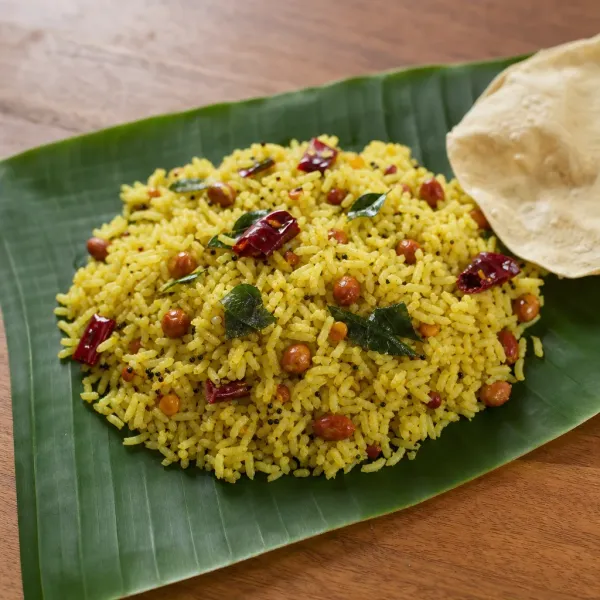
Mavinakayi Chitranna
Traditional Karnataka raw mango rice with fresh coconut-chilli paste, Byadagi chillies, groundnuts and curry leaf tempering. A classic summer chitran…
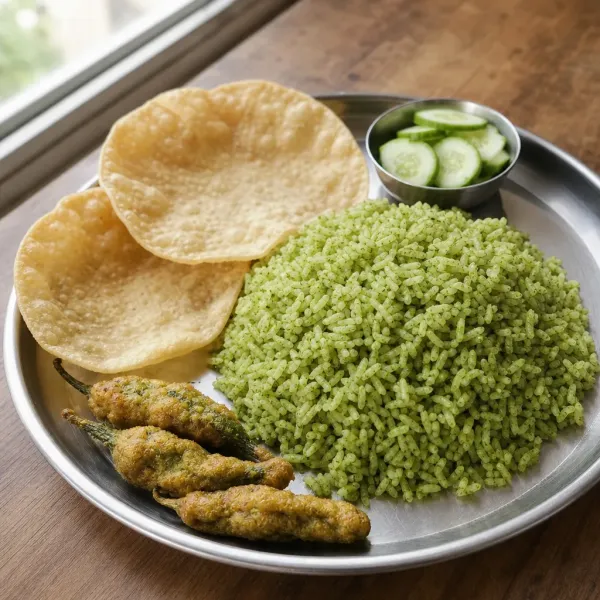
Kothamalli Sadam (Coriander Rice)
Traditional Tamil Iyer kothamalli sadam: fresh coriander paste with roasted dals, coconut and gingelly oil folded through cooled sona masoori rice.
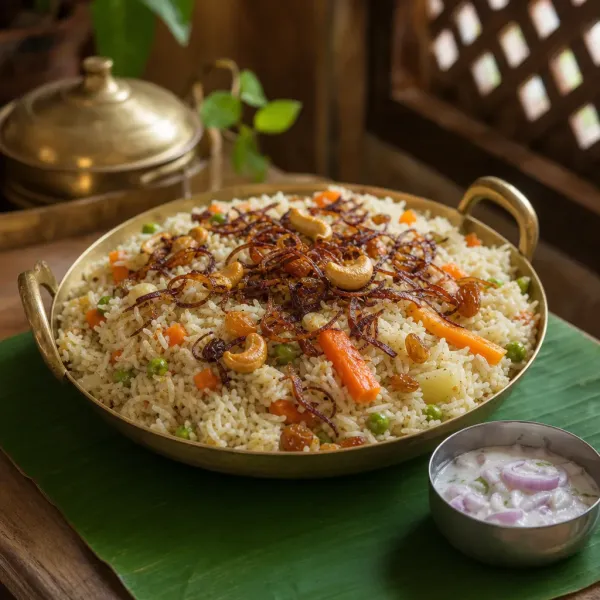
Vegetable Pulao (Mappila Style)
Traditional Malabar Mappila vegetable pulao cooked in coconut milk with whole spices and jeerakasala rice. Authentic Kerala Muslim household recipe.
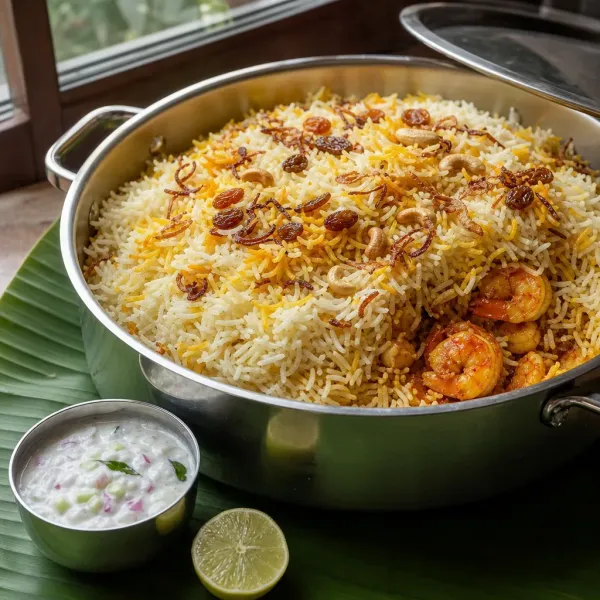
Malabar Prawn Biryani (Chemmeen Biryani)
Traditional Mappila-style prawn biryani from Malabar, Kerala, made with kaima rice, coconut oil, and a thick prawn masala, finished on dum.
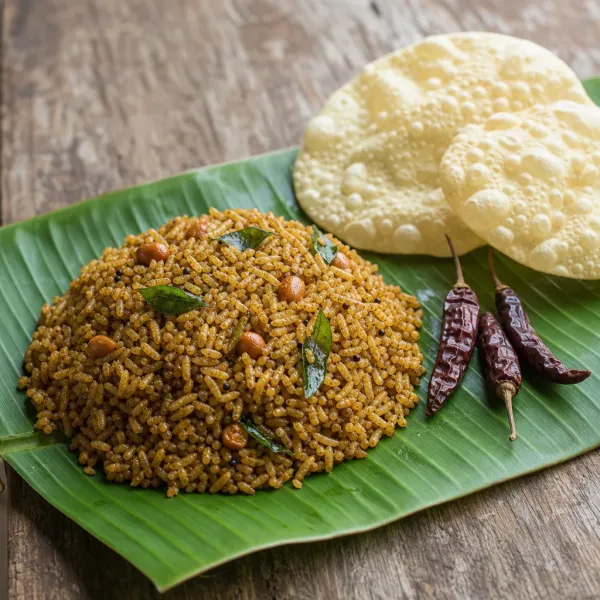
Puliyodarai with Pulikachal
Traditional Tamil Iyer puliyodarai made with homemade pulikachal paste, gingelly oil, and firm-cooked raw rice. Temple-style tamarind rice recipe.
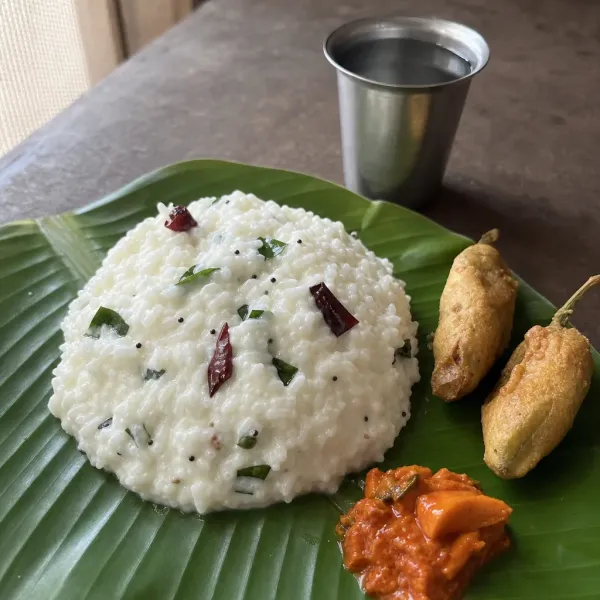
Thayir Sadam
Authentic Iyer-style thayir sadam with gingelly oil tempering, mustard seeds, curry leaves and fresh curd. The traditional Tamil Brahmin curd rice re…