

Puliyodarai with Pulikachal Recipe
Malayalam പുളിയോദരൈTamil புளியோதரைKannada ಪುಳಿಯೋಗರೆTelugu పులిహోర
- Prep20 min
- Cook40 min
- Serves4
- DifficultyMedium
- DietVegan
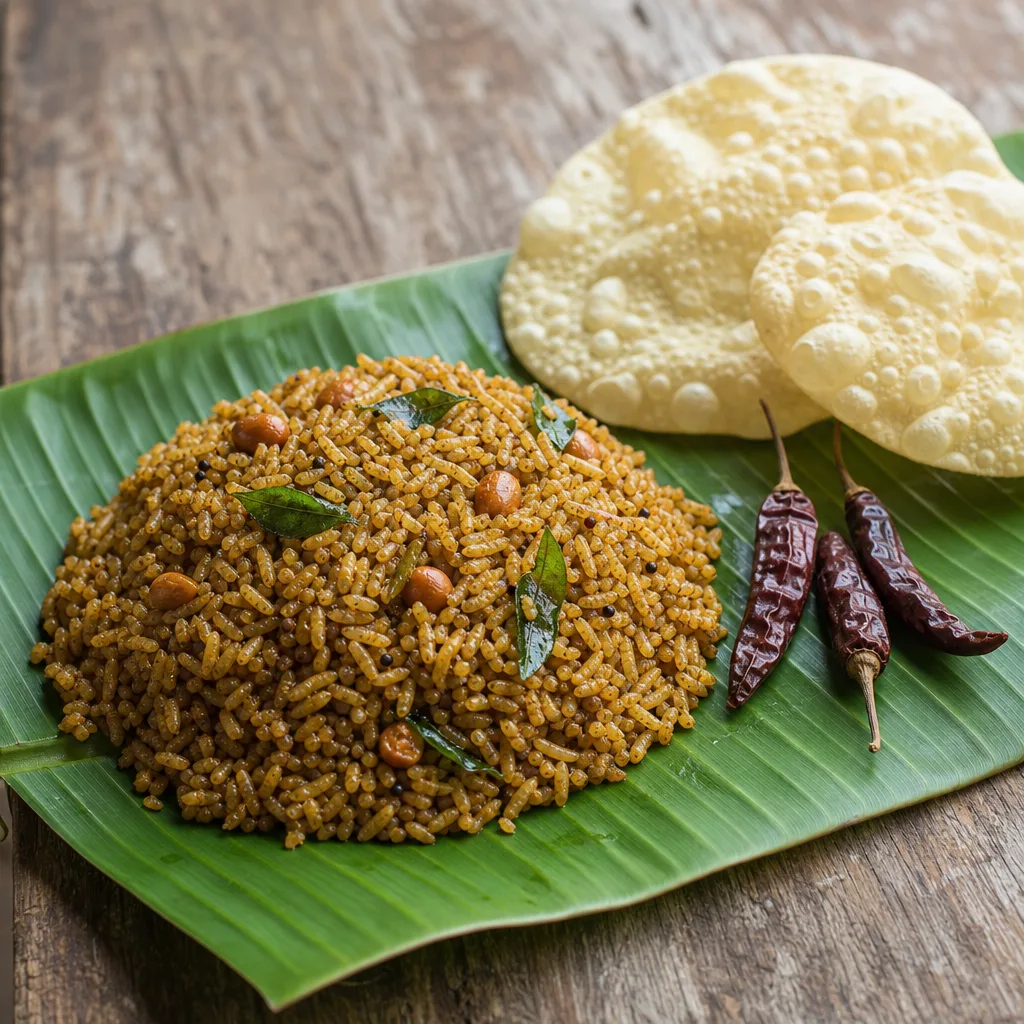
Puliyodarai is temple food in Tamil Nadu. It is the rice that is pressed into small portions and distributed as prasadam at Iyengar temples, wrapped in banana leaf, still warm and fragrant with gingelly oil and dried red chillies. In the Iyer household it is made for travel, for festivals, and whenever cooked rice needs to become a full meal without much fuss. It keeps well through a day without refrigeration, which is precisely why it has always been the rice packed for long journeys.
The heart of the dish is the pulikachal, a concentrated tamarind paste cooked down with spices until it is thick, dark, and nearly jammy. The pulikachal is made separately and can be stored in the refrigerator for two to three weeks. When you want the rice, you warm a little of it in gingelly oil, toss in the cooked rice, and it is done. Most Iyer households keep a jar of pulikachal the way other kitchens keep pickle.
The rice must be cooked firm and dry, each grain separate. Soft or sticky rice turns the dish to a clump. The gingelly oil is not optional and cannot be replaced with any other fat. It is what gives puliyodarai its particular warm, slightly nutty undertone alongside the sharp tamarind.
Ingredients (serves 4)
For the pulikachal (tamarind paste)
For the rice
For the final tempering (optional but traditional)
Method
Cook the rice
Wash the raw rice two or three times and cook it with enough water so it is just cooked through but completely firm, not soft. In a pot on the stove, 300 g of raw rice needs about 500 ml of water; check at 12 minutes. Spread the cooked rice on a wide plate or thali immediately, drizzle the 2 tsp of gingelly oil over it, and gently separate the grains with a fork or your fingers. Let it cool completely to room temperature. If you mix tamarind paste into warm, soft rice, it turns to mush.
Dry-roast the spices for the pulikachal
In a dry heavy pan over low heat, roast the coriander seeds, black pepper, and cumin separately, each for about a minute, until they smell toasted and the coriander turns a shade darker. Do not roast them together as they take different times. Cool them and grind coarsely in a stone grinder or small mixer jar. Set aside. The grind should not be a fine powder; a little texture is correct.
Soak and extract the tamarind
Soak the 100 g of tamarind in 250 ml of warm water for 20 minutes. Squeeze it thoroughly with your fingers, working out all the pulp. Strain through a sieve, pressing hard. Discard the fibres and seeds. You should have a thick, dark pulp, roughly 200 ml. If it is thin and watery, your tamarind was dry; squeeze harder or soak a little longer.
Build the tempering
Heat 4 tbsp of gingelly oil in a heavy-bottomed kadai over medium heat. When the oil shimmers, add the mustard seeds and wait for them to splutter fully. Add the broken dried red chillies, then the chana dal and urad dal. Stir constantly; the dals go from pale to golden very quickly and will burn if you look away. When the chana dal is a deep golden colour, add the peanuts and fry for another minute until they begin to colour. Add the curry leaves carefully as they will spit.
Add asafoetida and turmeric
Reduce the heat to low. Add the asafoetida and stir for 10 seconds. Add the turmeric powder and stir once. The oil will turn a bright yellow. This is the moment before the tamarind goes in; do not skip the low heat step or the asafoetida will taste raw.
Cook down the tamarind
Pour in the tamarind pulp carefully as it will bubble up sharply. Raise the heat to medium. Add the salt now. Cook uncovered, stirring every few minutes, for 20 to 25 minutes. The paste must reduce to roughly half its volume and the oil will begin to separate and float at the edges. This is the sign it is ready. If you stop too early, the raw tamarind taste will remain in the finished rice.
Add the ground spices and jaggery
Add the coarsely ground coriander, pepper, and cumin to the reduced tamarind paste. Stir well. Add the grated jaggery. Cook for another 3 to 4 minutes, stirring, until everything is combined and the paste is thick enough to hold its shape on a spoon. Taste for salt and sourness. The pulikachal should be intensely flavoured because it will be diluted when mixed with a large quantity of plain rice. Remove from heat and cool.
Mix the rice
Measure 5 to 6 tbsp of pulikachal into a wide bowl. Add 1 tbsp of gingelly oil. Add the cooled cooked rice. Using clean hands or a wide spatula, mix gently but thoroughly, making sure every grain is coated. Work from the bottom up. Taste after mixing and add a little more pulikachal if you want more sourness. The rice should be a deep tawny brown, not pale yellow.
Final tempering
Heat 1 tbsp of gingelly oil in a small pan. Add the mustard seeds and let them pop. Add the broken dried red chillies and curry leaves, fry for 20 seconds, and pour the entire tempering over the mixed rice. Fold it in gently. This final tempering is traditional in many Iyer households and adds a fresh top note of oil and spice to the finished rice.
Rest before serving
Let the mixed rice sit for at least 15 minutes before serving. The tamarind paste needs a little time to fully penetrate each grain. Puliyodarai eaten immediately after mixing is sharper and less rounded than the same rice eaten half an hour later. If you are making it for travel or a festival, it genuinely improves over two to three hours.
How to serve
Appalam (papad), a small portion of coconut chutney or mor milagai (sun-dried curd chillies), and a piece of raw banana or raw mango pickle. In temple distribution it is served on its own, pressed into a small mound on a banana leaf.
Served with: Appalam (papad), a small portion of coconut chutney or mor milagai (sun-dried curd chillies), and a piece of raw banana or raw mango pickle. In temple distribution it is served on its own, pressed into a small mound on a banana leaf.
Cook's tips
Storing the pulikachal
The pulikachal keeps in a clean, dry glass jar in the refrigerator for up to three weeks. Make a large batch and use it as needed. Always use a dry spoon to take from the jar.
The rice variety matters
Use short-grain raw rice (pacharisi), not basmati and not matta rice. Basmati is too fragrant and competes with the tamarind; matta is too starchy and the grains do not stay separate after mixing.
Oil is not optional
Gingelly oil is what holds the dish together and preserves it through the day. If you reduce the oil to cut calories, the rice will clump and the tamarind will taste sharp and unbalanced.
Tamarind quality
Use fresh, pliable tamarind from a block, not tamarind concentrate. Concentrate is too sharp and has none of the rounded sourness of properly cooked-down tamarind pulp. The colour of the finished pulikachal with block tamarind is a deep reddish-brown; with concentrate it is flat and dark.
Common mistake: mixing warm rice
If the rice is even slightly warm when you mix in the pulikachal, it will become sticky and the grains will break. Spread it out and wait until it is genuinely at room temperature.
Regional variations
Andhra pulihora uses a similar base but adds raw peanuts and sometimes curry leaves fried in a larger quantity of oil; Karnataka puliyogare, particularly the temple version from Udupi and Melkote, uses a distinct dry powder (gojju pudi) rather than a wet paste; Iyengar puliyodarai from Tamil Nadu is close but differs in spice ratios and the use of asafoetida more liberally.
Glossary
- Pulikachal புளிக்காச்சல்
- The concentrated cooked-down tamarind paste that is the base of puliyodarai; the word means roughly 'that which has been boiled with tamarind'.
- Nallennai நல்லெண்ணெய்
- Cold-pressed unrefined gingelly (sesame) oil; the fat used in Tamil Nadu for kuzhambu, pickles, and rice dishes like this one.
- Perungayam பெருங்காயம்
- Asafoetida; used in Iyer cooking as a substitute for onion and garlic, which are avoided in strict Brahmin households.
- Pacharisi பச்சரிசி
- Raw rice, as distinct from parboiled rice (puzhungal arisi); the correct rice for puliyodarai.
- Mor milagai மோர் மிளகாய்
- Green chillies soaked in salted buttermilk and sun-dried; eaten as a condiment alongside rice dishes.
- Appalam அப்பளம்
- Thin crisp wafer made from urad dal, fried or roasted; the standard accompaniment to Tamil rice meals.
Two things decide whether this works: the pulikachal must be cooked all the way down until the oil separates and the raw sourness is gone, and the rice must be completely cool and dry before it is mixed in. Get those two right and the rest follows.
More Rice Dishes recipes
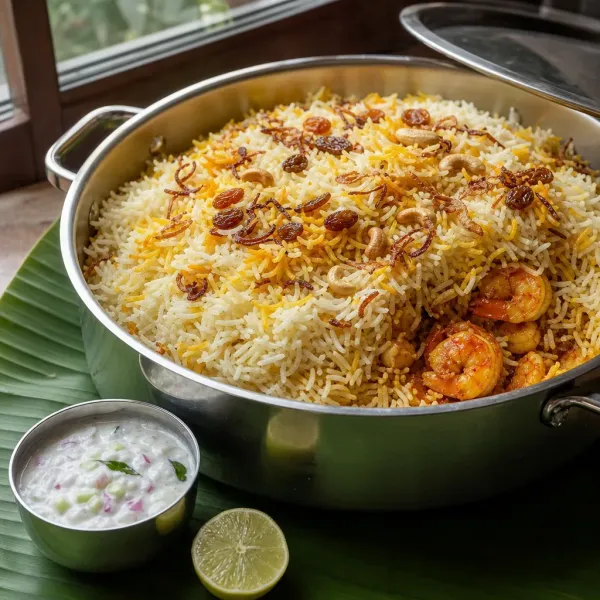
Malabar Prawn Biryani (Chemmeen Biryani)
Traditional Mappila-style prawn biryani from Malabar, Kerala, made with kaima rice, coconut oil, and a thick prawn masala, finished on dum.
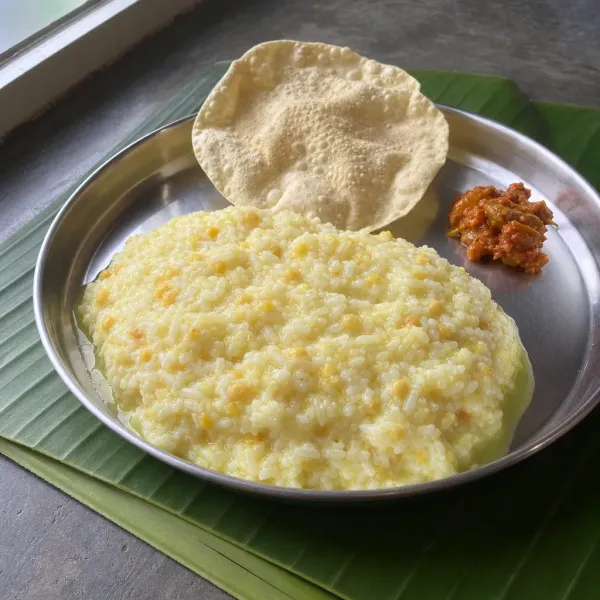
Paruppu Sadam
Traditional Iyer-style paruppu sadam: soft raw rice stirred with toor dal and finished with ghee, the first course of a Tamil Brahmin meal.
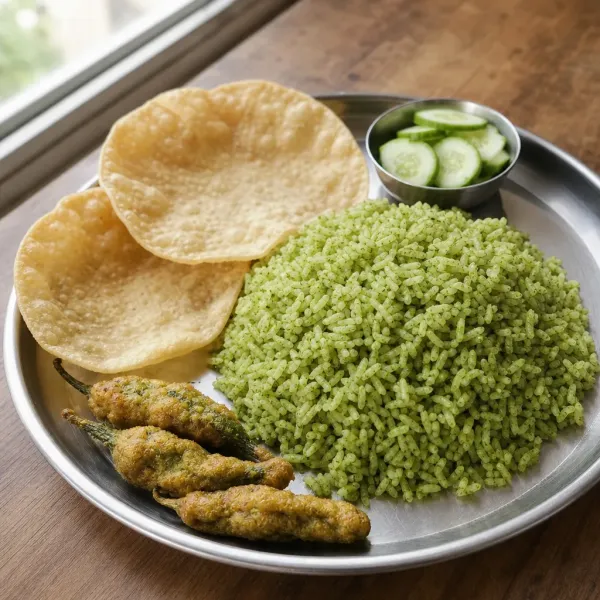
Kothamalli Sadam (Coriander Rice)
Traditional Tamil Iyer kothamalli sadam: fresh coriander paste with roasted dals, coconut and gingelly oil folded through cooled sona masoori rice.
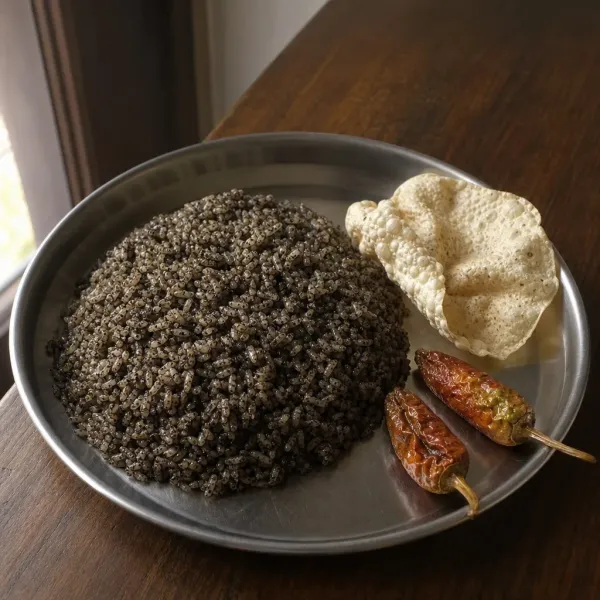
Ellu Sadam
Traditional Tamil Brahmin ellu sadam made with dry-roasted sesame powder, gingelly oil and cooked rice. A simple, sattvic dish for festivals and ever…
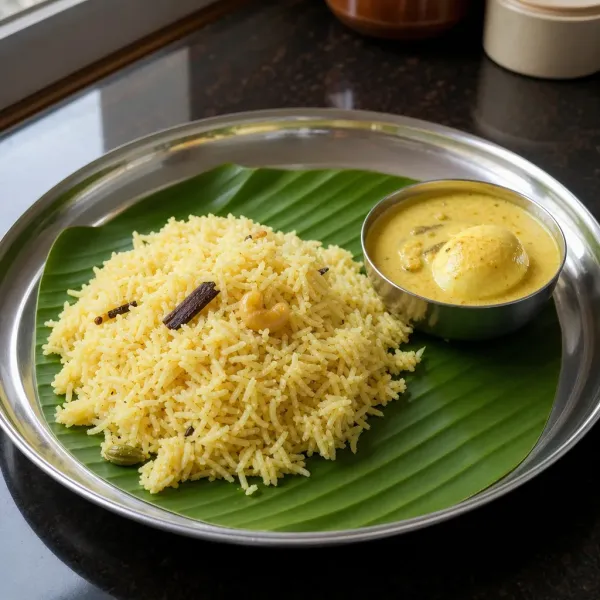
Nei Choru (Kerala Ghee Rice)
Traditional Malabar Mappila nei choru made with jeerakasala rice, pure ghee and whole spices. Step-by-step household method for perfectly separate, f…
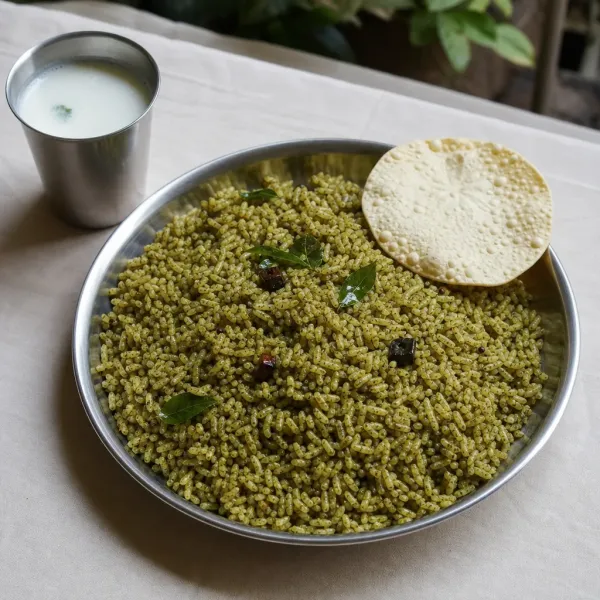
Karuveppilai Sadam (Curry Leaf Rice)
Traditional Tamil Iyer recipe for karuveppilai sadam: cooked rice mixed with a dry-roasted curry leaf spice powder and gingelly oil. Ready in 40 minu…