

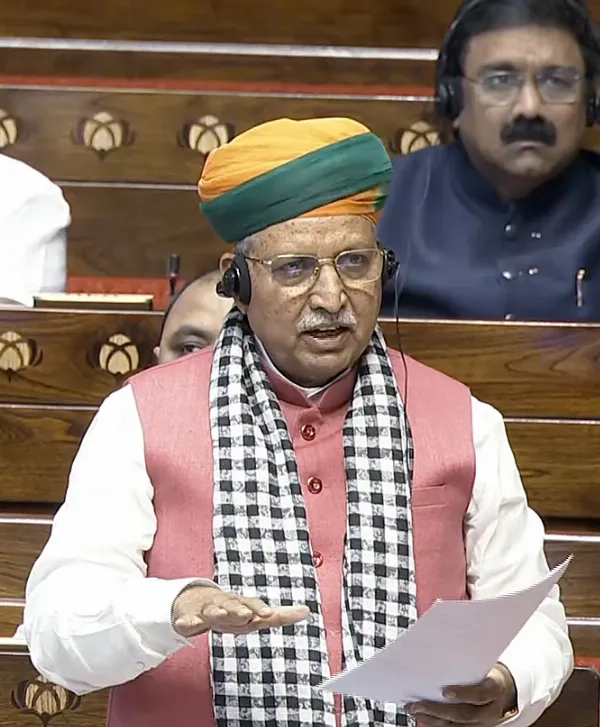
Evening LL.B. graduates of 1999-2000 or earlier batches can practice law: Meghwal
New Delhi, Feb 5
Minister of State for Law and Justice Arjun Ram Meghwal said on Thursday that only those evening law college graduates who passed the LL.B. course in the academic year 1999-2000 or earlier are entitled to be enrolled as an advocate as per the Bar Council of India rules.
Meghwal, in a written reply to a question in Rajya Sabha, said that only those LL.B. degree holders who did not complete their law degree through the evening classes till the academic year 1999-2000 were ineligible to practice law.
He said no state-wise recognition of evening, night-school, part-time, weekend, holiday, online or distance LL.B. courses exists or has existed since 2000-2001, a position reiterated by the Bar Council of India through statutory rules, circulars.
Meghwal said the BCI has informed that under the earlier Rules of Legal Education, 1989, the Council had permitted and recognised evening LL.B. courses offered by certain universities and law colleges, including institutions in Delhi and some other States, subject to compliance with the then-prevailing standards.
However, with effect from the academic year 2000-2001, the Bar Council of India, through the Rules of Legal Education, 1999, referred to that time as Standards of Legal Education and Recognition of Degrees in Law (Rules), discontinued the recognition of evening law degree courses across all States, he said.
The BCI has consistently maintained this position under its Rules of Legal Education, 2008, which mandate that LL.B. is a regular, full-time professional course requiring prescribed daily and weekly classroom hours, minimum attendance, and a fixed academic teaching window between 8 a.m. and 7 p.m.
In reply to another question, the MoS said the Government of India has taken various initiatives to promote and strengthen Alternative Dispute Resolution mechanisms, including institutional arbitration.
To enable preferred recourse to institutional arbitration, the India International Arbitration Centre Act, 2019, has been enacted, leading to the establishment of the India International Arbitration Centre, thereby creating an independent and autonomous body for facilitating institutional arbitration, said Meghwal.
The Centre, since its establishment, has conducted workshops, conferences and seminars relating to domestic and international arbitrations, for awareness and training, and CPSEs/PSUs have participated in it.
— IANS
Reader Comments
What about those who passed after 2000? Many working professionals pursued evening LL.B. to better their careers. Discontinuing recognition seems harsh. Could there not be a way to validate their degrees if the course was rigorous? 🤔
Good move by BCI to standardize legal education. Law is a serious profession requiring full-time dedication. The 8 a.m. to 7 p.m. window ensures proper training. Quality should not be compromised.
My uncle graduated from an evening law college in '98 and has been practicing for decades. He will be relieved to hear this official confirmation. Better late than never!
Interesting read. The focus on institutional arbitration is a positive step for India's business landscape. A robust ADR framework is crucial for attracting foreign investment and easing court burdens.
While standardization is good, I respectfully disagree with the blanket ban post-2000. Many reputed universities offered these courses. Could there not be a grandfather clause or a separate qualifying exam for those graduates? This decision affects livelihoods.
We welcome thoughtful discussions from our readers. Please keep comments respectful and on-topic.