


Mazha: Kerala's Many Rains, and the Novel Soaked in Them
Kochi, Nov 6
When it rains in Kerala, everything changes. "The day my husband tried to kill me, it had been raining for three days straight." That is the first line of Ten Out of Ten, the debut novel by Kochi author Anosh Abraham.
Notice what comes second in that sentence. Not the husband. Not the danger. The rain. Any Malayali reading it will understand. In Kerala, rain is never just weather. It decides when schools reopen, when weddings are fixed, when paddy is sown and when the fishing boats stay on the shore. It is the background music of first love, the excuse for a second cup of tea, and, on bad days, a red alert on every news channel.
Kerala does not have one rainy season. It has several, each with its own name, mood and memory. Here is a short guide to them, and to why one novel set in the monsoon hills of Munnar is soaked in rain from the first page.
Two monsoons and a month of rain
Edavappathi: the big arrival. The southwest monsoon reaches Kerala first in all of India, usually around the first of June. Malayalis call it Edavappathi, because it comes in the second half (pathi) of the Malayalam month of Edavam. This is the rain that every Indian news channel waits for. It comes from the Arabian Sea in heavy, grey sheets, and it brings most of Kerala's yearly rainfall in just four months. Schools reopen in this rain. New umbrellas, new notebooks, wet uniforms: for generations of Malayalis, Edavappathi smells like the first day of class.Karkidakam: the dark month. The heaviest stretch of the season falls in Karkidakam, roughly mid-July to mid-August. In the old days, when farm work stopped and food ran short, people called it panja masam, the month of scarcity. Today many Hindu homes read the Ramayana through the month, and families cook karkidaka kanji, a medicinal rice porridge with herbs, to keep the body strong through the damp. It is also the traditional season for Ayurvedic treatment, when the body is believed to absorb oils and medicines best.
Thulavarsham: the thunder rain. Just when the sky seems to settle, a second monsoon arrives from the northeast in the month of Thulam, from October into December. Thulavarsham is a different animal. Mornings are bright and hot. Then, almost every afternoon, the clouds pile up over the hills, and the evening breaks open with thunder, lightning and short, violent downpours. If you are reading this in Kerala in November, you have probably heard it rumbling today.
A language with a word for every rain
They say a people names carefully what it lives with closely. Malayalam has words for rain the way English has words for traffic.| Word | Malayalam | What it means |
|---|---|---|
| mazha | മഴ | rain, the word every Malayali child learns early |
| chaattal mazha | ചാറ്റൽ മഴ | a light drizzle, the kind you walk through without an umbrella |
| perumazha | പെരുമഴ | heavy rain |
| pemari | പേമാരി | a torrential downpour that goes on and on |
| thoramazha | തോരാമഴ | rain that simply refuses to stop |
| idimazha | ഇടിമഴ | a thunderstorm, the signature of Thulavarsham |
| mazhakkaaru | മഴക്കാറ് | dark rain clouds gathering over the hills |
| kurukkante kalyanam | കുറുക്കന്റെ കല്യാണം | "the fox's wedding", rain falling while the sun shines |
| njaattuvela | ഞാറ്റുവേല | the old farming calendar's rain spells, each tied to a star |
Munnar in the monsoon: beauty with a warning label
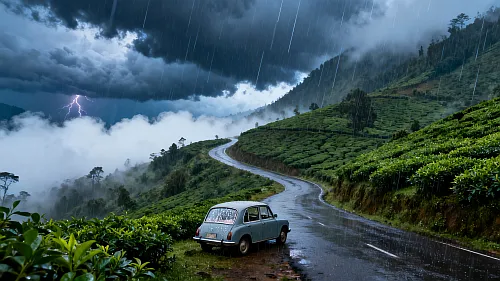
Nowhere in Kerala does rain look as dramatic as it does in Munnar. Sitting around 1,600 metres up in the Western Ghats in Idukki district, the old tea town disappears into cloud for days at a time in the monsoon. The fog rolls across the tea bushes so thickly that the road ahead simply ends in white. Waterfalls appear on every rock face, and the hills turn a green so deep it almost hurts to look at.The novel's narrator, Priya, puts it in Gen Z terms when she first sees the Munnar fog: thick, white, everywhere, "like someone had deleted the whole world."
But monsoon Munnar has a second face. The same rain that paints the hills can loosen them. Steep ghat roads close at night when the warnings go up, and landslides are a real and recurring danger. The Pettimudi landslide of August 2020, which buried a row of tea workers' homes near Munnar and took dozens of lives, is still a painful memory in Idukki.
That is why Keralites watch the India Meteorological Department's colour-coded alerts so closely. Yellow means be aware. Orange means be prepared. Red means extremely heavy rain is expected, and that it is time to act: stay off the high roads, stay away from slopes and streams, and listen to local authorities.
In Ten Out of Ten, a newly married couple arrives in Munnar for their honeymoon with exactly such a red alert over the hills.
Why Ten Out of Ten is soaked in rain
Anosh Abraham has said that Munnar has been his favourite place since he first saw it as a boy, "in every season and every kind of rain." It shows. In his novel, the rain is not scenery. It behaves almost like a character, and its mood changes with the story.* Rain as romance. Kerala has always fallen in love in the rain. A shared umbrella, a steaming glass of chaya, a plate of pazhampori on a wet evening. Priya's arranged marriage begins in that soft, hopeful drizzle, with a horoscope that says ten out of ten.
* Rain as warning. Then the honeymoon. Fog that hides the road. A red alert over the hills. A husband who goes strangely quiet when she plans a sunset picnic on a lonely hilltop, with a flask of tea and a sea of cloud below. In the monsoon, the hills look most beautiful exactly when they are most dangerous, and so does a marriage.
* Rain as memory. A year later, in Kochi, Priya is trying to begin again. But anyone from Kerala knows how one sound of rain on a tin roof can carry you straight back to a place you are trying to forget.
* Rain as cleansing. And rain, finally, washes things. The book is about the labels women are made to carry and the long road from betrayal to forgiveness. In Kerala, after the worst pemari, the sky always clears, and the hills always turn green again.
It is fitting that the book reaches readers in November, in the middle of Thulavarsham, with thunder rolling over Kerala most evenings. Few seasons are better for curling up with a story set in the rain.
Visiting Munnar in the rain? Do it the safe way
Monsoon Munnar is worth seeing at least once. Unlike the couple in the novel, just go prepared.1. Check the weather alerts every day. Follow IMD and Kerala State Disaster Management Authority updates for Idukki district. If a red alert is declared, postpone the trip.
2. Never drive the ghat roads after dark. Fog cuts visibility to a few metres, and night closures are common during heavy rain.
3. Stay away from slopes, streams and lonely viewpoints during heavy rain. That perfect sunset spot is not worth the risk. (Trust us on this one. Read the book.)
4. Pick a stay on stable ground. Ask your hotel or homestay about road access and power backup before you book.
5. Pack for the cold and the wet. A proper raincoat, quick-dry clothes, a warm layer and shoes with grip. Munnar evenings can be surprisingly chilly.
6. Respect the leeches. They are part of the monsoon package in tea country. A little salt or tobacco powder in your socks is the local remedy.
Frequently asked questions
When does the monsoon reach Kerala? The southwest monsoon, called Edavappathi, normally arrives around the first of June. Kerala is the first Indian state to receive it.What is Thulavarsham? Thulavarsham is Kerala's northeast monsoon, from October to December. It brings sunny mornings and heavy afternoon or evening thunderstorms.
Why is Karkidakam special in Kerala? Karkidakam (mid-July to mid-August) is the wettest part of the monsoon. It is known for Ramayana reading, karkidaka kanji and Ayurvedic treatments.
What does kurukkante kalyanam mean? Literally "the fox's wedding". Malayalis use it for rain that falls while the sun is shining.
Is it safe to visit Munnar during the monsoon? Yes, with care. Check IMD alerts, avoid night drives on ghat roads, and postpone your trip if a red alert is declared for Idukki.
What is the novel Ten Out of Ten about? It is a romantic suspense novel by Anosh Abraham. A young woman's horoscope-perfect arranged marriage begins to unravel on a monsoon honeymoon in Munnar.
About the book
Ten Out of Ten: The perfect match that wasn't by Anosh Abraham is a romantic suspense novel set in Munnar, Kochi and Alappuzha. Priya, twenty-four, is matched ten out of ten with Rahul, a quiet bank officer from Thrissur. On their honeymoon in the monsoon hills, everything she believed about her perfect marriage comes apart in the mist.
The Kindle edition releases worldwide on 11 November 2026 and is available for pre-order now on Amazon.in, Amazon.com and Amazon.co.uk. It is free to read with Kindle Unlimited from release day, and the paperback is coming soon.
About the author: Anosh Abraham lives in Kochi, Kerala. He began writing short stories at the age of ten and has spent twenty-five years as a digital publisher and content creator. Ten Out of Ten is his first novel. More at anosh.com.
Coming tomorrow in this series: another Kerala story from the world of Ten Out of Ten.

— TINN
Leave a comment