

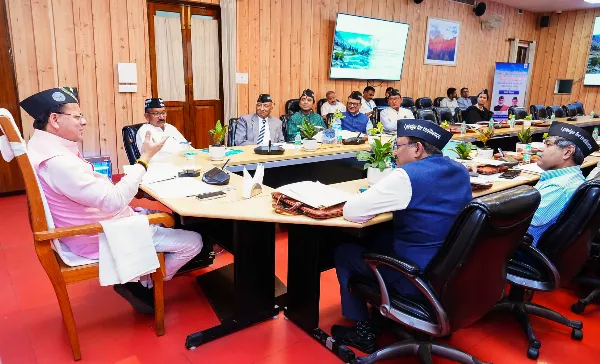
Uttarakhand CM Dhami chairs meeting to 'strengthen mutual coordination' among Himalayan states
Dehradun, April 24
A meeting of the Himalayan States Coordination and Policy Formulation Council was held on Friday at the Chief Minister's residence under the chairmanship of Pushkar Singh Dhami.
The meeting aimed to strengthen mutual coordination among Himalayan states and address shared challenges, an official statement released on Friday said.
"Detailed discussions were held on various points to develop a consolidated strategy and accelerate regional development," it added.
The Chief Minister stated that due to the similar geographical, environmental, and social conditions of Himalayan states, effective policy-making can be achieved through mutual cooperation and exchange of experiences.
"He emphasized that successful initiatives from other Himalayan states should be studied in detail and adopted as best practices," it read out.
"He added that the primary objective is to improve the quality of human life while maintaining a balance between the economy and ecology. He also highlighted that Uttarakhand is rich in natural resources and biodiversity, with immense potential in the conservation of the Himalayas and medicinal resources," it added.
The Chief Minister noted that continuous efforts are being made by the state government toward water conservation, including initiatives to rejuvenate water sources.
He stressed the importance of seeking regular support from institutions doing commendable work in the field of Himalayan and environmental conservation. He also suggested organizing periodic meetings and discussions with experts from Himalayan states to address various challenges.
"Key issues discussed during the meeting included climate change, disaster management, tourism, biodiversity conservation, protection of water sources, and development of border areas," it added.
He assured that the suggestions received during the meeting would be acted upon promptly, it added.
Chief Secretary Anand Bardhan stated that efforts would be made to ensure that Himalayan states work in an integrated manner to address their challenges.
"He added that a large population of the country benefits from the Himalayas, and emphasized the need to collaborate with national institutions working in this field for conservation and sustainable development," it added.
Council member and MLA Kishore Upadhyay highlighted the need for updated scientific and ecological studies of the Himalayan and mid-Himalayan regions, as well as assessment of water levels and flow in Himalayan rivers, it said.
Member and former DGP Anil Raturi emphasized that Himalayan states must work collectively to enhance livelihoods and manage resources effectively. Acharya Prashant suggested forming a joint task force for Himalayan states, noting that their challenges are largely similar and require coordinated policy responses, it added.
GS Rawat stressed the need for continuous efforts toward the conservation of nature and culture, it said.
Padma Shri awardee Kalyan Singh Rawat, along with Director General of UCOST Prof. Durgesh Pant and other officials, were also present at the meeting.
— ANI
Reader Comments
Good to see CM Dhami taking this seriously. The mention of 'border area development' is particularly important given our northern frontiers. But we need more than just meetings - let's see concrete steps on disaster management coordination, especially with Himachal and Jammu-Kashmir. Every monsoon brings fresh devastation and we're always caught off guard 🌧️
Is there any timeline for the 'joint task force' mentioned? These councils often meet, make big promises, and then we hear nothing for years. The Himalayas are the water tower of India - if we don't act now on climate change and deforestation, our rivers will dry up. The focus on 'economy vs ecology' balance is key. Let's see if this translates into real policy 🏞️
Appreciate the inclusive approach - bringing in experts like Acharya Prashant and Padma Shri awardees. The mention of 'medicinal resources' is crucial for our traditional knowledge systems. But I hope this isn't just about government coordination at the top - local communities, especially in border villages, need to be part of these conversations. They're the true custodians of the Himalayas 🌿
A well-intentioned initiative, but one can't help feeling cynical. We've seen countless committees on Himalayan conservation - the actual problem is implementation. The real test will be: does this council have teeth? Can it enforce coordination between states? The pitch to 'study successful initiatives' is good, but we need to stop reinventing the wheel. Let's copy what works (like Sikkim's waste management or Bhutan's carbon-neutral policies) and adapt to our context 🌱
K < We welcome thoughtful discussions from our readers. Please keep comments respectful and on-topic.