

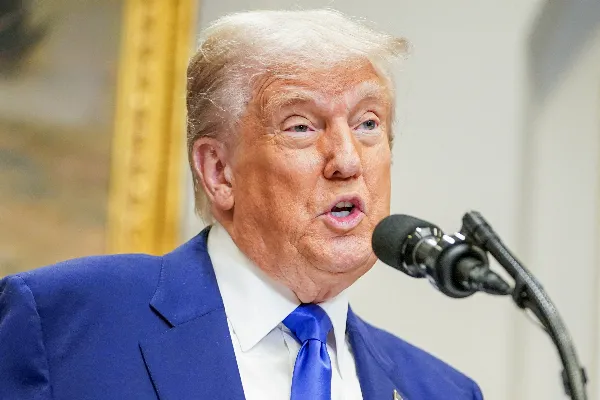
Trump links Hormuz crisis to oil opportunity
Washington, April 3
With tensions still simmering in the Gulf, U.S. President Donald Trump on Friday suggested the Strait of Hormuz could be reopened for oil gains, describing it as a chance to "MAKE A FORTUNE," as maritime traffic shows early signs of revival.
"With a little more time, we can easily OPEN THE HORMUZ STRAIT, TAKE THE OIL, & MAKE A FORTUNE. IT WOULD BE A 'GUSHER' FOR THE WORLD???," Trump said in a social media post.
His remarks come as new data indicate a cautious return of shipping activity through the strategic waterway, a key artery for global energy supplies.
Maritime intelligence firm Windward said 16 ships transited the strait on April 1, marking the third consecutive day of movement after a period of severe disruption.
Separate data showed 16 cargo vessels passed through on Wednesday, up from 11 the previous day, signalling a gradual recovery, though still far below pre-conflict levels.
The disruption began in mid-March, when Iran imposed a mandatory navigation corridor, overseen by the Islamic Revolutionary Guard Corps (IRGC), forcing vessels to alter their routes and operate under Iranian supervision.
Recent vessel movements suggest some operators are beginning to test those restrictions.
According to Windward, as of April 2, about 656 vessels were present in the Arabian Gulf, split between cargo ships (55 per cent) and tankers (45 per cent). Traffic remains skewed, with just one inbound transit recorded against eight outbound movements, dominated by container cargo and tanker departures.
Three Omani-controlled vessels - including two oil tankers and one liquefied natural gas carrier - exited the strait using standard international navigation channels, bypassing the Iranian-controlled corridor.
One of these, the LNG tanker Sohar, reached waters off Muscat, becoming the first LNG carrier to transit the strait since the conflict escalated.
A container ship linked to French logistics giant CMA CGM also passed through the strait, marking one of the first known transits by a Western-linked vessel since restrictions tightened.
Windward report underscores the dominance of so-called flag-of-convenience registries in the region. Panama leads with 142 vessels, followed by Liberia (95), Marshall Islands (93), and Iran (37), reflecting a mix of commercial and higher-risk shipping profiles.
Ownership patterns remain opaque. The firm said vessels transiting the strait involve beneficial owners from China, India, Turkey, and Iran, with about 25 per cent of ships maintaining unknown ownership - a trend analysts say complicates monitoring and enforcement.
— IANS
Reader Comments
The article mentions Indian beneficial owners in the shipping traffic. Our companies and economy are deeply entangled in this. We need a diplomatic solution, not more aggressive posturing. High oil prices will hurt every common person here.
Watching from abroad, but with family in Mumbai. The language is reckless. "Take the oil"? This isn't a game. Stability is what's needed for global trade, including for a growing economy like India's.
Respectfully, I think the focus is wrong. The real story is the 25% of ships with unknown ownership. How can we have proper oversight? This opacity is a bigger risk long-term than any one politician's statement.
Yaar, just when petrol prices were starting to look slightly better... 😓 This tension needs to de-escalate. Our government should use its good relations with both sides to push for calm. Energy costs hit everyone's pocket.
The data is interesting - Panama, Liberia flags dominating. It shows how complex global shipping is. But at the end of the day, if ships start moving again safely, it's good news for India. Fingers crossed the recovery continues.
We welcome thoughtful discussions from our readers. Please keep comments respectful and on-topic.