

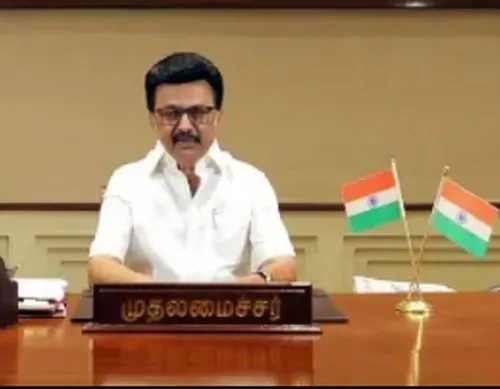
Tamil Nadu CM Stalin opposes use of 2011 census for women's reservation, seeks fair delimitation
Chennai, March 24
Tamil Nadu Chief Minister and DMK president M K Stalin on Tuesday raised concerns over reports suggesting that women's representation in Parliament and State Assemblies may be implemented based on the 2011 Census.
In an 'X' post, Stalin said such a move would be contrary to the provisions of the Constitution (128th Amendment) Bill, 2023, which envisages the implementation of women's reservation only after fresh delimitation based on the Census to be conducted after 2026.
"The recent newspaper reports indicate that women's representation in Parliament and Legislative Assemblies is being considered based on the 2011 Census. This step is not in line with The Constitution (128th Amendment) Bill, 2023 passed by the Union BJP Government and its earlier position to take up this historic initiative only after delimitation is carried out based on the Census conducted after 2026. This is most probably aimed at securing electoral gains in the forthcoming Assembly elections in four major States. Pushing such an important step when the Model Code of Conduct is already in force is unprecedented," MK Stalin said.
Reaffirming his support for women's reservation, Stalin said the DMK backs the initiative without any preconditions but stressed the need for fair delimitation. He maintained that the existing proportional representation of States should not be disturbed under any circumstances.
"Having said that, as the President of the DMK and the proud inheritor of the Dravidian legacy that has spearheaded women's empowerment for more than a century, I fully support this initiative of Womens Reservation without any preconditions, while at the same time stressing our right to fair delimitation," Stalin wrote on 'X'.
The Tamil Nadu Chief Minister further called for a constitutional safeguard to ensure that the current share of representation of States remains unchanged for the next 30 years. He emphasised that the process of delimitation and distribution of constituencies must incorporate such a provision.
"It is our consistent stand that the current proportional representation of States should not be disturbed under any circumstances. To achieve this, the delimitation and distribution of constituencies among States must include a constitutional provision ensuring the same for the next 30 years," Stalin said.
In view of the prevailing Model Code of Conduct and the political climate, Stalin urged the Centre to convene a Special Session of Parliament in early June to take up constitutional amendments related to delimitation, increase in seats, and protection of States' representation.
"Considering the current Model Code of Conduct and the preoccupation of political parties, I request that a Special Session of Parliament be convened in early June to enact these historic constitutional amendments for delimitation, increase of seats, continuation of the current share of representation of States, and a guarantee that such representation will continue for the next 30 years," said the 'X' post.
As per the top sources, the Government has planned two major amendments. 2023's Nari Shakti Vandan Act tied women's reservation to the new census and delimitation. Due to census delays, the plan is to proceed with the 2011 census data. The 2011 census is to be the basis for delimitation and seat redistribution. Lok Sabha seats may increase from 543 to 816 post-amendment.
A bill will be introduced in Parliament to amend the Nari Shakti Vandan Act.
A separate Delimitation Bill will be introduced. Both bills need to be passed as Constitutional amendments for women's reservation. The new Lok Sabha is likely to have more than 800 seats. Keeping up with the status quo, there is no provision for OBC reservation, and SC/ST reservation will continue. However, states won't have a role; the bill passed by Parliament will apply to them.
Currently, the Lok Sabha has 543 seats. With a proposed 50% increase, the number of seats will rise to 816, with 273 (about a third) reserved for women.
The government's key point is that they won't wait for a new census to give women, comprising half the country's population, fair representation in Parliament. Instead, delimitation will be done using the 2011 census data.
The Home Minister led a crucial meeting with NDA parliamentary floor leaders, discussing the amendment to the Nari Shakti Vandan Act. Shah has briefed several opposition leaders on the proposed plan. The opposition supports women's reservation, but discussions are ongoing to build consensus on seat distribution and delimitation.
If passed, this bill will be India's biggest democratic shift since independence, giving the country 273 women MPs by 2029. The 2029 general elections will see contests on 816 Lok Sabha seats, changing the majority mark from 272 (for 543 seats) to 409.
— ANI
Reader Comments
Finally, women will get their due! 273 women MPs is a dream come true. 🤩 But I agree with CM Stalin that the process must be fair. Using old census data might hurt states that controlled population growth well. Let's implement it, but correctly.
The central government should listen. A special session in June is a reasonable request. Rushing such a historic change during election mode is not right. Consensus is important for something that will reshape our democracy for decades.
As someone who has lived in India for 10 years, this is fascinating. Increasing Lok Sabha seats to 816 is huge! But the concern about penalizing states with better family planning makes sense. The constitutional safeguard for 30 years seems crucial.
The delay in census is a problem of the government's own making. Now they want to use 13-year-old data? Stalin's point is valid - follow the procedure laid down in the 128th Amendment. Don't change the goalposts for short-term gains.
While I fully support women's reservation, I'm worried about the lack of OBC quota within it. And increasing seats to 816 will make Parliament even more unwieldy. The focus should be on quality representation, not just quantity. Good that Stalin is raising these issues.
D We welcome thoughtful discussions from our readers. Please keep comments respectful and on-topic.