


Munnar's Tea Hills: The Story Behind Kerala's Greenest Postcard
Kochi, Nov 7
From a royal land lease in 1877 to a worker-owned tea company, the story of how Munnar became tea country, and why a cup of tea sits at the heart of the novel Ten Out of Ten.
A cup of tea on a misty hill
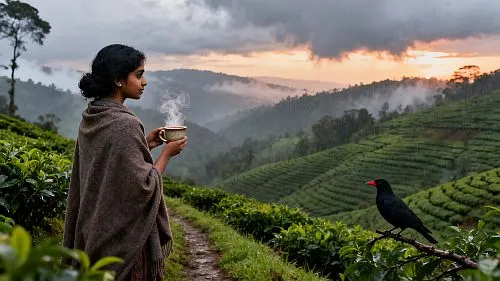
Look at the cover of Ten Out of Ten, the debut novel by Kochi author Anosh Abraham, and you will see a young woman holding a cup of tea on a misty hilltop at sunset. Behind her, the hills of Munnar roll away into cloud.It is the most Kerala picture imaginable. And like most simple pictures, there is a long story behind it.
Every hill in that frame is covered in tea, planted row by careful row over more than a century. Here is how a quiet forest in the Western Ghats became one of India's best-known tea regions, and why a cup of tea matters so much in a novel about a marriage that goes wrong.
Three rivers and a name
Munnar takes its name from geography. In Malayalam, moonu aar (മൂന്ന് ആറ്) means "three rivers", and the town sits where the Mudrapuzha, Nallathanni and Kundala streams meet.The hills around it are called the Kannan Devan Hills. Long before any planter arrived, these slopes were home to the Muthuvan tribal community. Local history says the range is named after Kannan Devan (also remembered as Kannan Thevar), a tribal chief who guided the first British visitors through the forest. The name stuck to the hills, then to the company that farmed them, and finally to a tea brand that millions of Indians still drink every morning.
How Munnar became tea country
The story begins with a land deal. In 1877, John Daniel Munro, a British officer in the service of Travancore, leased about 1,36,600 acres of the Kannan Devan Hills from the Poonjar royal family, the traditional custodians of these hills. The price was a security deposit of Rs 5,000 and an annual rent of Rs 3,000.The early planters tried coffee and spices first. Tea was not the obvious choice. But in 1880 a European planter named A. H. Sharp planted tea on about 50 acres at Parvathy, land that is now part of the Sevenmallay estate. The cool, damp air and acidic soil suited the bushes perfectly, and the hills began to turn green in neat lines.
What followed is more than a century of change:
| Year | What happened |
|---|---|
| 1877 | Munro leases the Kannan Devan Hills from the Poonjar Raja |
| 1880 | A. H. Sharp plants the first tea at Parvathy |
| 1895 to 1897 | Finlay Muir & Company buys 33 estates; the Kannan Devan Hills Produce Company is formed to run them |
| 1902 | A monorail, later a light railway, starts carrying tea from Munnar to Top Station |
| 1924 | The great flood destroys the railway and much of the region |
| 1964 | The Tata Group partners with Finlay to form Tata-Finlay |
| 1983 | Tata Tea Ltd is formed |
| 2005 | Tata Tea hands most of its Munnar estates to KDHP, a new company largely owned by its own workers |
That last change made Munnar unusual. Kannan Devan Hills Plantations Company (KDHP) became one of India's first participatory management companies, with thousands of plantation workers as shareholders. The same year, India's first tea museum opened at KDHP's Nallathanni estate.
Life on the estates, and the flood of '99
The tea hills look peaceful in photographs, but they were built by hard work. Generations of workers, many of them Tamil families who came up from the plains, cleared the slopes, planted the bushes and plucked the leaves by hand. They lived in long rows of estate quarters called layams (ലയങ്ങൾ), and many of their grandchildren still work the same hills today. The famous "two leaves and a bud" that makes good tea is still picked largely by women, basket on the back, in sun, mist and rain.The planters also brought remarkable engineering. Around 1900, the tea company built one of India's earliest hydroelectric power houses at Pallivasal. From 1902, the Kundala Valley Railway, first a monorail and later a narrow-gauge line, carried tea from Munnar to Top Station on the way to the ports.
Then came the rain. In July 1924, Kerala suffered one of the worst floods in its recorded history. Malayalis still call it thonnootti onpathile vellappokkam (തൊണ്ണൂറ്റിയൊൻപതിലെ വെള്ളപ്പൊക്കം), the flood of '99, because it fell in the Malayalam year 1099. In Munnar, landslides and floodwaters wiped out the railway completely. It was never rebuilt. A few rusted relics and an old bridge are all that remain.
Regular readers of this series will recognise the theme. In Munnar, rain gives everything and can take everything back.
Chaya: Kerala's everyday ritual
Munnar grows the tea, but the whole of Kerala drinks it. Chaya (ചായ) is not a drink in Kerala so much as a punctuation mark in the day.There is the early morning chaya before the newspaper. The eleven o'clock chaya at the office. The four o'clock chaya with pazhampori, parippuvada or a plate of banana chips. And the chaya you order at a roadside chayakkada (ചായക്കട), where the tea maker pours it from a height, back and forth between two vessels, until it foams. Malayalis call this meter chaya, measured not in cups but in the length of the pour.
Chaya is also how Kerala welcomes people. In an arranged marriage, it is the cup the girl carries out to the boy's family at the pennukaanal, the girl-seeing visit. Many love stories, and many disappointments, have begun over that first nervous cup of tea.
Tea in Ten Out of Ten
In Ten Out of Ten, Priya, twenty-four and newly married, arrives in Munnar for her honeymoon with Rahul, the quiet bank officer from Thrissur whom the horoscopes called a perfect match. It is the monsoon, and a red alert hangs over the hills.Priya plans something simple and romantic: a sunset picnic on a lonely hilltop. A flask of tea. A sea of cloud below. A small black bird with a red beak. It is the scene that inspired the book's cover, and exactly the kind of moment every honeymoon album dreams of.
But Rahul goes strangely quiet when she plans it. And in one evening in the mist, everything Priya believed about her perfect marriage comes apart.
That is the quiet power of the image. A cup of tea in Kerala means home, welcome and comfort. In this novel, the same warm cup, held on the edge of a misty hill, becomes the moment when comfort turns into danger. Anosh Abraham, who says Munnar has been his favourite place since he first saw it as a boy, uses the tea hills the way a good thriller uses a quiet house: beautiful, familiar, and not quite safe.
Visiting Munnar's tea country
* Tea Museum, Nallathanni estate India's first tea museum, run by KDHP. See old planting tools, photos from the early estates and the flood, and a working factory that shows how green leaf becomes the tea in your cup.* Walk the estate roads Early morning, when the mist is still sitting on the bushes, is the best time. Stay on the paths and do not pluck the leaves.
* Look for the old railway A few relics of the Kundala Valley Railway survive around Munnar and on the road to Top Station.
* Buy fresh Tea from Munnar's estate outlets is often fresher than what reaches city shops.
* Mind the season The monsoon (June to September) is the most dramatic, but check weather alerts, avoid night drives on the ghat roads, and postpone if a red alert is declared for Idukki.
Frequently asked questions
Who planted the first tea in Munnar?A. H. Sharp, a European planter, planted tea on about 50 acres at Parvathy in 1880.
Why is Munnar called Munnar?
Moonu aar means "three rivers" in Malayalam. The town sits where three streams meet.
What is KDHP?
Kannan Devan Hills Plantations Company, formed in 2005, manages most of Munnar's tea estates. Its workers hold a large share of the company.
What was the flood of '99?
A catastrophic flood in July 1924 (Malayalam year 1099) that destroyed Munnar's railway and caused widespread damage across Kerala.
What is the novel Ten Out of Ten about?
A romantic suspense novel by Anosh Abraham. A young woman's horoscope-perfect arranged marriage begins to unravel on a monsoon honeymoon in Munnar.
Ten Out of Ten: The perfect match that wasn't by Anosh Abraham is a romantic suspense novel set in Munnar, Kochi and Alappuzha. Priya, twenty-four, is matched ten out of ten with Rahul, a quiet bank officer from Thrissur. On their honeymoon in the monsoon hills, everything she believed about her perfect marriage comes apart in the mist.
The Kindle edition releases worldwide on 11 November 2026 and is available for pre-order now on Amazon.in, Amazon.com and Amazon.co.uk. It is free to read with Kindle Unlimited from release day, and the paperback is coming soon.
About the author: Anosh Abraham lives in Kochi, Kerala. He began writing short stories at the age of ten and has spent twenty-five years as a digital publisher and content creator. Ten Out of Ten is his first novel. More at anosh.com.
— TINN
Leave a comment