

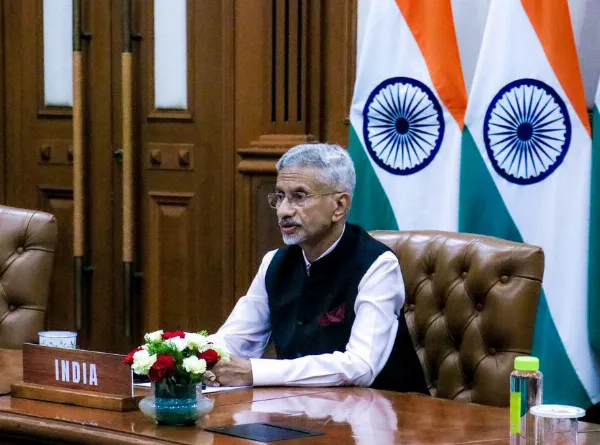
Jaishankar talks with Indonesia's FM Sugiono on West Asia conflict; agrees on early Joint Commission meeting
New Delhi, March 12
External Affairs Minister S Jaishankar on Thursday held a conversation with his Indonesian counterpart Sugiono and agreed to hold a Joint Commission meeting soon to enhance their Comprehensive Strategic Partnership.
The two leaders exchanged perspectives on the ongoing West Asia conflict, Jaishankar said.
In a post on X, Jaishankar wrote, "Pleased to talk to FM Sugiono of Indonesia. Exchanged perspectives on the West Asia conflict. Discussed bilateral ties and agreed to hold the Joint Commission meeting at an early date."
The engagement comes amid heightened tensions in West Asia following joint US-Israeli military operations that resulted in the killing of Iran's former Supreme Leader, Ayatollah Ali Khamenei, on February 28. In retaliation, Iran targeted Israeli and US assets across several Gulf countries, disrupting shipping in key waterways and impacting global energy markets.
Earlier today, the Ministry of External Affairs said that Jaishankar spoke to his Iranian counterpart Abbas Araghchi to discuss the safety of shipping and energy security.
Addressing a press briefing in the national capital, which was held following a string of attacks on commercial vessels in the crucial waterway of the Strait of Hormuz between Iran and Oman, a key route for global oil trade, External Affairs Spokesperson Jaiswal said the discussion focused on ensuring the safe passage of ships and maintaining stable energy supplies through the region.
"EAM and FM of Iran have had three conversations in the last few days. The last one discussed issues pertaining to safety of shipping and India's energy security. Beyond that, it would be premature for me to say anything," Jaiswal said.
Furthermore, the MEA also confirmed that around 9,000 Indian nationals, including students, seafarers, professionals, business people, and pilgrims, are currently in Iran and are being assisted amid safety concerns in the country.
Several Indians, particularly students, have already returned home, while others have been shifted to safer locations. Those wishing to travel to Azerbaijan and Armenia for onward flights are being provided visas and facilitated border crossings, MEA said.
Meanwhile, Jaishankar has also been in contact with several other international counterparts regarding the crisis. He spoke with French Foreign Minister Jean-Noël Barrot on Wednesday and expressed his intent to continue the dialogue in person. He also held a telephonic conversation with Russian Foreign Minister Sergey Lavrov on Wednesday, describing the interaction as a "good telecon", emphasising that the discussions covered mutual perspectives on the escalating situation in West Asia.
— ANI
Reader Comments
The most important part of this article is about the 9,000 Indians in Iran. My heart goes out to the students and professionals there. Thank you MEA for the assistance being provided. Please ensure everyone's safe return. The diplomacy is important, but our people's safety comes first.
Indonesia is a crucial maritime neighbor and a fellow large democracy. Strengthening this partnership is wise, especially when global shipping routes are under threat. Hope the Joint Commission focuses on concrete steps for regional stability and protecting Indian interests in the Strait of Hormuz.
While the diplomatic outreach is commendable, I hope there is a clear, long-term strategy beyond crisis management. We seem to be reacting to events. A more proactive foreign policy framework for West Asia is needed, one that safeguards our energy needs without getting entangled in others' conflicts.
Talks with Indonesia, Iran, France, Russia... Dr. Jaishankar is doing the rounds. This shows the complexity of the situation. India has to balance relations with all sides. Not an easy task, but crucial for our national interest. Jai Hind!
The impact on global oil trade is what worries me the most. Any disruption in the Strait of Hormuz will shoot up petrol and diesel prices in India. The government must have contingency plans ready. Good that energy security is being discussed directly with Iran.
We welcome thoughtful discussions from our readers. Please keep comments respectful and on-topic.