

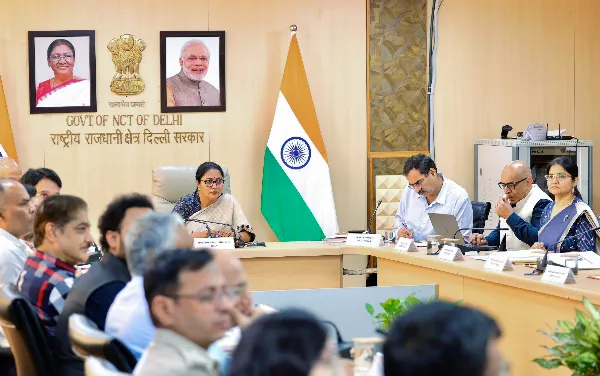
Delhi CM Rekha Gupta reviews heatwave preparedness measures; to launch awareness campaigns
New Delhi, April 24
Delhi Chief Minister Rekha Gupta on Friday chaired a high-level review meeting at the Secretariat to assess preparedness under the Heat Wave Action Plan 2026, issuing clear and time-bound directions to all departments to strengthen measures at every level, according to a press release.
With temperatures rising steadily and heatwave conditions intensifying, Gupta said the government is on full alert and has set a clear target of bringing heatwave-related deaths down to zero by 2030.
The meeting was attended by Chief Secretary Rajiv Verma and senior officials from all concerned departments. The Chief Minister directed that all hospitals ensure adequate bed capacity for heat-related cases and that every ambulance is equipped with essential facilities to handle heat emergencies.
She also called for a comprehensive citywide awareness campaign to educate residents on preventive measures. Schools have been instructed to introduce a 'water bell' system to prompt students to drink water at regular intervals and prevent dehydration.
CM Gupta further ordered that clean drinking water be made available across hospitals, schools, construction sites, Atal canteens, police stations, post offices and DTC bus stands.
"ORS must be accessible at all major public locations. Water tankers, water coolers and water ATMs should function seamlessly across the city. In addition, adequate arrangements for shade and drinking water for animals and birds must be ensured," she said.
Heat Action Plan 2026 is being implemented through the Delhi Disaster Management Authority (DDMA), which is coordinating efforts across multiple departments in collaboration with more than 17 knowledge partners, including NGOs, to ensure a scientifically robust and well-synchronised response.
Highlighting the urgency, the Chief Minister noted that Delhi has recorded unprecedented temperatures in recent years, with the mercury touching 43.7°C in 2025 and staying above 40°C for nearly 40 days over the past two to three years. In response, a comprehensive and science-based framework has been put in place. As part of early warning and preparedness, the India Meteorological Department's colour-coded alert system green, yellow, orange and red, is being used for continuous monitoring, with real-time alerts being disseminated to departments as well as the general public/
On the health front, more than 339 health centres across Delhi have been equipped with ORS, ice packs and related supplies, while over 30 hospitals now have dedicated 'cool rooms' for heatstroke management. Additionally, 174 medical officers and ASHA workers have been trained to handle heat-related illnesses, and 330 ambulances have been kept on standby for emergency response, the release said.
The release further added that in terms of public infrastructure and field-level interventions, drinking water points, water coolers, shaded shelters and cooling points are being set up across the city. Delhi Police has installed over 11,000 air coolers and more than 1,900 water coolers, while the traffic police are carrying out large-scale distribution of ORS packets, a drive that will be further expanded in the coming days.
Placing special emphasis on the safety of construction workers and other vulnerable groups, the Chief Minister directed that working hours be suitably modified, particularly to avoid exposure during peak afternoon heat. Employers have been instructed to mandatorily provide shaded areas, rest breaks, drinking water and ORS at worksites to safeguard workers from the adverse effects of extreme heat, the release said.
The release added that Gupta also instructed all departments to work in close coordination and ensure effective, on-ground implementation of the plan so that residents of Delhi are protected from the severe impact of the ongoing heatwave.
— ANI
Reader Comments
Zero deaths by 2030? That's an ambitious target! But with 40+ days of 40°C, we need much more than awareness campaigns. What about planting more trees? Our urban forest cover is pathetic. Also, these cool rooms in hospitals sound good on paper, but what about the rural-urban divide in access?
Impressive coordination—over 17 knowledge partners including NGOs. That's a strong ecosystem. The 11,000 coolers at police stations and 330 dedicated ambulances show concrete action. However, I'd love to see real-time transparency: a public dashboard tracking heatwave incidents and response times.
Every year same story—announcements, meetings, but when April hits, we're scrambling. The water coolers at traffic signals are a good start, but the real test will be July when humidity joins the heat. And what about our street dogs and cows? The CM mentioned animals—let's see if that gets implemented. 😓
As a Delhi resident who lived through last year's 44°C, I can say: these measures are necessary but not sufficient. The construction worker clause is crucial—many builders ignore safety norms. Hope the government enforces strict penalties for violations. Also, ORS at every public location is a no-brainer after seeing people collapse at bus stops.
Love the focus on education—training 174 medical officers is good, but we need thousands more. Also, why not involve local RWAs and youth clubs for door-to-door awareness? That's how we build community resilience. The colour-coded alerts are useful, but many poor families don't have smartphones to
We welcome thoughtful discussions from our readers. Please keep comments respectful and on-topic.